The Physics of Life - vocabulary
5 fundamental properties of chemical particles to initiate biological evolution

♥ Definiens:
Chemical particles that initiated the proces of biological evolution should have the following 5 fundamental properties:
- they should absorb resources to build themselves
- they should reproduce themselves
- they should build themselves on the basis of a design
- they should have this design stored within themselves
- this design should also duplicate, with the possibility of change
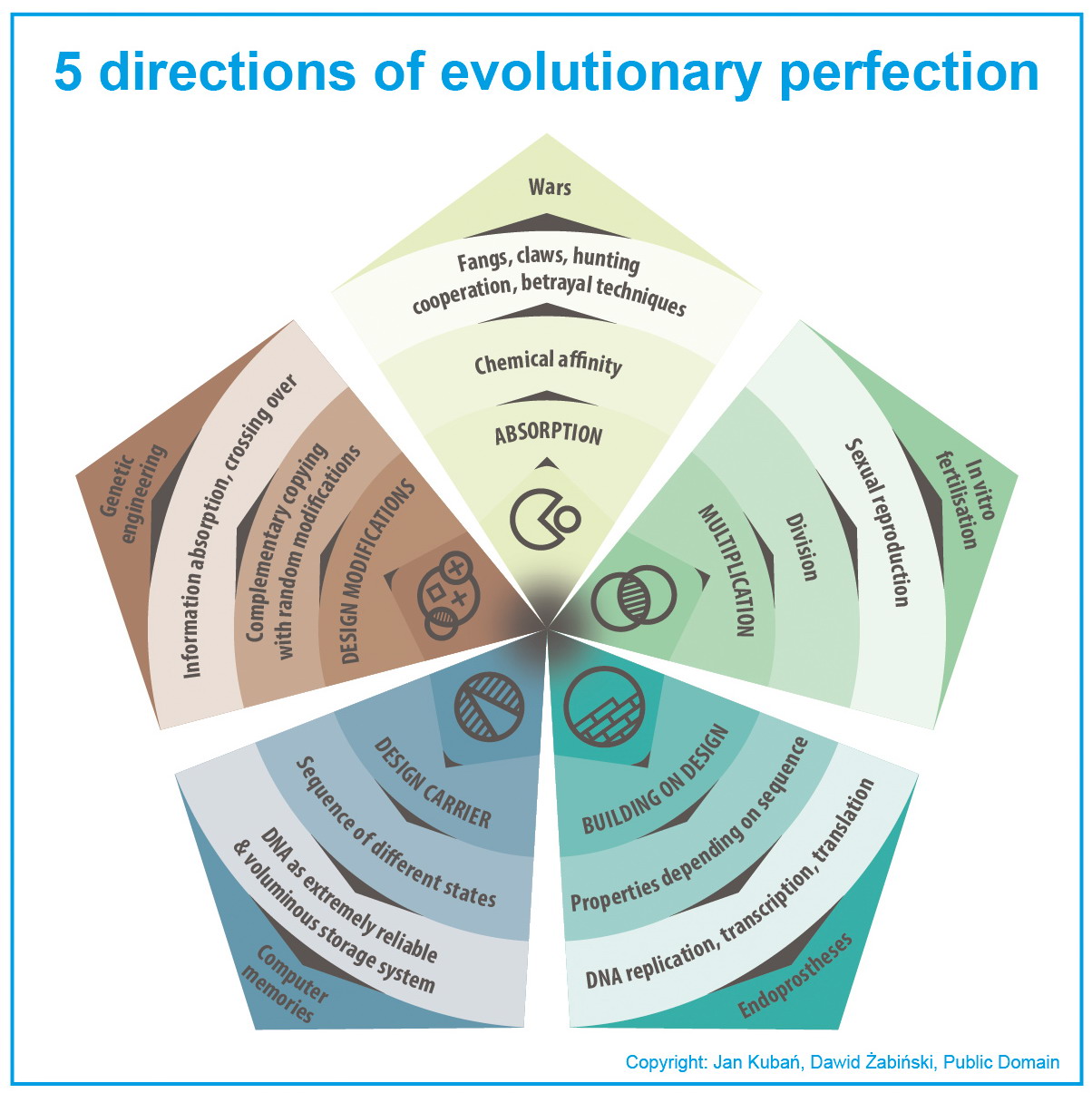
Remarks:
-
The chemical particles that have these fundamental features are RNA particles. There are ribonucleotide sequences that:
- absorb free ribonucleotides to build themselves; (fundamental property nr. 1)
- replicate by making complementary copies; (fundamental property nr. 2)
- their features depend on the sequence of the ribonucleotides they are built from – thus it is the simplest form of interpretation of information; (fundamental property nr. 3)
- they are, themselves, information and during duplication this information may change due to influence of disturbances. (fundamental properties nr. 4 i 5)
Associated concepts:
- Gerpedelution
- Biological evolution
- RPD-type particles
- RNA
Absolute thinking
♥ Full definition of Absolute thinking.
Remarks:
-
- It's as though if you were a person with only one eye. And you would only see, length and width, and you have no sence of depth. When you take away the one eye, it's the same as what suddenly becomes consciousness, except it's not just the third dimension, it's a multiple dimension. And it exists in thought, in reasoning, in emotion, in imagery because it brings memory into the picture.
- That's very interesting. I do understand what you mean about three dimensions, but a person who had never seen three dimensions, who I'd said had one, or one eye damaged, would not know what you're talking about, threee dimensions. So perhaps that's why I can't understand…
- That's exactly right. It's a wholeness that's multifaceted…
But not multifaceted in separate little categories. Multifaceted in a way that three dimensions brings out a larger picture, a larger sense of itself.- Oh, very interesting! I don't understand at all.
Associated concepts:
Accumulation of innocents
♥ Definiens:
The process ending with a crisis, which is initiated by the simultaneous action of factors that individually, or in smaller groups, have no or negligible impact on the process.
Remarks:
-
An even more insidious initiator of processes inevitably leading to a disaster is a group of several factors occurring at once, which individually or in smaller groups do not pose a threat to the system: And 44 percent of the time, the two pilots have never flown together before, so they’re not comfortable with each other. Then the errors start—and it’s not just one error. The typical accident involves seven consecutive human errors. One of the pilots does something wrong that by itself is not a problem. Then one of them makes another error on top of that, which combined with the first error still does not amount to catastrophe. But then they make a third error on top of that, and then another and another and another and another, and it is the combination of all those errors that leads to disaster.
[Gladwell Malcolm: "Outliers. The Story of Success" page 118].
Associated concepts:
Ahamkara
♥ Definiens:
A term borrowed from Sanskrit, literally "the concept of Self in any created thing or action". It is a disorder of perception and analysis of reality by living objects caused by the perception of oneself as the main authority – "It is I (or eventually the group to which I belong) about whom the world revolves".
There are two barriers to objective observation: natural barriers of objective observation and ahamkara – the subjective barriers to objective observation.
Ahamkara includes:
-
The conviction of our own omnipotence. Eg.: Nothing will happen to me);
-
Overstated self-esteem: the Dunning–Kruger effect (When people overestimate their knowledge in areas they do not specialise in);
-
The conviction of our own infallibility
Supreme triumph of reason is self-doubt in his own infallibility - Miguel de Unamuno; -
Valuation - appropriateness of information according to personal system of values.
Each of our acts of knowledge is an act of valuing, as in all animals - the so-called recognition rule. You can't free yourself from it, you can only understand it. The value system means that we often reject or distort information. There is no evaluation-free information. - Jan Szymański; -
Misinterpretation of the received stimuli, resulting from the limitations or "over-zealousness" of the senses. E.g. optical illusions;
-
Lack of knowledge (The sciences have two extremes which meet. The first is the pure natural ignorance in which all men find themselves at birth. The other extreme is that reached by great intellects, who, having run through all that men can know, find they know nothing, and come back again to that same ignorance from which they set out; but this is a learned ignorance which is conscious of itself. Those between the two, who have departed from natural ignorance and not been able to reach the other, have some smattering of this vain knowledge and pretend to be wise. These trouble the world and are bad judges of everything. The people and the wise constitute the world; these despise it, and are despised. They judge badly of everything, and the world judges rightly of them. - Blaise Pascal)
-
Preaching without understanding.
Nothing is more shameful than to affirm before knowing according to Cycero. -
After-decision dissonance
After making a choice, especially when it is irreversible, the tendency to realistically evaluate the alternative disappears. A person begins to stress the advantages of the choice made and the disadvantages of the rejected option. -
Attachment to previously discovered patterns, knowledge originally acquired and information that first convinced us.
See Experiment "2,4,6". -
Thinking using rigid thinking patterns instead of using the absolute thinking;
-
The desire for power, including criticizing and instructing others about what and how to do something,
-
Inadequate moral assessment: so-called Kali syndrome, Why do you look at the speck of sawdust in your brother's eye and pay no attention to the plank in your own eye? - Matthew 7:3. Excessive criticism of someone else's minor flaws without being aware that we have much more serious deficiencies,
-
Inadequate achievement assessment: our own pride and others, such as jealousy;
-
Inadequate response to criticism - the discrepancy between the vision of one's own perfection and its outer reception. See Syndrome of criticism
-
The concept of happiness, that is how you find happiness,
-
The hierarchy of needs (according to Maslow)
- Physiological needs (food, shelter, procreation, etc.)
- Safety needs (protection against illness, unemployment and age-incapacity for work)
- Love/Belonging needs (need of acceptance, love, friendship, belonging to a group, elite)
- Esteem needs (need of success, respect, prestige, importance)
- Self-fulfillment needs (the need to develop oneself, abilities, talents, interests, confirmation of self-value
-
Narcissism - behaviour consisting of admiring your self and your own characteristics, self-worship. The concept comes from Greek mythology, where the young Narcissus fell in love with his own reflection, which he saw in the water;
-
Desire for fame, respect and prestige;
-
Programmability - we are highly vulnerable to propaganda, although we are convinced that it does not affect us at all; See Ron Jones' experiment
-
Reluctance to associate withe people better than us, and often even to those who have done something good for us. Read more
-
…
Remarks:
-
One result of ahamkara is the Rashomon phenomenon: the phenomenon of subjective perception of memories, which is manifested by the fact that different observers of the same event tell much different, but equally probable, versions of how it happened.
-
Distortions of perception of reality caused by our self were originally noticed by Plato: man does not see objects directly, but their projections in the form of shadows on the wall. He cannot see reality because he is sitting in a cave of his own worldly affairs.
-
A great observer of ahamkara was French philosopher François de La Rochefoucauld (1613-1680): We defend ourselves against unveiling the real mechanisms that govern people, because we are afraid that they would be discovered in ourselves More maximes by François de La Rochefoucauld
-
You envy my medals, but you are not interested in how I got them.
-
People, if they can, want to live and prosper at someone else's expense. This lust is rooted in the nature of man, in a primitive, universal, and unadorned instinct to satisfy his own needs with minimal effort.
- Frédéric Bastiat -
Who would go beyond the pattern he had studied for over 15 years?
Associated concepts:
Quotes from literature: in Polish or Google English from Polish
- associated with Ahamkara
Anomie
Definiens:
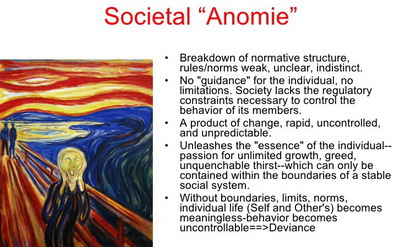 In sociology, anomie is a societal condition defined by an uprooting or breakdown of any moral values, standards, or guidance for individuals to follow. Anomie may evolve from conflict of belief systems and causes breakdown of social bonds between an individual and the community (both economic and primary socialization).
[Wikipedia eng., 2020.08.25]
Associated concepts:
Anticipative pursuance
♥ Definiens:
Pursuance while carrying out an analysis of the opponent object's behaviour. It consists of drawing conclusions from the observed movements of the opponent and controlling own actions in such a way that either:
-
act coherently - that is to foresee, for example, opponent's position in the future and be in the same place at that time or
-
anticipate - which is to predict exactly what the opponent will do at a given moment and overcome their actions.
-
defeat the opponent using their own resources, e.g. in the form of momentum or swing. The Japanese named this kind of action judo - a gentle way.
-
force an opponent to react in a specific way and use this reaction to your needs - counter-attack
-
having a palette of counterattacks to the known actions of the opponent, sense coming actions and effectively eliminate the threat - combination.
Anthropomorphism
Definiens:
attribution of human traits, emotions, or intentions to non-human entities.
Remarks:
Quotes from literature: in Polish or Google English from Polish
- associated with Anthropomorphism
Apoptosis
Definiens:
A natural process of programmed cell death in multicellular organisms. Thanks to this mechanism, worn or damaged cells are removed from the body. Apoptosis can be compared to a planned cell suicide aimed at improving the welfare of the whole organism. [See the "I/group" dilemma].
Applied confrontation
♥ Definiens:
Checking how the discovered rules and laws work in practical situations.
Aristocraticization
♥ Definiens:
The process of losing self-esteem and effectiveness of people in power.
Associated concepts:
- Biedocraticization
- Elitism
- Degeneration of power
- Model of governance
- Typical instruments of governance
Quotes from literature: in Polish or Google English from Polish
- Power makes stupid - Fryderyk Nietzsche;
- Power tends to corrupt, and absolute power corrupts absolutely - John Dalberg-Acton;
- associated with Aristocraticization
Artificially false messages
♥ Definiens:
The phenomenon of creating messages that have upset the process of observation. Artificially false messages are one of the elements of the barriers to objective observation.
Remarks:
-
One of the main sources of artificially false messages are people in power applying social engineering.
Associated concepts:
- Ahamkara
- Barrier in processing of information
- Barriers to objective observation
- Matrix
- Methods of the elimination of distortion of observation
- Naturally false messages
Quotes from literature: in Polish or Google English from Polish
- associated with Naturally & artificially false messages
Asch Conformity Experiment
♥ Definiens:
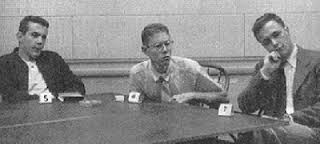
Detailed description of Solomon Asche's Conformity Experiment on www.simplypsychology.org
One of the most important sociological experiments in The Physics of Life, showing that people conform for two main reasons:
- because they want to fit in with the group (Normative influence)
- because they believe the group is better informed than they are (Informational influence).
Links:
- Reenactment of the original Solomon Asch Conformity Experiment
- Amusing film showing conformity: https://www.youtube.com/watch?v=BgRoiTWkBHU
Associated concepts:
Attractor
♥ Definiens:
In systems theory, attractor is the set of states in phase space (a space in which all possible states of a system are represented), in which, over time, all the states of all system properties tend to reach for this set of states. An attractor can be a point (equilibrium position), curve (trajectory), closed curve (limit cycle) or fractal (strange attractor).
Attractor "attracts", as its name implies, the states of the system properties. When the system has several attractors, each of which has its own area of attraction.
The existence of attractors are evident in many areas including biology, physics, astronomy, economics and social psychology.
Remarks:
-
The opposite of an attractor is a repeller
-
The characteristic features of biological evolution: speciation, endosymbiosis and symbiogenesis cause that organic matter absorbs inorganic matter to become biocenosis - the attractor. Transformation of biocenosis over time illustrates the HeKroGram.
Atlases/Looters
♥ Definiens:
Atlases/Looters - a fundamental classification of humans. Communities owe their existence to Atlases (Producers). They are pushing the world forward, producing the desired goods, making breakthrough inventions and exchanging them on the principle of free market. Looters (Thieves) do not produce, they do everything to take over someone else's resources, without giving anything in return. They take over, of course, on the basis of theft, plunder or robbery, effectively cheating using the tactics of behaviour from the series of cheating von tactics.
Remarks:
-
This classification was proposed by Ayn Rand and brilliantly described in her book "Atlas Shrugged"
-
The Physics of Life uses the same classification: Producers (generators of desired resources) and Thieves (annihilators of the desired resources). See Producers/Thieves
Other classification: ants versus grasshoppers.
Other classification: victims versus predators.
Other classification: makers versus takers.
Associated concepts:
Quotes from literature: in Polish or Google English from Polish
- associated with Atlases/Looters
Autodynamic system(/object)
♥ Definiens:
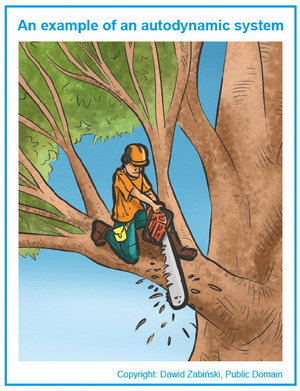
System (/object), which generates the processes that change the system itself or its components.
Examples:
-
Biological evolution occurring in the Earth's ecosystem, whose elements are all living objects, their behaviour makes the next generation of living objects different from their predecessors and they also behave differently. (An example of continuous iterative autodynamism).
-
The man cutting off the branch on which he is sitting. (It is an example of singular autodynamism).

Associated concepts:
Balance of resergy
♥ Definiens:
Resergy balancing means balancing not only the additive and conservative values of matter and energy, but also balancing information that is neither additive nor conservative. The purpose of this balancing is to make specific decisions about the further operation of a living object.
This balancing is very difficult because, in the case of matter and energy, it can be based on strict mathematical methods, while in the case of information, precision is doubtful. It is due to the nature of information: it is not possible to consider all variants, therefore experience is used, i.e. innate or acquired patterns of behaviour tested in given or similar circumstances. Information balancing involves determining probability distribution in a given decision area, taking into account your current capabilities and only based on making a decision that is still burdened with a certain probability of success or, in other words, a risk of failure.
Remarks:
-
Today, too, it is believed that nothing is so helpful to solve a problem as the office. However, this is an absurd point of view at first glance. The Office employs officials. It is in the interest of civil servants, once they have been hired, paid and given some power, to keep all this as long as possible…. Meanwhile, the pretext for which the office was established was to solve a problem. If the problem is resolved, the Office should be brought to an end without delay. In such a situation, the officials working for the Office have no interest in resolving the problem quickly. On the contrary, it is in their personal interest to take as long as possible to solve the problem… - S. Michalkiewicz
Associated concepts:
Bankers
Definiens:
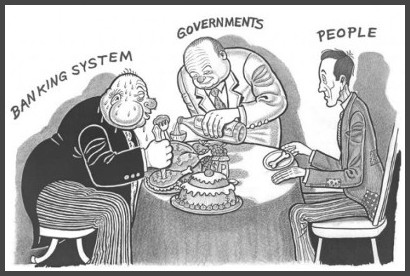
Associated concepts:
Quotes from literature (in Polish):
- connected with the concept of Bankers
Diary:
Barrier in processing of information
♥ Definiens:
The inability to make a one hundred percent faithful simulation of a complex system behaviour or, in other words, the inability to build a one hundred percent faithful model of a certain class of systems.
Remarks:
-
A simple proof of this is that one is unable to build a computer, which can memorise the whole history of all its memory cells, because it needs supplementary cells which were not part of the original memory.
Associated concepts:
- Ahamkara
- Barriers to objective observation
- Naturally false messages
- Artificially false messages
- Matrix
- Methods of the elimination of distortion of observation
Barriers to objective observation
♥ Definiens:
Inability to make true observations of reality due to the following groups of distortions:
-
passive distortion when being observed: observation influences the observed object and may change it or it's behaviour. [See Heisenberg's uncertainty principle];
-
active distortion when being observed: if the observed object is self-conscious of the fact of being observed it could react pursuancely and use any methods known in order to confuse the observer. [See: Syndrome of Matrix]
-
passive distortion of observation: both the observer and the instruments which are being used to observe have their own characteristics, and these distort the observation. A man who can not naturally hear infrasound cannot understand the behaviour of elephants and whales, which use them to communicate over long distances;
-
active distortion of observation: if the observing object is self-conscious, usually they behave typically for its population, of which it is a member. Populationally typical emotional reactions, therefore, can filter the information that comes and "see only what they want to see" and/or "not see the obvious". A native will see their own country through rose-tinted glasses;
-
distortion due to the delay of information: due to the fact that the information gained from observed objects does not reach the observer instantaneously. The observer therefore sees no current state of the object, but a previous state;
-
impossibility of simultaneous observation: one observer is not able to observe several processes taking place at the same time or one process from different points of view.
These factors are related to the observation itself. After observation, the information is analysed and conclusions are drawn. Any natural disturbance at this stage is ahamkara.
Remarks:
-
We observe the world around us through our senses. Their operation is based on very simple principle - a factor, such as a photon (or a sound wave), reflected from the observed (or listened) object or emitted by it, splashes the sensory receptor cells and causes a change in their condition. It is easy to see that if such a factor can change the state of the cells in the same way may change the state of the observed object, if it is sufficiently small. Therefore, that observation may change the observed object, and this leads to the conclusion that we will never be able to accurately measure all states of all the surrounding objects.
-
These restrictions do not only include objects of a small size but also large and distant objects. If the information about them (or its elements) reaches us in five minutes, then we do not observe their current state but how it was five minutes ago.
-
As far as observation is concerned, Far Eastern philosophy states that every living creature in this world is subject to four basic flaws:
- imperfect senses
- succumbing to illusions
- tendency to deceive themselves and others ("I know that's not true, but in front ofothers I willpretend that it is")
- inevitable mistakes
-
The proof of this are optical illusions.
Associated concepts:
- Ahamkara
- Barrier in processing of information
- Naturally false messages
- Artificially false messages
- Matrix
- Methods of the elimination of distortion of observation
Basic factor of development of societies
♥ Definiens:
The basic mechanism that causes the enrichment of the community. The permission for producers to accumulate profits from the voluntary exchange of their production surplus.
Only those social groups that can ensure the dominant advantage of Makers over Takers can grow.
Remarks:
-
In history, when there were economic crises, leaders used this mechanism in order to escape the crisis. Examples include: Catherine the Great in Russia (18th Century), Lenin in the USSR (1921), Liu Shaoqi in Peoples Republic of China (1962) and the new, post-communist government in Poland in the 1990's.
-
The primary factor in the development of societies are the rule of law (not lawyers), and the resulting respect for property acquired through their own work - Andy Eyschen.
-
English name proposed: BFDS - Basic Factor for Development of Societies
-
[In China during the Great Starvation] of these 45 million, from 1 to 3 million people committed suicide and 2.5 million were beaten to death by party cadres, because, as one bitter scientist says: "they did not work hard enough, they dared to protest, because they moved too slowly, because one morning they did not have the strength to go to work, because in some cases they were considered to be too old or too sick - and what to do with such a person? Continue to feed them?".
In China, this period is officially called the "three years of natural disasters" and hardly anyone knows it's real story. In fact, says Dikötter, these "disasters" were almost entirely caused by people. The Communist Party herded hundreds of millions of peasants into collective farms in order to improve the performance of agriculture and industry, and to begin to compete with the superpowers (China intended to overtake Britain in steel production in 15 years). This radical collectivization simply destroyed the incentive to work. Agricultural productivity collapsed - hence hunger.
[Quotation from the article "The great famine and great shame" - Sunday Times
http://ciekawe.onet.pl/spoleczenstwo/wielki-glod-i-wielki-wstyd,2,4790703,artykul.html] -
Everyone should have the same phone, live in similar houses, drive identical cars or better, a bike (why rush). Everyone should wear the same clothes. Then there will be no divisions. It was the case not so long ago in China and it doesn't work… If one tries harder, you can afford more and it shows by you driving a top-of-the-range car and talking on the best mobile phone. And it is OK, because others will want the same, and this motivates them to act. This is the engine of progress. In this way we get to know the world around us and take possession of it (in a few years we will even explore Mars). The fact that people want better things and chase money, causes that now we can treat such diseases as: diabetes with human insulin produced by mutant bacteria. The drug companies do not invent new drugs, not because they are so noble, but for the fact that their CEO's want to have an even newer model of Bentley. - ~egon:
Quotes from literature: in Polish or Google English from Polish
- associated with BFDS
Behaviour
♥ Definiens:
Behaviour are changes in the state of a set of properties of an object. It can be seen as a mathematical process.
Belief
Definiens:
Giving a high probability of the truth to a statement without total knowledge.
Remarks:
-
If someone has no purpose and meaning in life he is more vulnerable to believe, any belief without scrutiny without questions
Barun Mitra
Links:
Associated concepts:
Benchmarking
♥ Definiens:
Benchmarking is the practice of comparing performance of a company to industry the best and best from other companies.
Quality, time and cost are usually measured. On this basis, performance is determined using specific indicators, for example: cost per unit of measure, productivity per unit of measure, cycle time of x per unit of measure or defects per unit of measure. This results in a measurable level of performance that is then comparable. After comparing the results, one goes on to analyse which causative factors (eg. business processess) need to be ajusted to be able to compete with market leaders. Then they are implemented.
Other definientia:
-
A standard of excellence, achievement, efficiency etc., against which similar things must be measured or judged.
-
Any standard or reference by which others can be measured or judged.
-
An established point of reference against which something can be measured in tests comparing their performance, reliability, etc.
Benign neglect
♥ Definiens:
An educational method of leaving a person with a problem, with the view that he can overcome it by himself, learning and gaining new experiences. In cases where the person is not fit to find a solution, small steps are needed to help. The teacher can only intervene to:
- stop a catastrophe
- provide a gentle push in the right direction
The core of the method is to help the person to find their own solutions with as little guidance as possible. Applying benign neglect ensures that the participant receives no lasting damage, accepting that small failures are expected. This method teaches pursuance in the most perfect way. The people subjected to this method learn anticipation and, subsequently, how to out-think or out-plan an opponent. Learning by experience is the most effective way.
Associated concepts:
Biedocraticization
♥ Definiens:
The process of acquiring self-esteem and increase effectiveness of people living in poor conditions. The opposite to aristocraticization.
Remarks:
- Strength borns out of necessity, and dies from the lack of it. - Leonardo da Vinci
Associated concepts:
Quotes from literature: in Polish or Google English from Polish
- associated with Biedocraticization
Biological evolution
♥ Definiens:
Biological evolution is a process that, in terrestrial conditions, called into existence living objects and continues to shape their subsequent generations. Biological evolution is a self-excited natural process generated by the RPD phenomenon, which is the constructor of objects by grouping chemical molecules, then their disintegration and re-reconstruction. The other natural phenomenon influencing biological evolution involves the synthesis of proteins based on the information stored in DNA and RNA particles, which are also RPD-type particles, and which are also carriers of information upon which the proteins are built from amino acids.
The RPD phenomenon was the ignition from which all life began. The RPD also called into existence the following processes:
-
The first stage of gerpedelution - the natural synthesis of proteins;
-
The second stage of gerpedelution - selection due to a conflict of interest in the environment in which, for the multiplication of RPD-type objects, the resources required for this multiplication ceased to exist;
-
The third stage of gerpedelution - the reproduction with different types of defects within the RPD particles, which are the carriers of the designs (e.g. particles of RNA and DNA) for synthesising the protein structures.
Biological evolution is an example of an autodynamic system, consisting of objects, the interactions between them and the self-reconstructing processes excited by the system itself. Note, the system in our case is constructed from: all living objects, their designs stored within them and the external conditions in which they operate - that is, the gravitational field in the water and air near the surface of the Earth. This system generates a process, which changes the system itself, which in turn changes the process generated by it and so on. [New definition: autodynamic system - system exciting processes which rebuilds the system].
Therefore the three stages of gerpedelution in terrestrial biological evolution were, in their initial phase, clearly separated from each other and occurred in sequence, but when feedback started to effect RPD-type objects, these steps began to overlap and intersect. From a certain point in biological evolution, we started to consider these RPD-type objects as living objects. An example of overlapping can be memetic designs, which are continually shaping living objects during its life and mitochondria, which are separately subjected to "their own biological evolution" within every cell of every living object.
5 characteristic features of biological evolution:
-
The first characteristic feature (the ambiguity of improvement):
provided that the selection function is strong enough, the subsequent generations of objects subjected to it have an increasingly perfect form (to achieve their life purpose). When the selection function is weak, the subsequent generations of objects subjected to it are less and less perfect (to achieve their life purpose). -
The second characteristic feature of biological evolution (the orthogonality of improvement):
in the case of the strong selection function, the perfection manifests itself:- in the change of the tactics of structure and the tactics of behaviour, leading to consistently winning conflicting situations, or
- in aggregation of cooperation, linking living objects (or RPD-type particles) into groups, for example: cells, organs, flocks, swarms, schools, societies, which are also associated with continually improving the achievement of the life purpose.
Summary: biological evolution, at the same time, aggregates productive cooperation and improves theft mechanisms.
-
The third characteristic feature of biological evolution (the speed of coercion for improvement):
Biological evolution very quickly leads to the depletion of free resources. Consequently, the objects subjected to biological evolution are forced to compete for the available resources. And competing results in a very strong selection function. -
The fourth characteristic feature of biological evolution (the complexity of improvement):
Biological evolution perfects subsequent generations of living objects in terms of the efectiveness of their life purpose: absorb resources then multiply. -
The fifth characteristic feature of biological evolution (the ability to differentiate):
in the case of a strong selection, the aggregation of cooperation gradually, in subsequent generations, leads to specialization, due to the Law of Comparative Advantage.
More information about the difficulties in understanding Biological evolution and the probability of the emergence of life can be found on a separate subpage.
Remarks:
-
Who are we in the end? We are a part of a force which acts badly in producing goodness. Paraphrasing "Faust" by Johann Wolfgang von Goethe
So what then are living objects? The result of a process whereby the vast majority is killed by selection in order to create the perfect minority. [John Freeslow] -
It is not true that, from the very beginning, Polish and Ukrainian were two separate languages, and dialects were their branches. No, at first there were numerous dialects, and only from them did the process of shaping the literary languages begin. And so, if there were two Ukrainian states, it could give birth to two different languages: A-Ukrainian and B-Ukrainian. Because the state itself does not create a nation, bu it can affect the language and this, in turn, will shape the state. [Janusz Korwin-Mikke, NCzas 19/2011, str. XLIV]
Associated concepts:
- Gerpedelution
- Evolutionary game model
- Evoluant
- Evolution
- Chain of succession
- Evolutionary self-supporting object
- Prevoluant
- Evolutionary popping
Biosystem
♥ Definiens:
Biosystem is composed of all living objects, their generational sequences, the processes that these sequences generate and the feedback of these processes on the subsequent generations of living objects. In other words it is the ecosystem analysed throughout its development.
Remarks:
-
Biological evolution is a component of biosystem.
-
The concept has been introduced to draw special attention to the fact that biological evolution can not be regarded in isolation from the objects subjected to it, especially living objects. To better understand all phenomena associated with life, it is worth using this term.
-
Life should be analyzed through the prism of the set of all living objects, their generational sequences, the processes that these sequences generate and the feedback of these processes on the subsequent generations of living objects.
Associated concepts:
Blocker
Definiens:
Something or someone that prevents something from happening or succeeding:
- I've installed an ad blocker so I don't get all those annoying adverts popping up when I'm browsing.
- The board needs to identify staff who are blockers of company's development.
Remarks:
Bureaucracy
Definiens:
An organizational system in which authority is linked to the office. That is, rulers are appointed, not elected.
Remarks:
Calhoun's experiment
♥ Definiens:
One of the most important sociological experiments in The Physics of Life, showing that even when living conditions are ideal, the population may self-destruct due to a dramitic decline to an unsustainable fertility rate.
Full description of John Calhoun's experiment.
Associated concepts:
Causative factors
♥ Definiens:
The generic name given to the factors of any kind, which cause a given object / system to meet the criteria of objectivity. These include initiators, constructors, destructors, and terminators.
Remarks:
-
William Shakespeare was the causative factor of the object "Macbeth".
-
The owner of a factory is the causative factor of the object "factory" and the process "efficient production" (a process can also be considered as an object).
-
In less general terms, causative factors could be called shaping factors.
Associated concepts:
Chain of layers
♥ Definiens:
Sequence of logic elements (e.g. events or genes) that undergo a certain criterion gives a logical truth as an answer. However, if any of the elements are added, removed or shifted, this criterion will no longer be met.
Remarks:
Victory is not the sum, but the correct sequence of events.
-
Projects have the character of a chain of layers. If you want to realize the project, not only the correctness of the implementation of the elements, but also the order in which they are installed.
-
The result is that the calculations taken for granted are based on a series of nested (chained) assumptions, each of which can be a source of error.
Associated concepts:
Quotes from literature: in Polish or Google English from Polish
- associated with Chain of layers
Chain of succession
♥ Definiens:
The name consists of two words: Chain - indicates an ordering on the basis of the subsequent components one by one. Succession carries two meanings: direct - in the sense that there is a transfer of something (e.g. information or ownership) following the object before - and the second, which can be seen as controversial, the transfer is done because one of the objects was a success (e.g. reproductive success).
Remarks:
-
The line of succession of teaching: the concept present in Vaishnavism philosophy - chain of the transmission of knowledge: those who were not taught do not have the right to teach.
-
Not only have you been lucky enough to be attached since time immemorial to a favored evolutionary line, but you have also been extremely-make that miraculously-fortunate in your personal ancestry. Consider the fact that for 3.8 billion years, a period of time older than the Earth's mountains and rivers and oceans, every one of your forebears on both sides has been attractive enough to find a mate, healthy enough to reproduce, and sufficiently blessed by fate and circumstances to live long enough to do so. Not one of your pertinent ancestors was squashed, devoured, drowned, starved, stranded, stuck fast, untimely wounded, or otherwise deflected from its life's quest of delivering a tiny charge of genetic material to the right partner at the right moment in order to perpetuate the only possible sequence of hereditary combinations that could result-eventually, astoundingly, and all too briefly-in you.
Bill Bryson "A Short History of Nearly Everything" page 3.
Associated concepts:
- Chain of layers
- Genetic chain of succession
- Memetic chain of succession
Chaos theory
♥ Definiens:
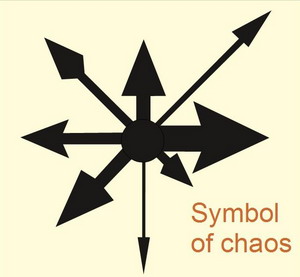
Chaos theory is a branch of mathematics focusing on the study of property of a system which behaves radically differently depending on the initial conditions. An even infinitesimally small change in these conditions (see disturbance) cause a significant change in the quantitative or qualitative behaviour of the system.
Characteristic
♥ Definiens:
Characteristics it is a regularity in the response of a system to an external stimuli, regularity which can be described to some extent (e.g. by a function).
If we know the full set of stimuli that can affect the system, and we know how the system responds to each of them, we can say that we know all the possible behaviours of the system. However, because we are limited by the barrier in processing of information, in order not to remember the entire set of stimuli-response we try to look for some regularities that are called characteristic. If we manage to store such characteristic in the form of e.g. a function, it allows for low memory usage and their mathematical analysis.
Characteristic of the behaviour is the shortest description possible which gives the most information about the behaviour.
Associated concepts:
Characteristic features of those in power
♥ Definiens:
A set of characteristic features of people involved in politics:
-
Maintenance of power - the first and the foremost concern of people in power is to do everything not to lose this power. In the past they lied less, because the physical elimination of political opponents was the most efficient. Today, killing is used less often, while the art of presenting a false picture of reality has been brought to mastery. Nowadays, in a system of representative democracy, governments, pursuing their goal, manipulate citizens like children. They lie to voters with sweet promises in order to buy their vote.
-
Centralization of power - doing everything to have the most power.
-
Distribution - people like to get everything for free (see the Nature of Honest Man). The rulers know this very well and use it. Under various, heart-catching slogans, they take from one group and, after deducting a large part for themselves, which they believe is due, they give away the rest. They have to take it, because they don't produce anything themselves.
-
Bureaucratic management - it is the belief of the rulers that the government process can be reduced to one simple rule: all problems can be solved by making the right provision and/or employing the right number of officials. This, of course, results in the collapse of society by numerous laws and regulations. After all, there are so many of them that no one controls them and, worse, many of them contradict each other. However, it doesn't bother those who rule - the more you talk, the better you are. After all, you can always interpret the law differently. And for lawyers it's paradise on earth. Interestingly, there were countries where governments were based entirely on the bureaucratic apparatus, but they all ended miserably. Regulations cannot be replaced by common sense and regulations cannot force creative thinking.
-
The conviction that giving money is enough to get work done efficiently and effectively. However, history shows that state institutions are far from efficiency and effectivness, and many of them still have to be subsidized.
-
Tax increases, indebtedness and money spoilage. Of course, money is needed to govern by giving away. To obtain it, rulers have used several methods proven throughout history:
-
They collect taxes - which are a compulsory financial charge or some other type of levy. In theory, taxes should be used to fund the necessary public expenditures. As the ruling history shows, taxes increase and increase their amount more often, cases of their reduction or cessation of their collection are extremely rare.
-
They take bank loans.
-
They ruin money - this is the most wicked method of creating money "from almost nothing." In the past, the ruler took a kilogramme of gold coins, smelted them and added a kilogramme of copper, then knocked out two kilogrammes of "gold" coins. The ancients gave an adequate name to this practice - inflation, meaning bulge or filling out. However, the host of helpful servants of the government changed the definition of inflation so that hardly anyone understood it. Recently, it is no longer spoiling money by smelting it and adding less valuable metals to it, now it is "raising prices by producers". Nice operation, change of definition and shifts responsibility to unguilty producers.
-
They profit from state-owned enterprises - it is a theory, because in practice state-owned enterprises are unprofitable and instead of generating income they have to be subsidized.
-
The practice of seizing public money.
-
-
To achieve their goals they use social engineering tools.
-
Propaganda - all this inept governance must be masked with something. Propaganda, or fake news, (see also Von tactics…) is used for this, and everything revolves around two theses: if something is positive - it is thanks to those in power, if negative it is a natural process or the action of the enemies of state.
-
Continuous expansion of statism A state employee is a state dependent employee. Dependent, i.e. executing the orders of those in power. If he doesn't do it, he can be released. Statism arises from the desire to centralize power - the desire to make everyone dependent on the rulers.
-
Nepotism and PMF-ism PMF - Passive, Mediocre but Faithful.
-
Reluctance to systems solutions. System solutions make certain processes happen on their own. And the rulers don't like it. Better the separation of privileges and favouring through financing is better. They can then prove that they rule.
-
Personal values and ideals change. It is commonly said that "power changes people", "power tends to corrupt and absolute pover corrupts absolutely". With the change of social position these may change: emotionality, self-esteem, the way we process information, the way one acts or to empathize changes. And this occures beyond one awareness. It is observed in those in power:
- A growing belief that they deserve to have power and to control others
- The tendency to base moral judgments on general rules, while ignoring individual issues - "authority is blind" to the issues of individuals
- As their position increases, the tendency to consider someone else's perspective decreases
- Political leaders, managers, heads of companies "turn off" empathy. They listen to themselves rather than to other people
- They fall into pride, arrogance and egotism. This is usually initiated by some political success, sometimes it is enough that they have been elected or appointed.
The greatest curse of any power are pride, arrogance and the addiction to power. Everybody who has power is sussceptible to these traits including heads of small and large companies, people who have positions of authority, but politicians are particularly sussceptible.
-
Dividing society. As a result of all these factors, there is a division into "us" and "them", well known from the last years of socialism in Poland. We - the nation, and they - the rulers, but all their governance is certainly not caring for the development of the country.
-
Creating conflicts. Divide society into classes, groups,… Define them and set them in conflict against each other.
-
Creating problems. They create some problem that didn't exist before. They invente enemies from outside and inside the country or the company to create power to themselves. Ergo: invent an artificial problem to deal with it and gain more power over the people.
Diary:
Classic pursuance
♥ Definiens:
A simple pursuance without carrying out an analysis of the opponent object's behaviour. Is based on target location, setting the direction of the pursuit and directing its generalized speed in accordance with this direction.
Cobra effect
Definiens:
The cobra effect occurs when actions taken for a given purpose are counterproductive. This term is used to illustrate the causes of incorrect actions taken in the economy and politics.
Remarks:
-
The term "cobra effect" originated in an anecdote that describes an occurrence during India under British rule. The British government was concerned about the number of venomous cobras in Delhi. The government therefore offered a bounty for every dead cobra. Initially this was a successful strategy as large numbers of snakes were killed for the reward. Eventually, however, enterprising people began to breed cobras for the income. When the government became aware of this, the reward program was scrapped, causing the cobra breeders to set the worthless snakes free; the wild cobra population further increased. [Wikipedia stan 2020.10.28]
Associated concepts:
Cognition
Definiens:
the process of acquiring knowledge and understanding through thought, experience and senses.
Remarks:
-
Emotions have a great impact on cognition.
Associated concepts:
Cognitive dissonance
Definiens:
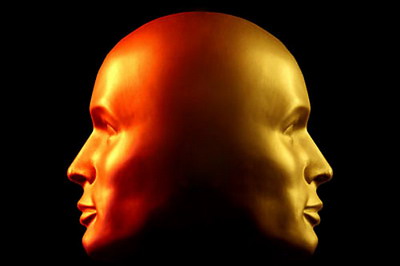 Psychological stress that occurs when events, facts, opinions, beliefs, theses, ideas and values expressed by someone else are not consistent with your own beliefs, ideas and values.
Associated concepts:
Cognitive models of The Physics of Life
♥ Definiens:
Simplified models of complex natural processes occurring in life. These include:
- Glubb cycle
- Social Cycle
- Revolution's cycle
- Biological evolution
- Gerpedelution
- Goethe's_model_of_society
- Prisoner's dilemma
- Iterated cooperation dilemma
- Iterated prisoner's dilemma
- Small evolution
- Model KSP: King, shaman, people
- Model of a gardener
- Model SDC: Shepherd, dogs, cattle
- Model of a board
- How Life Is Competing model
- How Life Is Competing and Evolving model
- Natural Pressure for Social Exploitation
Associated concepts:
Concidence
♥ Definiens:
The notion of concidence (from the Latin concido - sink, die) is somewhat contradictory to emergence, it is a decline in the subjective perception of an observer, of certain properties within the rising complexity of the system. When we measure the temperature of water, we are not interested in the properties of the individual particles that it consists of.
Associated concepts:
Conflict of interest
♥ Definiens:
A situation in which:
- object N wants exactly the same thing that object C wishes to avoid
- both objects want the same thing, but only one of them can get it,
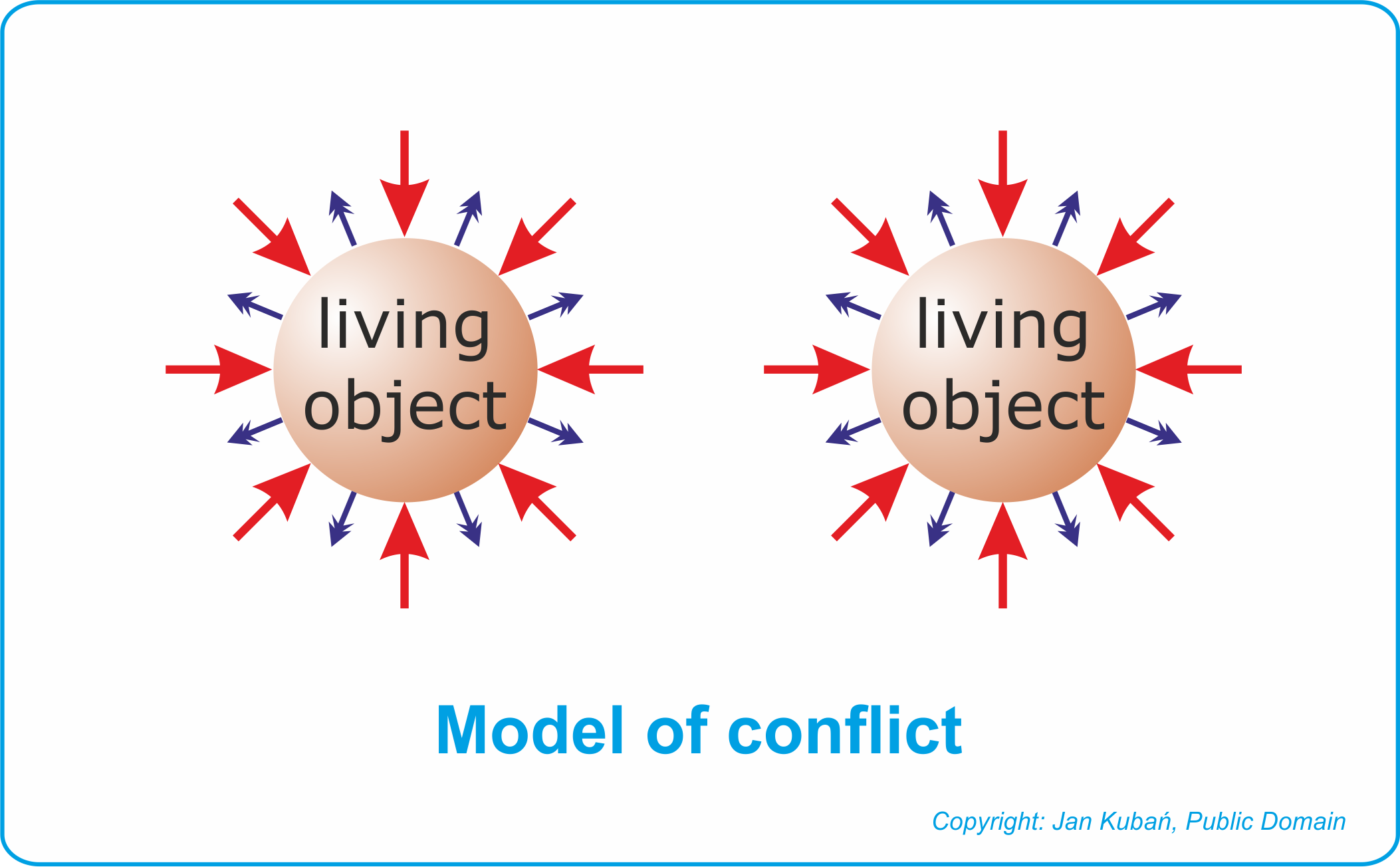
Both objects desire the same resource (red arrows) and discard the same resources as unnecessary (dark blue arrows)
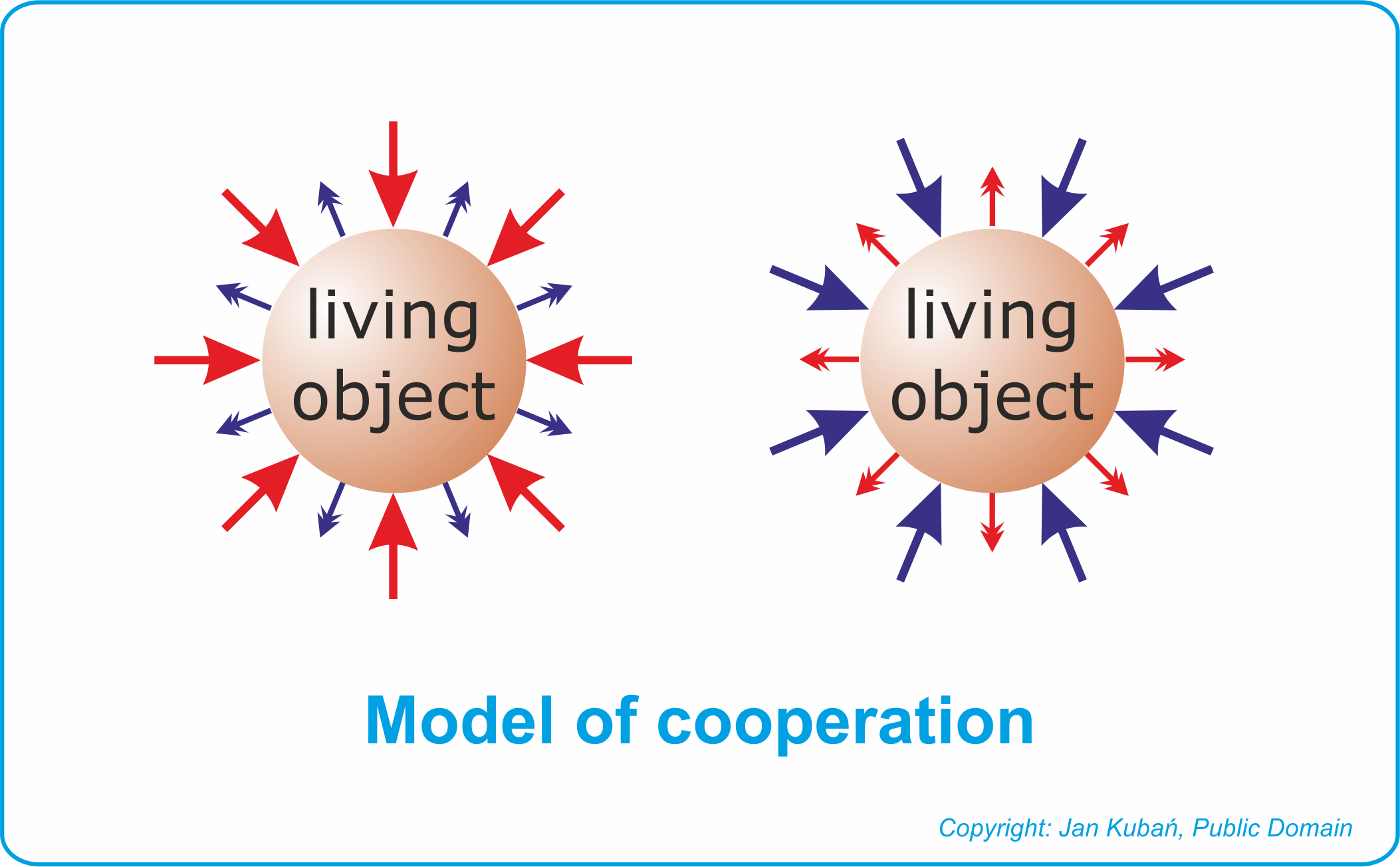
The left object desires a resource (red arrows), which the second object discards as unnecessary. In turn, the second object craves the resource that the first one excretes
Associated concepts:
Conformity
♥ Definiens:
a change in belief or behaviour due to the real or imagined influence of a social group.
Other definientia:
-
Conformity is the act of matching attitudes, beliefs, and behaviours to group norms or politics.[1] Norms are implicit, specific rules, shared by a group of individuals, that guide their interactions with others. People often choose to conform to society rather than to pursue personal desires because it is often easier to follow the path others have made already, rather than creating a new one. This tendency to conform occurs in small groups and/or society as a whole, and may result from subtle unconscious influences (predisposed state of mind), or direct and overt social pressure. Conformity can occur in the presence of others, or when an individual is alone. For example, people tend to follow social norms when eating or watching television, even when alone. [Wikipedia 20191017]
Remarks:
- Social engineering programmes human behaviour using, amongst others, conformity.
Associated concepts:
Links:
- John Paul the II - Conformity
- "Prudential: Everybody's Doing It": https://www.youtube.com/watch?v=BgRoiTWkBHU
Constructors
♥ Definiens:
Any factors extending the LOAO in any way. They strengthen the ability of an object to fulfill the criteria of objectivity. If the fulfillment of this criteria can be measured, the constructors increase its value.
Remarks:
-
Constructors of the object "fence" include: painting, maintenance and repair, search for paint to discover which protects the rails for longer;
Associated concepts:
Quotes (in Google Polish) from literature:
- related to the concept of Constructors
Commonly Denied Undeniable Truth
Definiens:
The undeniable truth is that economic freedom in the pursuit of individual profit brings collective benefits. Therefore, a free market entrepreneur who risks capital in the pursuit of profit is, in effect, a social benefactor.
Constructors of socialism
Definiens:
Constructors pushing societies into socialism:
Man's natural willingness to live at the expense of others.
Envy that others have more than I do.
Hostility towards the rich.
Assigning the state a higher moral value than the individual.
-
The belief that the rulers, like parents, want the best for us and that, like parents, they know how to provide it to us.
-
Seeing interpersonal relationships as a zero-sum game - and the resulting belief that the rich get richer and the poor get poorer.
-
Von Sociall tactic used by rulers. In other words, the blind faith that a welfare state which can deal, by itself, with the abuses of its employees is possible.
-
The common fear of individuals of finding themselves in the worst-off social group, which is supposed to justify a departure from the principle of self-ownership and inviolability of property rights.
-
The belief that goods and services in the economy exist just like that and appear like manna from heaven, ready to be distributed.
Statism favoured by educators.
The belief that capitalism results in the widening of the wealth gap between the rich and the poor.
-
We are so programmed, by biological evolution, that socialist form of government intuitively seems to be the best. Most of us are so sure about this, that no historical facts can change this view. Moreover, these facts do not force most people to reflect, but they perform Cognitive dissonance.
Remarks:
-
People are convinced of the positive impact of all scholarship programmes, grants, subsidies etc., because they are infected by the virus of socialism - we would like to get everything for free ourselves.
Associated concepts:
Competition (economics)
Definiens:
 Competition is an economic mechanism in which various objects maximize yields from a limited pool of resources. For example, producers and sellers compete for buyers, consumers compete for goods, entrepreneurs for production factors, employees for jobs. To maximize yield, the price, quality, breadth of the offer, specialization, comprehensiveness, timeliness, delivery time, security, confidentiality, modernity, etc. are used.
Competition causes companies to develop new products, services and technologies, which allow consumers to make more choices and buy better products. Competition is a natural mechanism that ensures the lowest prices for the best products. If there was no competition (monopoly) or if competition was limited (oligopoly) the products and offer would be expensive and/or of low quality.
Associated concepts:
Correction rule
♥ Definiens:
A rule that specifies how to control systems (e.g. social): the more frequent the corrections, the smaller they are; the less frequent they are, the larger they have to be. Since the correction involves a cost that the system must incur to implement it, it is easy to notice that in the case of destabilizing disturbances, the later it is introduced, the higher the cost.
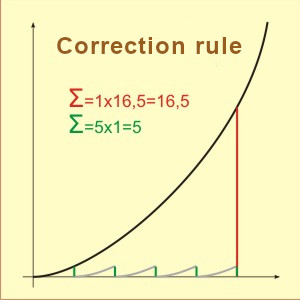
The cost of the correction is represented by vertical lines on the chart. The graph shows that the sum of faster adjustments is smaller than the late adjustment. In the event that the correction cost was represented by the area under the curve (this is the case in most real systems), the correction cost would be even higher.
Remarks:
- The correction rule applies to the control of systems generating monotonic processess.
Associated concepts:
Creative destruction
Definiens:
Creative destruction is the effect of the evolutionary ratchet mechanism, which allows living objects or their aggregations (see organizational levels of living objects), who better fulfill the purpose of life, to pass through the selection stage, while those who do not pass are destroyed.
This is a phenomenon which denies living objects the right to life. From our perspective, this is a negative thing, relating to suffering. It occurs when there is a:
- strong selection function,
- high rate of reproduction,
- selection function destroys objects that do not meet its requirements.
It should be noted, however, that the above factors perform better when there is a large number of objects to chose from. It is the foundation of the creation of new tactics of structure and tactics of behaviour that improve the chances of achieving the purpose of life. The larger the selection pool the easier it is to select what is needed. However, this means that a greater number of living objects are unsuccessful and are destroyed.
Remarks:
-
The concept of creative destruction is perfectly captured in the quotation from the poem "Faust" by Johann Wolfgang von Goethe: Who are you then? I am part of that power which eternally wills evil and eternally works good. Paraphrasing, it can be said that living objects are the result of a process which, through selection, does not allow the vast majority of them to reproduce, but chooses a perfect minority.
"The 59 keys for understanding the beginning of life", page. 100. -
Creative destruction - an expression appearing in the works of Michail Bakunin (1814-1876), Friedrich Nietzsche (1844-1900) and Werner Sombart (1863-1941). In the book "Capitalism, Socialism, Democracy", the Austrian economist Joseph Schumpeter (1883-1950) popularized the term, using it to describe the transformation process that accompanies a groundbreaking discovery. In Schumpeter's vision of capitalism, the constant emergence of new entrepreneurs, with revolutionary ideas, is a force that is able to sustain long-term economic development. The economist accepted the fact that such a change results in the loss of position by enterprises that previously enjoyed an established, even monopolistic, market position.
Wikipedia pol., state 2020.01.19
associated concepts:
Criteria of objectivity
♥ Definiens:
The criteria by which it is stated whether an object remains the same object. They are neither objective nor universal - they are determined subjectively by the observer who defines the object. Other observers could either agree with this proposed criteria or make up their own.
Criteria of objectivity, although it is determined by the subjective observer, may have its own characteristics. The most important characteristics are:
-
Linearity - criterion is the sum of sub-criteria:
CoO = P1+P2+P3+…
Criterion of objectivity is more complete when more sub-criteria are fulfilled.
-
Conjunctional non-linearity - criterion is the (logical) conjunction of sub-criteria:
CoO = P1*P2*P3*…
If even one of the sub-criteria is not fulfilled, the criteria of objectivity is not met.
-
Recursional non-linearity - criterion is the recursion of sub-criteria:
CoO =…(P3(P2(P1)))
If the criterion of objectivity is to be met, all sub-criteria have to be fulfilled in a given order. [ie. genetic code, sequence]
Associated concepts:
Curse of knowledge
♥ Definiens:
Blockage of cognitive abilities by information (knowledge) already acquired.
Remarks:
-
The mental resistance to new ideas is partly due to the fact that they have to displace established ideas. New facts are not usually accepted unless they can be correlated with the existing body of knowledge; it is often not sufficient that they can be demonstrated on independent evidence. Therefore premature discoveries are usually neglected and lost. An unreasoning, instinctive mental resistance to novelty is the real basis of excessive scepticism and conservatism.
["The Art of Scientific Investigation", W. I. B. Beveridge (1908-2006) page. 119]Wilfred Trotter said:
"The human mind likes a strange idea as little as the body likes a strange protein and resists it with a similar energy. It would not perhaps be too fanciful to say that a new idea is the most quickly acting antigen known to science. If we watch ourselves honestly we shall often find that we have begun to argue against a new idea even before it has been completely stated."
["The Art of Scientific Investigation", W. I. B. Beveridge (1908-2006) page. 109]Persecution of great discoverers was due partly to mental resistance to new ideas and partly to the disturbance caused to entrenched authority and vested interests, intellectual and material. Sometimes lack of diplomacy on the part of the discoverer has aggravated matters. Opposition must have killed at birth many discoveries. Obscurantism and authoritarianism are not yet dead.
["The Art of Scientific Investigation", W. I. B. Beveridge (1908-2006) page. 119]
Associated concepts:
Cycle of failure
♥ Definiens:
A typical mechanism for top-down economies. Teams that receive a given amount of money to perform a specific task, are not usually able to complete it within the budget. This is mainly due to the fact that employees do not bear the consequences for non-performance. The manager therefore asks for an increase in the amount of money, which, of course, makes workers lazier as they are being rewarded for not working.
Remarks:
-
The key was moving the national civil service to a performance management system rather than awarding each department a pile of money every year hoping they would do their best, and letting intentions guide the process rather than results. An essential element of this initiative was a change in the budget process that converted each appropriation into a “purchase agreement” that specifially detailed what the department was to produce. The teeth to this innovation was that the CEO of the agency could be terminated for not producing the outputs specifid in the purchase agreement. In most intentions-driven systems, failures usually lead to calls for larger budgets and a repeat of the cycle of failure. Under performance management systems, failures more often lead to a sacking of the responsible bureaucrats and/or a re-examination of the premises and objectives of the program.
Bill Freeza "New Zealand’s Far-Reaching Reforms. A Case Study on How to Save Democracy from Itself" -
If the measures adopted fail to achieve the beneficial results expected and end in disaster, they ask for more and more government interference.
Ludwig von Mises "Planned chaos"
Associated concepts:
- Socialism
- Cobra effect
- Statism
Definiendum
♥ Definiens:
A word or expression that is being defined.
singular: definiendum (eng: name)
plural: definienda (eng: names)
Associated concepts:
- Definiens
- Duo-definienda - double meaning
- Duo-definientia - double named
Definiens
♥ Definiens:
The word or words serving to explain the meaning of a definiendum
singular: definiens (eng: meaning)
plural: definientia (eng: meanings)
Remarks:
- Definiendum and definiens are often confused, and therefore it may be helpful to use this rule of thumb: alphabetic principle - definiendum precedes definiens, where the first word is usually the meaning we are looking for
Associated concepts:
- Definiendum
- Duo-definienda - double meaning
- Duo-definientia - double named
Degeneration of power
♥ Definiens:
The natural behaviour of people in power which leads to:
- its abuse - in various aspects such as laws, taxes and physical and mental pressure
- its facilitating - for example by raising inflation by printing money which leads to devaluation
- creation of privileged groups - the guards power. See "The State"
These behaviours lead to
- reduction in the ability of those in power to manage effectively (see Aristocraticization)
- economic crises
- war
-
detachment from those that rule to the population
(“Let them eat cake” is the most famous quote attributed to Marie-Antoinette, the queen of France during the French Revolution. As the story goes, it was the queen's response upon being told that her starving peasant subjects had no bread.) -
the creation of false theories of mystical, religious and scientific character legitimizing power
If in the minds of the people does not lurk the authority of God and the momentum of religion, the power of the prince or the state does not have its own authority. Because the religion easily stops the people when the power brings them to poverty, misery, destitution, hostility and despair. So there is nobody in power who does not use the authority of God as a regulator
- Giordano Bruno
Remarks:
-
In 1571, Moscow was invaded by the Crimean Khan Devlet Giray. According to V.B. Kobrin, the degenarated oprichnina showed they were completely unfit for combat. Accustomed to looting civilians, only a few of the tsar's guardsmen stood up for the war, so they accumulated only one regiment instead of five. After which, the tsar disbanded the oprichnina.
Associated concepts:
Democracy
Definiens:
Democracy (Greek: δημοκρατία, dēmokratiā, from dēmos "people" and kratos "rule") is a form of government in which the people have the authority to choose their governing legislation.
Who people are and how authority is shared among them are core issues for democratic theory, development and constitution.
Generally, there are two types of democracy: direct and representative. Liquid democracy combines elements of these two basic types. However, the noun "democracy" has, over time, been modified by more than 3,500 adjectives which suggests that it may have types that can elude and elide this duality.
[Wikipedia Eng., 2020.07.30]
Although there are similarities between the two different systems of democracy, they are very different when analysed.

Representative democracy:
In a Representative Democracy, the people elect representatives, who in turn vote on legislation and participate in the policy-making process.
Direct democracy:
In a Direct Democracy, the people may propose and implement legislation or political action by voting on it themselves.
| Comparison of Representative and Direct Democracy | |
|---|---|
| Direct Democracy | Representative Democracy |
| Decisions are taken | |
| Through referendums | By elected or appointed bodies |
| Accountability | |
| Government held accountable | Government is not held accountable |
| Parliament | |
| Parliament is subservient to the people. I's power is greatly weakened by political tools of direct democracy. | Parliament is sovereign |
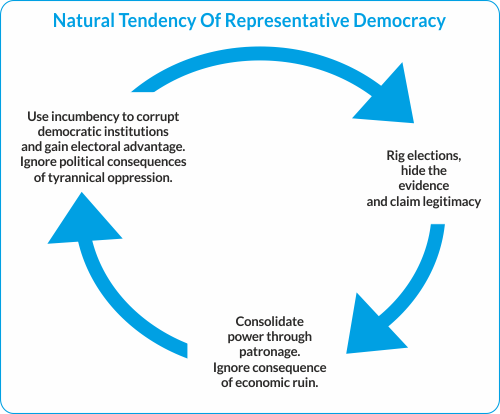
Associated concepts:
Quotes (in Google Polish) from literature:
- related to the concept of Democracy
Links:
- "Direct Democracy versus Representative Democracy: Cost and Benefits for the Citizenry", by Mark O'Kane [Dokument pobrany ze strony https://ecaef.org/about-ecaef/ w dniu 2020.07.30]
- "Direct Democracy versus Representative Democracy: Cost and Benefits for the Citizenry", by Karol Zdybel [Dokument pobrany ze strony https://ecaef.org/about-ecaef/ w dniu 2020.07.30]
Diary:
Desergy
♥ Definiens:
The unnecessary resources desired by a living object.
Desergy, as resergy, consists of: matter, energy and information. Therefore, it is not additive nor able to be conserved. It depends on time, environmental conditions and, moreover, objects and their interactions.
Examples:
- absolute power;
- extreme financial profit;
- overaccumulation of wealth;
- overaccumulation of political power;
- life without effort and responsibility while being respected by others;
Remarks:
-
The concept of desergy should not be confused with the term resergy - the necessary resources;
-
The name "desergy" comes from an amalgamation of the words Desired resources & energy.
-
Earth provides enough to satisfy every man's needs, but not every man's greed. - Mahatma Gandhi
Associated concepts:
Design
♥ Definiens:
A set of information, stored in any way, necessary to create an object, i.e. its properties of structure or behaviour.
Genetic designs and memetic designs are two of the most important designs in The Physics of Life.
Destructors
♥ Definiens:
Any factors shortening the LOAO in any way. They weaken the ability of an object to fulfill the criteria of objectivity. If we can measure the fulfillment of this criteria, the destructors reduce its value.
Remarks:
-
Destructors of the object "fence" include: the weather, a child who hits the ball into it peeling paint and unreliable workers who painted it badly;
Associated concepts:
Dichotomous Thinking
♥ Definiens:
also called black-and-white thinking or all-or-nothing thinking. The individual tends to think in extremes, for example: an individual's actions and motivations are all good or all bad with no middle ground. Dichotomous Thinking is a characteristic element of reductionist thinking and because of the phenomenon of the curse of knowledge it can block the four types of higher level thinking: systemic thinking, multitudinal thinking, game thinking and life thinking.
Remarks:
-
Examples of dichotomous thinking are:
- good – bad;
- true – false;
- innocent – guilty;
- we – they;
- friend - foe;
- tyranny – liberty;
- democracy – dictatorship;
- justice - injustice;
- civilisation – barbarianism;
- capitalism – socialism.
-
It is a common defense mechanism used by many people.
-
According to Edward de Bono, dichotomous thinking is one of the flaws of traditional human thinking, because it prevents the perception of the entire spectrum of data of the given phenomena and what is around them. Such thinking is full of concept traps: dichotomous thinkers either consider a phenomenon as black or as white, they do not see any grey and they do not even take into consideration that grey might exist. Thinking around these extremes is practically impossible, as it is immediately overwhelmed by established patterns, which can not be questioned. For example, you moderately deny that you are not a democrate you are immediately classified as a fascist. If you begin to talk about socialism you are automatically classified as a Marxist, and so on [see Syndrome of Machiavelli- ed. JF]. The polarization is so vast that it does not allow any compromise.
[Wikipedia, Pol., 2016.11.05]
Dilemma
♥ Definiens:
A dilemma (greek: δί-λημμα means "double proposition") is a situation in mathematical game theory, where we have two options, one of them results in certain benefits and losses and the other offers an alternative set of benefits and losses. In reality neither of the options are practically acceptable.
Both these options constitute a dilemma pair
The natural basis of any kind of dilemma is a conflict of interest.
Examples of a dilemma pair:
-
Dilemma pair "My interest versus the interest of the group" in "I/group" dilemma"
-
Dilemma pair "Short-term benefit versus long-term benefit" in "Short-/long-term benefit" dilemma
Associated concepts:
- Prisoner's dilemma
- "I/group" dilemma
- "Short-/long-term benefit" dilemma
- Madison's Dilemma - Key dilemma of ruling
- Iterated cooperation dilemma
- Iterated prisoner's dilemma
- Typical dilemmas
Dissipative system/object
♥ Definiens:
A system or object whose maintenance requires a constant energy input and which, as a result, dissipates this energy.
Remarks:
-
Examples of dissipative objects. Basic: flame, vortex; more complex: laser; the most complex: living objects.
Disturbance
♥ Definiens:
Unpredictable factor influencing the process at a given moment.
Remarks:
-
Disturbance does not influence a system in a determined way, because if it did so it would not be a disturbance, but a factor.
-
From the point of view of systems theory, disturbances are classified as destabilizing or insignificant. A sensitivity analysis studies the consequences of any disturbance on the system.
-
It is not widely known
that in mountaineering
even the smallest error
can screw you up
Associated concepts:
- Sensitivity_analysis
- Non-linearity
- Stability
- Butterfly effect
Quotes (in Google Polish) from literature:
- related to the concept of Disturbance
DNA
♥ Definiens:
Deoxyribonucleic acid, DNA for short – a multimolecular organic chemical compound that belongs to the group nucleic acids. It is the carrier of genetic information for living organisms. [Wikipedia, pol. state 2011.02.20]
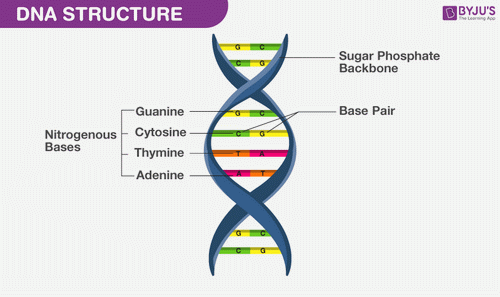
Source: https://byjus.com/biology/dna-structure/
Associated concepts:
Duality of Nature
♥ Definiens:
Duality of Nature manifests itself in the cyclic grouping of particles and the subsequent separation of objects made by this grouping.
In space, particles tend to group into planets, stars, galaxies, etc. Each astronomical object is a single centre of concentration of matter. Larger objects absorb smaller objects. Black holes concentrate matter in the strongest way. When certain limits of concentration are overpassed, it explodes. An example of this could be the Big Bang.
The Earth's gravitational conditions, particularly in marine areas, make grouping particles spontaneously separate once certain limits have been exceeded. A specific type of such particles are RPD-type particles, and their evolutionary successors, such as synthesizing replicators.
Duality of Nature is due to a natural tendency of chemical particles to attract or repel other particles. Therefore, every interaction between particles can only be classified as attraction or repulsion.
Remarks:
-
Heraclitus of Ephesus::
This world, which is the same for all, no one of gods or men has made. But it always was and will be: an ever-living fire, with measures of it kindling, and measures going out. -
Aleksander Gudzowaty
[…] everything in the world (also in the universe), is subjected to an objective law of nature called the "Law of Concentration". It is a model of development due to explosions which are a natural consequence of each concentration. -
Portal of knowledge
It is assumed (at present it is not completely certain) that if the density of matter in the universe exceeds a certain critical size, the end of it will lead to a great collapse - the collapse of all matter into a black hole. After this, possibly followed by the next Big Bang. -
Another definiendum of duality of nature is the Law of Concentration.
Associated concepts:
Dunning–Kruger effect
Definiens:
The Dunning-Kruger effect - a psychological phenomenon in which unskilled people in some area tend to overestimate their skills, while highly qualified people tend to underestimate their skills.
This phenomenon was described and documented by Justin Kruger and David Dunning from Cornell University.
Kruger and Dunning drew attention to numerous earlier studies that seemed to suggest that, for capabilities as diverse as motor vehicle operation, chess or tennis, "ignorance is more often a cause of confidence than knowledge" (as Charles Darwin put it). They hypothesized that, in the case of ability, that anyone can possess, to a greater or lesser degree, certain traits:
- they do not see their low level of ability,
- they cannot correctly assess their level of ability,
- they cannot correctly assess the level of ability in others,
- they only recognize and agree that their level of ability is low only after proper training.
[Definition cames from Pol. Wikipedia, 2020.06.22]
Duo-definienda
♥ Definiens:
In other words : "Double meaning".
Two (or more) definienda for one definiens
Two (or more) meanings for one name
Remarks:
For example: "fly" - 1/. an insect; 2/. to move in or pass through the air with wings etc.
-
An example of duo-definienda is the rich - a person who has a large property, thought to be have been gained dishonestly. Ayn Rand's book "Atlas Shrugged" has shown that you can become rich in two ways: by producing goods and exchange them on the free market - Atlases, or using different types of coercion - Looters.
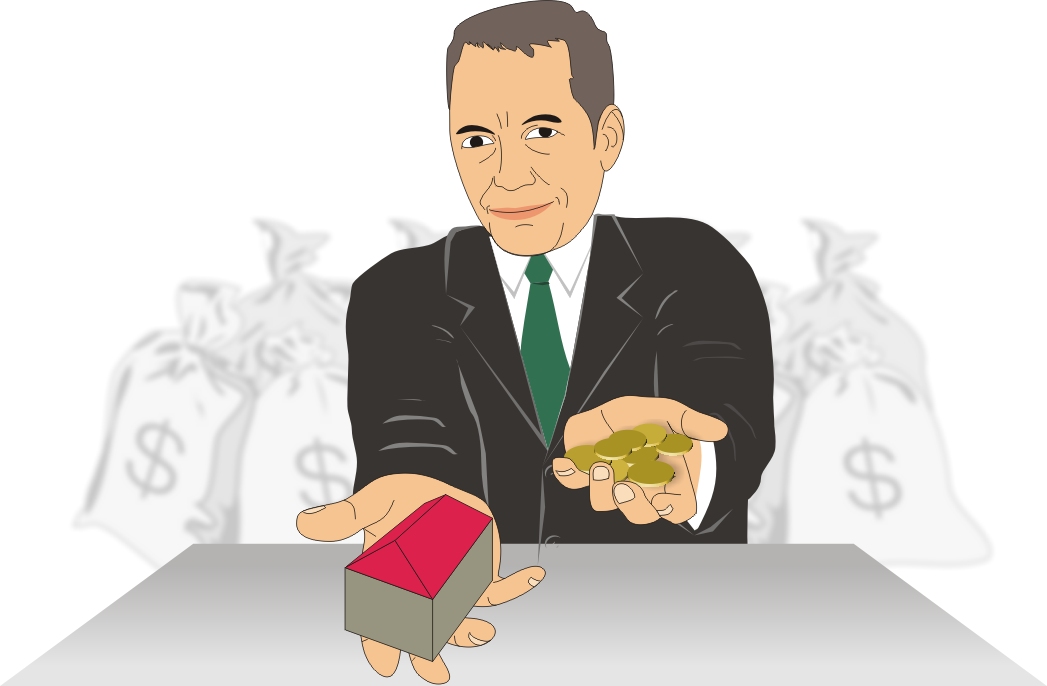
Rich man - maker
rich by production of resources and free exchange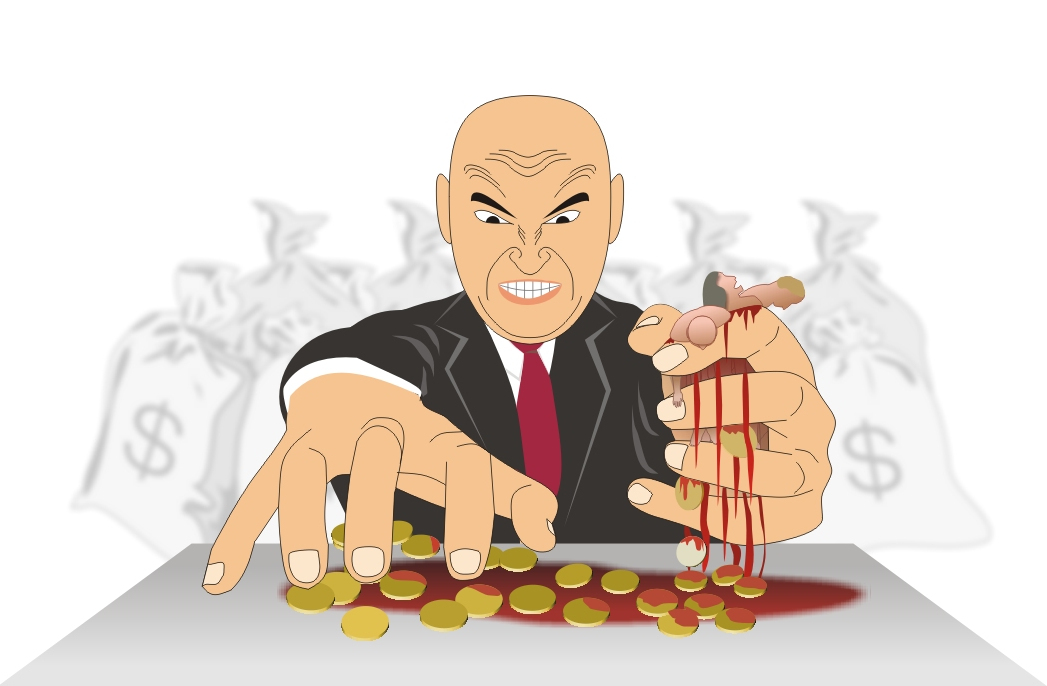
Rich man - taker
rich gatherer of resources by plunder, looting and robbery
-
One of the most dramatic duo-definientia in this context is "evolution" - the key to understanding life (as Robin Dunbar put it). As of February 2013, the merriam-webster on-line dictionary reported at least 6 different definientia to this definiendum:
1/. one of a set of prescribed movements
2/. a: a process of change in a certain direction:  unfolding
    b: the action or an instance of forming and giving something off:  emission
    c: (1) a process of continuous change from a lower, simpler, or worse
           to a higher, more complex, or better state:  growth
       (2) a process of gradual and relatively peaceful social,
           political, and economic advance
    d: something evolved
3/. the process of working out or developing
4/. a: the historical development of a biological group (as a race or species): phylogeny
    b: a theory that the various types of animals and plants have their origin in
       other preexisting types and that the distinguishable differences are due to
       modifications in successive generations; also :  the process described by this
       theory
5/. the extraction of a mathematical root
6/. a process in which the whole universe is a progression of interrelated phenomena
		   10.04.2019
6 different definienda plus 6 more sub-definienda and 2 more sub-sub-definienda!
Associated concepts:
Quotes from literature:
- in Polish Duo-definienda
Duo-definientia
♥ Definiens:
In other words : "Double-named".
Two (or more) definientia for one definiendum
Two (or more) names for one meaning
Remarks:
- Astronaut & Cosmonaut
- Space & Cosmos
Associated concepts:
Duvernay's rule
♥ Definiens:
A huge number of people are asking for help, only a few of them deserve to be helped, and only a few of those few who deserve to be helped can properly use it.
Remarks:
This rule was formulated by the Frenchwoman Ivonne Duvernay in 1989.
-
In Vedic philosophy we find this statement: charity shown in the wrong place and at the wrong time, to people who do not deserve it, without proper attention and respect – is the charity in the guna of ignorance.
Economics
Ecosystem
♥ Definiens:
An ecosystem is made of two components:
-
biocenosis - interacting organisms living together in a certain biotope.
-
biotope – an area of uniform environmental conditions providing a space for the assemblage of living objects.
The ecosystem is a functional unit, in which there is an exchange of resergy (matter, energy and information) between the biocoenosis and the biotope.
Associated concepts:
Elitism
♥ Definiens:
the belief that certain individuals or social groups, because of their birth, skills, knowledge, wealth, faith, origin, race, are more valuable than others and for this reason should occupy a privileged position in a society.
Associated concepts:
- Aristocraticization
- Biedocraticization
- Degeneration of power
- Model of governance
- Typical instruments of governance
Emergence
Emotions
♥ Definiens:
A typical set of automatic reactions of a living object caused by a typical set of external and/or internal factors. A set of reactions may be composed of: messages, behaviours, physiological processes etc. Emotions were built into living objects by process of biological evolution - they happened to be victory factors to recurring problems that faced our prevoluants.
Emotions are definitely faster and more powerful than rational reactions.
Quotes from literature (in Google Polish):
- related to the concept of Reason/Emotions
Associated concepts:
Endosymbiosis
♥ Definiens:
A specific type of symbiosis in which the cells of one living object live inside the cells or tissues of another.
Other definientia:
-
Endosymbiosis is a specific type of interaction between living objects, some living objects live inside others. This is not surprising, because this phenomenon occurs literally at every step - even in our digestive tract there is around 2 kg of the so-called bacterial flora that helps us digest food.
-
A very interesting example of multilevel endosymbiosis is the coexistence of bacteria living in cells of the chewing louse (Mallphaga), which are insects that parasitize birds and mammals:eating exfoliated skin, feathers and various secretions, including blood flowing from wounds. […] Some live as internal parasites, penetrating inside the quill of bird feathers. A close symbiotic relationship arose between some lice and bacteria. This bacteria live in mycetocytes - special fat cells of the louse and help the louse digest food (keratin). Lice without these bacteria die within a few days [www.trojszyk.com/ciek.php].
Remarks:
-
Endosymbiosis can be confused with symbiogenesis, so it is worth looking at both definitions at once.
Energy
♥ Definiens:
Energy is a scalar physical quantity informing what constitutes the potential of an object and what is the value of this potential.
Entrepreneurs
Definiens:
Entrepreneurship is the ability to forsee the future in a sufficient extent and according to it set the goals and effectively achieve them. This includes the effective responses to disturbancies (unpredicted events) and effective use of opportunities to which an entrepreneur prepares all the time. And here I would put curiosity first and everything that derives from it: learning, experimenting by trials and errors, selfimprovement and gaining experience.
Remarks:
-
The most important attribute of an entrepreneur is extreme curiosity, and a desire to understand how things work. The most characteristic is to innovate to meet a gap in the market, or detect a supply and demand mismatch, or discover a new and better way to meet the needs of the consumer even when the consumer or user has not identified any particular shortcomings. Only the success of the new product or service brings to light what was missing in the earlier arrangement, which no one earlier had identified and therefore did not try to resolve. Finally, entrepreneurship is not limited to the economic sphere.
A good worker in an industry could also share such characteristics, and be among the most productive employees, and be an asset to the entrepreneur. Likewise, these characteristics can also be shared by civic and political entrepreneurs.
Entrepreneurs rarely would do a risk benefit calculation. They are not reckless, but are capable of taking considerable risk after thorough diligence on the venture. They believe that their idea is a possible winner, and risk everything on it, even while accepting that if it fails they may lose everything.Barun Mitra
Epistemology
Definiens:
Epistemology is the science that explores the process of understanding reality by humans.
Other definientia:
-
Cognitive theory
Remarks:
-
(from Greek ἐπιστήμη [epistēmē], meaning "knowledge", and λόγος [logos], meaning "logical discourse")
-
It deals with such problems as:
- What is knowledge?
- How is knowledge acquired?
- What do people know?
- How do we know that we know?
-
Technological empiricism does not naturally mean blindly tossing from one badly thoughtout experiment to another. The empiricist inventor usually has an idea, or rather—thanks to what he has already achieved (or what others had achieved before him)—he can see a short stretch of the road ahead of him. The sequence of his actions is regulated by negative feedback (the failure of an experiment explains every time that this is the wrong way). As a result, the road he takes is like a zigzag, but it is certainly going somewhere and has a definite direction. Gaining theoretical knowledge allows for a sudden leap ahead. - ["Summa technologiae", St. Lem, str. 45].
-
A widely held view is that creativity in science is based on what is known as evolutionary epistemology or the chance-permutation model. In essence, this model suggests that scientists randomly generate theories, of which the good ones survive since they are selected because of their explanatory powers. The creative process is said to entail mental elements which are permutated in a random manner, and these random permutations are selected by another process so that the best ideas survive. ["Nienaturalna natura nauki", Lewis Wolpert, str. 72]
-
There is no doubt that the process of biological evolution is a strong constructor in the process of Human cognition. An excellent illustration of this are religions: if we consider religion (a memetic project with a slew of principles to follow) as a victory factor, then from the whole palette of various religions (created in a randomly conceived way), only those that contribute to the continuing population growth of their followers will survive. To illustrate this phenomenon, you can paraphrase a well-known English idiom: The proof of the pudding is in the eating The validity of the victory factor is confirmed by the fact that it prolongs the duration of the population, and this duration transfers the victory factor to subsequent generations.
It seems that a good general name for this mechanism would be evolutionary popping, which, in its most general form, refers to tactics of structure and tactics of behaviour. It operates in two dimensions: individual and populational. And how it affects each of these dimensions explains the How Life Is Competing model. -
Auguste Comte studied epistemology and claimed that cognition takes place in three stages: theological, metaphysical and positive.
Stages of cognition
nr according to Auguste Comte according to Stanislaw Lem according to The Physics of Life 

Theological Stage
relies on supernatural or religious explanations of the phenomenamagical thinking stage observation stage
stage of the observation and perception of certain patterns.II Metaphysical Stage
when people explain phenomena through abstract concepts and irrational speculation (usually detached from reality);stage of technological empiricism stage of the building and verification of models
phase of discovering cause-and-effect relations, and building models, both cognitive and predictive ones. These models are built on the basis of: own and other people's experiences, personal and other people's accepted emotions, own and accepted set of concepts, own and largely accepted moral systems, self-interest and interest of social groups to which one belongs, cultural environment in which one operates, learned and acquired rules of thinking process.III Positive Stage
when people formulate theorems based on facts and dependencies of coexistence, or the consequences between facts. In this phase, people can determine and predict facts previously unknown. This phase is identical to the scientific phase.stage of technological knowledge stage of full cognition
phase of having full cognitive models and the most trustworthy predictive models (in many cases fully trustworthy models can not be developed)IV regulatory stage stage of full and universal cognition
when all cognitive and predictive models are widely known, intellectually accepted and applied. When all contamination of models and their use resulting from the interest of their own and particular social groups will be eliminated.
It is highly unlikely that this phase will be ever reached.
Associated concepts:
- Philosophy
- Curse of knowledge
- Model
- Table of elements of thinking in The Physics of Life
- Theory
- Science
Evoluant
♥ Definiens:
Every element in an evolutionary sequence which follows a given element.
Remarks:
-
For example: Homo erectus is an evoluant of Homo, Homo sapiens is evoluant of Homo erectus, Homo sapiens is evoluant of Pan troglodytes.
Associated concepts:
Evolution
♥ Definiens:
In fact, the definition of evolution is not clear and, what is more, ambiguous in two dimensions: it is used to name the process that created and continues to shape life on Earth (see definition no. 1) and to name the so-called life cycle (see definition no. 2).
To explain why it is not clear: Charles Darwin used the term "evolution" to name the process responsible for the development of life on Earth. This incomplete description of its mechanisms, which, at that time, was seen and understood by Wallace and Darwin, and so brilliantly described by the latter, is long-established in the scientific world as the only competent and detailed explanation of the whole issue. The English-speaking world, unfortunately, ignored the information coming from Russia (Kropotkin, Mierieżkowski) and, because of this, there has not been a universally accepted, comprehensive, description of the process that created and continues to shape life on Earth over the next 150 years.
One of the attempts to do so was the replacement of "evolution" (in the above sense) by the concept of "natural selection", but this also proved not to be quite true.
Therefore, one of the fundamental tasks of The Physics of Life is the development of a complete and logical description of the process which brought life into existence and continues to shape the successive generations of living objects. The term of gerpedelution was proposed in order to give a basic model of this process. The process itself is called biological evolution. The word "evolution" should be understood, as the ancient Romans proposed, as "development" and nothing more.
In turn, gerpedelution is a definiendum of an abstract cyclical process, consisting of three separate stages, that lays the foundation of how biological evolution operates.
Other definientia:
-
Evolution any change across successive generations in the heritable characteristics of biological populations. Evolutionary processes give rise to diversity at every level of biological organisation, including species, individual organisms and molecules such as DNA and proteins.[1] - [Wikipedia, eng., dated 20120208]
Here, evolution is defined not as a process but as a change. -
Stellar evolution the process by which a star undergoes a sequence of radical changes during its lifetime. - [Wikipedia, eng., dated 20120208]
Here, evolution touches only one object throughout its existence -
Each gradual change. Organic evolution, which is often referred to as evolution in short, means any intergenerational genetic change in a population. - ["On Human Nature", Edward O. Wilson]
-
Evolution is a process of biological change that makes organisms different from their ancestors. - ["Encyclopedia of Evolution"] [Please note that here the term process is used in the mathematical sense - ed. JF]
Associated concepts:
Evolutionary Bearing Capacity
♥ Definiens:
A feature of objects subjected to the process of biological evolution, such as: victory factors, ideas and other sociotypes, causing them to be propagated in a given population. Propagated, i.e. that living objects:
- acquire them and only those objects that have them are able to replicate (genetic transfer) or
- absorb them and pass them on to others of the same species (memetic transfer)
Remarks:
-
In the case of living objects these features are Victory factors. If the selection function is strong, in subsequent generations, the number of living objects that have this factor increases exponentially.
-
In the case of sociotypes, their carriers are living objects who are interested in transmitting or copying them.
Associated concepts:
Quotes (in Google Polish) from literature:
- related to the concept of Evolutionary Bearing Capacity
Evolutionary classification of systems
♥ Definiens:
We distinguish two kinds of systems according to how they pass through the selection process:
-
WSS (Wholly Selected Systems) - a group of objects selected as a whole in the gerpedelution process. In the particular case of biological evolution, WSS group is called a living object, which according to the elements it is built of, belongs to a given organizational level.
-
PSS (Partially Selected Systems) - a group of objects that are selected not as a group, but as singular objects. In the case of biological evolution, an example of a PSS group is a social group.
Evolutionary Game Model
♥ Definiens:
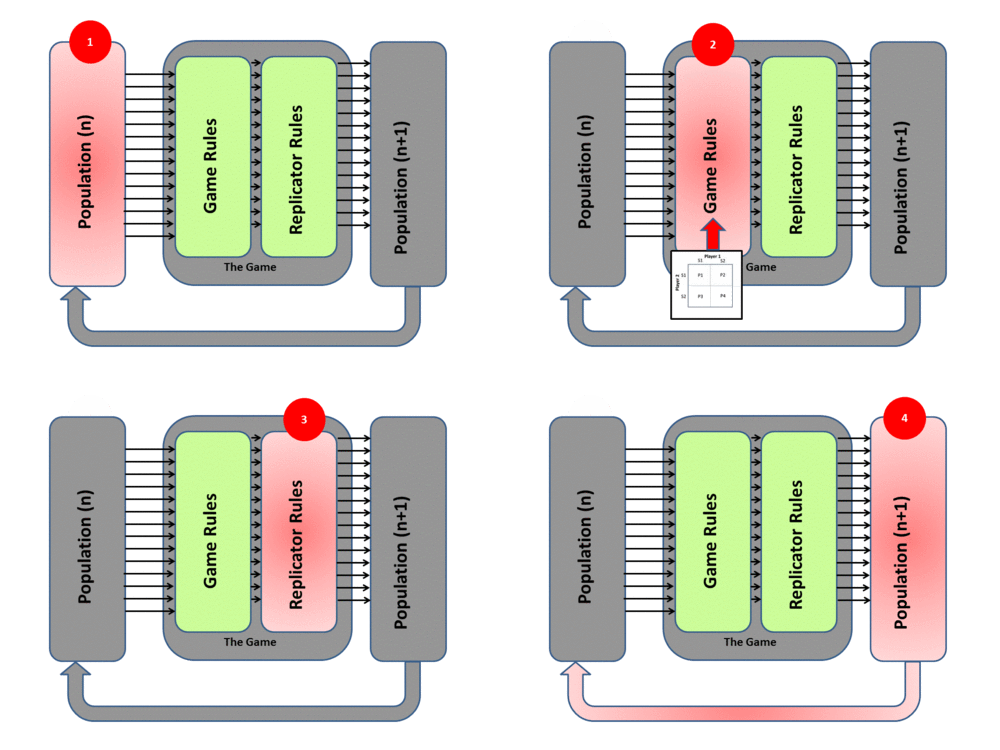
The Evolutionary Game Model transposes Darwinian mechanisms into a mathematical form by adopting a System Model of evolutionary processes with three main components - Population, Game, and Replicator Dynamics. The system process itself has four phases:
-
The model (as evolution itself) deals with a Population (Pn). The population will exhibit Variation among Competing individuals. In the model this competition is represented by the Game.
-
The Game tests the strategies of the individuals under the “rules of the game”. These rules produce different payoffs, in units of Fitness (the production rate of offspring). The contesting individuals meet in pairwise contests with others, normally in a highly mixed distribution of the population. The mix of strategies in the population affects the payoff results by altering the odds that any individual may meet up, in contests, with various strategies. The individuals leave the game pairwise contest with a resulting fitness determined by the contest outcome – generally represented in a Payoff Matrix.
-
Based on this resulting fitness, each member of the population then undergoes replication or culling determined by the exact mathematics of the Replicator Dynamics Process. This overall process then produces a New Generation P(n+1). Each surviving individual now has a new fitness level determined by the game result.
-
The new generation then takes the place of the previous one and the cycle begins again (and never stops). Mathematically speaking it is an Iterative process. Over time the population mix in such a system may converge to a stationary state – and if such a state cannot be invaded by any new “mutant strategies” it is by definition an Evolutionary Stable State (ESS).
Remarks:
-
Copied from Wikipedia Evolutionary game theory [2012.07.06]
-
If we assume that the stage of selection in gerpedelution is the game where the winners are allowed to reproduce we will get Evolutionary Game Model.
Associated concepts:
Evolutionary ratchet
♥ Definiens:
Sensitivity analysis of small evolution game leads to the conclusion that the process of biological evolution has a kind of ratchet mechanism. This mechanism is fully operational (it works as a real ratchet) when the selection criterion is competitive and extremely strong. Then if a better tactic of structure or tactic of behaviour appears in the population, there is no return to the worse tactics. If the selection function ramains strong, tactics remain at the same level and there is no descent.
However, if the selection criterion weakens, worse tactics may appear. Darwin described this as: the tendency to reversion to a less modified state [Source page 142].
Full description of the game Small evolution, in which the evolutionary ratchet mechanism is discussed in detail.
Remarks:
-
The evolutionary ratchet mechanism prevents organic substances which have already been submitted to biological evolution to withdraw from this peculiar race (quasi-constant and non-linear improvement).
-
Manfred Eigen and Peter Schuster in the work "The hypercycle" called this mechanism: the peculiar "once-forever" selection mechanism.
Associated concepts:
Evolutionary self-supporting object
♥ Definiens:
Any object which is stably maintained by the process of biological evolution.
Remarks:
- The opposite to an evolutionary self-supporting object is an evolutionary recessive object (disappearing, vanishing, leaving evolution = dying).
Examples:
- Each victory factor which enters into the evolutionary chain of succession for a considerably long (or permanent) period of time. For example: sexual reproduction, a pair of eyes.
- Religions
- The development of productivity giving the individual or social group a competitive advantage.
- The development of science, therefore cognitive models and predictive models
Associated concepts:
Evolutionary popping
♥ Definiens:
One of the mechanisms of biological evolution that gradually produces the given properties of living objects and other objects submitted to biological evolution. This process is based on:
-
typical for biological evolution mechanism of selection which is based on natural phenomena (eg, disasters) and/or self-exciting conflicts of interest due to lack of resources.
-
typical for the biological evolution, an exponential multiplication of living objects leading to the above-mentioned conflicts of interest regarding the access to resources.
-
typical for the biological evolution multiplication with modification causing the selection to be made from a set of (sometimes slightly) different living objects.
-
the phenomenon of the emergence of new tactics of structure and tactics of behaviour in proliferating living objects. (Note: Emergence does not mean "formation from nothing").
-
5 characteristic features of biological evolution which are expressed in the Second Principle of The Physics of Life.
-
capacity of self-spreadness, which means how the selected living objects change the characteristics of selection, modification and multiplication, the three basic stages of gerpedelution
Remarks:
-
It can be named in an alternative way: subsequent selection process.
-
It can be named in an alternative way: evolutionary transformation process.
-
Evolutionary popping transforms chemical affinity into pursuance.
-
Evolutionary popping transforms RPD-type chemical particles into Living objects.
-
Evolutionary popping creates specific memetic designs.
If we consider, for example, a death that affects social groups caused by a disaster, war or plague. It can result in the death of all members of the group or only a few. In the latter case, we have to deal with two specific outcomes:- only a few of the population dies
- only a few of the population survives
Note that when death touches the population, the natural phenomenon is the emergence of stories of miraculous rescues. When few survive, "miraculous" means low probability. On the other hand, stories of miraculous deaths never emerge. Thus, biological evolution has natural tendency to produce myths of miraculous rescues (in The Physics of Life, the myth is an object), whilst never produces myths of miraculous deaths.
-
Ideas are constructors of evolutionary popping when they help to fulfill the life purpose - in other words when idea brings benefits or increases fertility. Such ideas are evolutionary self-supporting objecta and self-spreading.
Associated concepts:
Ex nihilo
♥ Definiens:
Ex nihilo in Latin means "out of nothing". Often it is combined with the concept of creation, for example: Creatio ex nihilo which means "creation out of nothing". This refers mainly to philosophical and theological contexts, but can be found in other areas.
So far no one has managed to prove that something can arise from absolutely nothing. We know what matter is, but we do not know either how it was created or how it came to be. It seems, rather, that it should be Nothing (no matter) instead of Something (matter). Intuition says that a state of emptiness is more natural.
Very similar to ex nihilo are natural phenomena as:
-
self-excitation for example vibrations, but this can occur only when it is powered by an external source of (constant) power;
-
self-creation due to emergence
-
self-creation of information but for this, information carriers are required.
Therefore, it can be said that we know the three processes of the creation of quasi ex nihilo:
-
Self-excitation: consisting of the transformation of a constant stream of energy into a pulsating phenomenon;
-
Emergence: the formation of new features within the system, a result of mutual interaction of objects composing the system.
-
Self-creation of information: due to the composition of self-arranged chains of different objects or the same objects but whose features are in different states. If interpreted, these chains are information.
Life was created by the juxtaposition of the above-mentioned processes. There remains some key questions: "How was matter created?", and if matter always existed "Why is there SOMETHING in nature, rather than NOTHING?".
Associated concepts:
Experiment 2,4,6
This experiment shows that the first data and analysis on a given topic block the access to further data and subsequent analysis.
♥ Description:
This experiment is only successful when the participant does not know anything about it - blind experiment. This experiment can only be performed with one person.
Course of experiment "2,4,6"
The experimentor writes a sequence of three numbers "2,4,6" and explains the experiment to the subject, saying:
- This sequence was written according to a certain rule.
- Your goal is to find this rule.
- To do this, you need to write a sequence of three numbers, and the experimentor will tell you if your sequence conforms to the rule. This will be repeated as many times as you think are necessary.
- Note, you can write as many sequences as you want, but you have only one chance to specify the rule. if you are right - you win, if not - you lose.
- Do you need to hear the explanation again? Do you have any questions?
- If there are no queries, the experiment may begin.
- Subject gives a sequence of three numbers, the experimentor writes it down and, after analysis, marks "+" if the sequence fulfills the rule and a "-" if it does not.
- The experiment continues until the participant announces that they know the rule. The participant states the rule and the experimentor states whether the answer is correct or not.
- The rule is simple: "The next number will be greater than the previous one"
Main features of experiment "2,4,6"
As a rule, the majority of the participants
- understands the rules and refuses to have the instructions repeated.
-
create a rule which satisfies the given sequence and continue to give further sequences which fulfil their rule.
By doing this they try to convince themselves that their rule is right and cease looking for the rule of the experimentor.
Remarks:
-
Professors are more likely to lose, as they generally look for more complicated solutions. However, students are more likely to search for quicker, less complex answers. Subsequently, the students are more likely to win.
Associated concepts:
Feature (or property)
♥ Definiens:
An individual, measurable property of the observed object. Because a feature is measurable, it therefore has a state - defined as a state of a property.
Associated concepts:
Feedback
♥ Definiens:
A realtionship between two objects where the first influences the other, and the second subsequently influences the first. Therefore, the first object changes the functionality of the second object, and these changes, in turn, alter the functionality of the first object. Thus, the first object influences itself through a mediator, which is the second object.
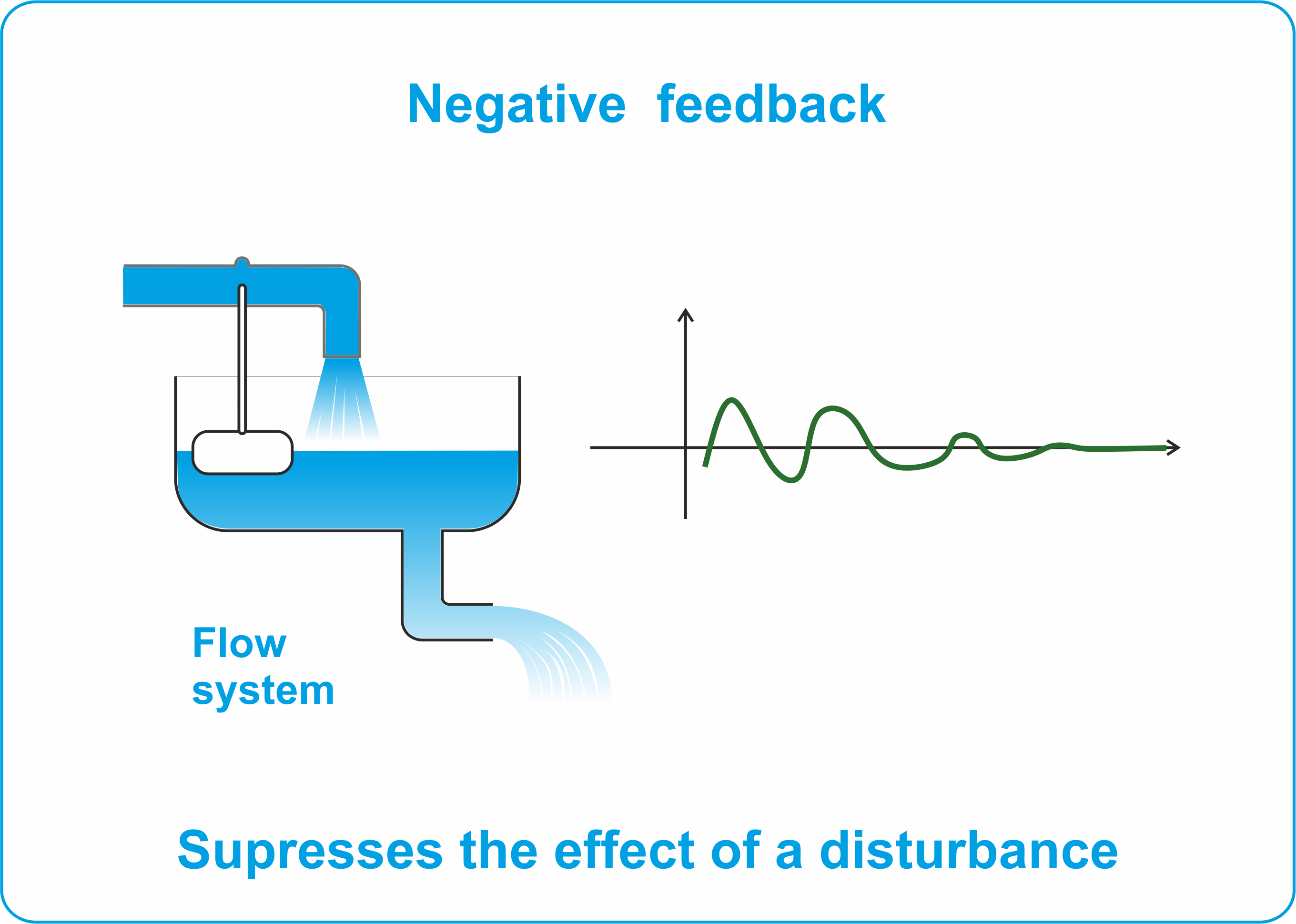
Negative feedback is when the state of some property of a system is disturbed, the system seeks to change the value of that state in the opposite direction (hence the name "negative"). Therefore, negative feedback results in a reduction of this disturbance.
A good example of a negative feedback system is a toilet cistern. In this system we have a float ball connected to the water supply in such a way that it restricts it when the water level tries to go above the required level. When there is not enough water in the system the ball opens the water supply.
Thus, the water in such a tank will have tendency to be maintained at a given level.
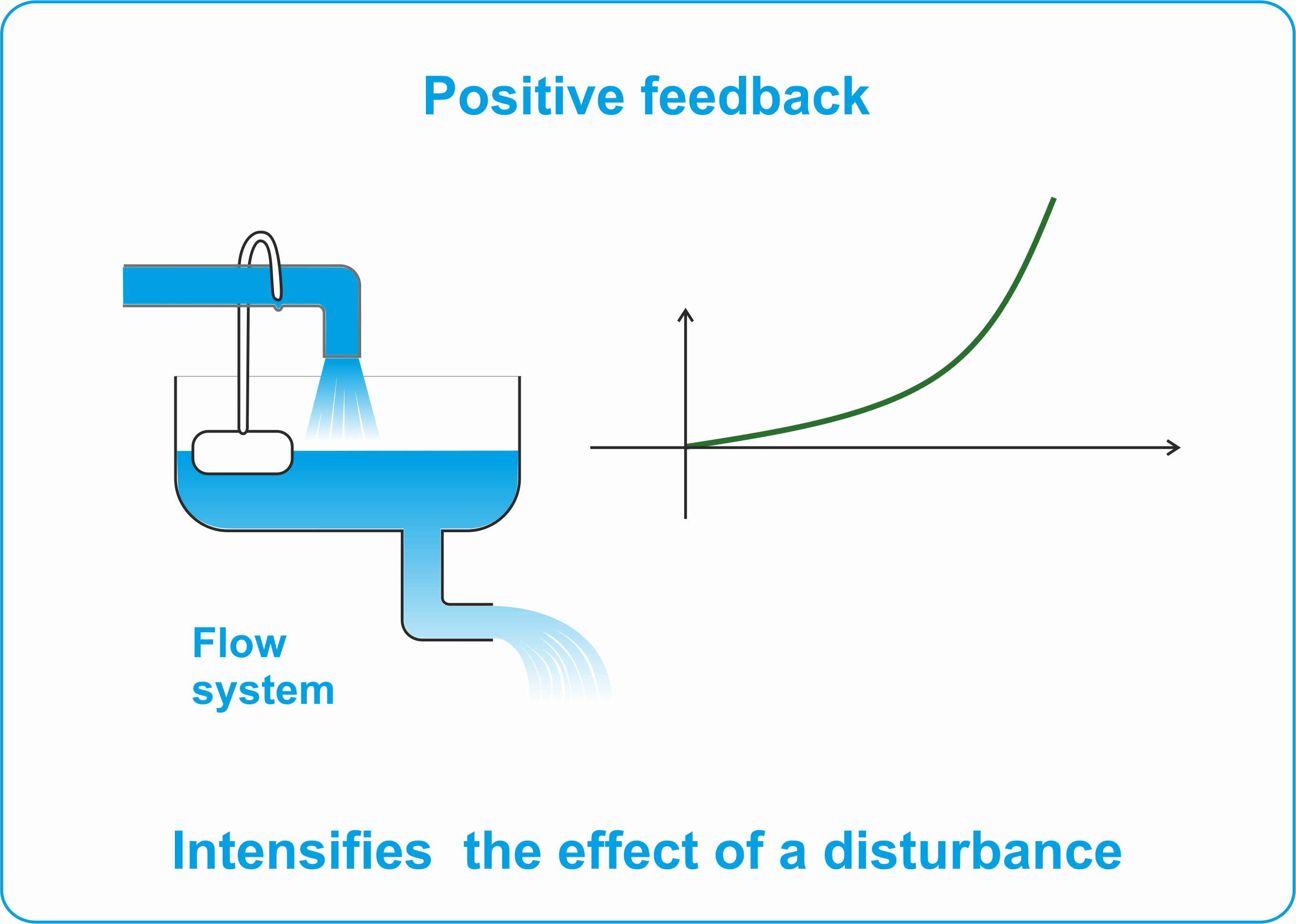
Positive feedback is when the state of some property of a system is disturbed, the system seeks to change the value of that state in the same direction (hence the name "positive"). Therefore, positive feedback results in a strengthening of this disturbance.
A good example of a positive feedback system is a toilet cistern with the reverse control. In this system we have a float ball connected to the water supply in such a way that it opens the inlet valve when the water level increases. When water level decreases the system closes the water supply.
Thus, the water level in such a tank will steadily rise or steadily fall until the tank overflows or is empty.
Quotes (in Google Polish) from literature:
- related to the concept of Feedback
Associated concepts:
Financial leash
General definiens:
The mechanism of making living objects dependent by providing them with a specific type of energy in a completely or partially cost-free manner.
Special definiens:
The mechanism of making people dependent by providing financial resources in a completely or partially cost-free way.
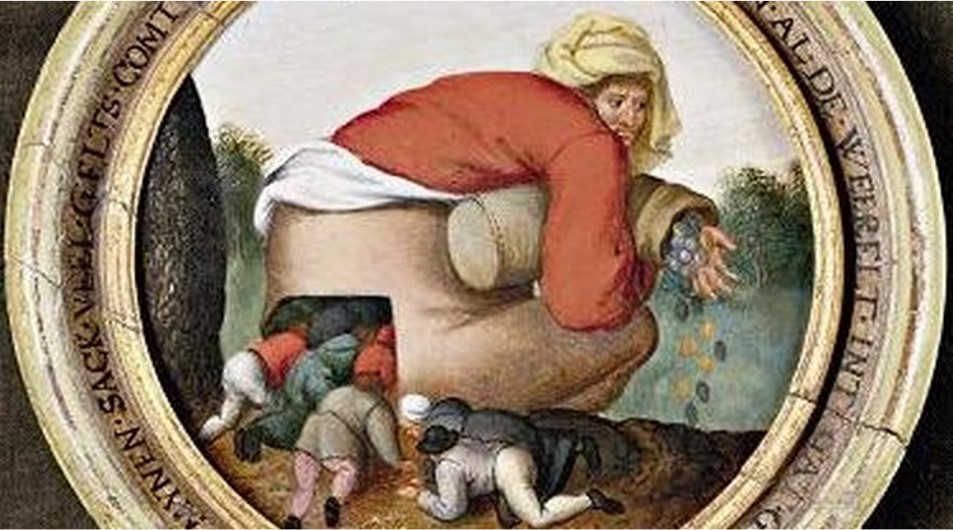
Remarks:
-
The above definitions are very general, while the definiendum refers to a specific case: people's dependance by giving them money. This concept will probably reach popular consciousness exactly in this context.
-
The way how the financial leash oparates results directly from the phenomenon of supercompensation and the First Law of the Physics of Life.
Associated concepts:
First Law of The Physics of Life
The law stating that tactics of behaviour and tactics of structure are shaped by the source of resergy and external conditions:
♥ Contents:
The source of resergy shapes the tactics of structure and tactics of behaviour used to implement them, rewarding objects that have them with duplication in the third stage of biological evolution
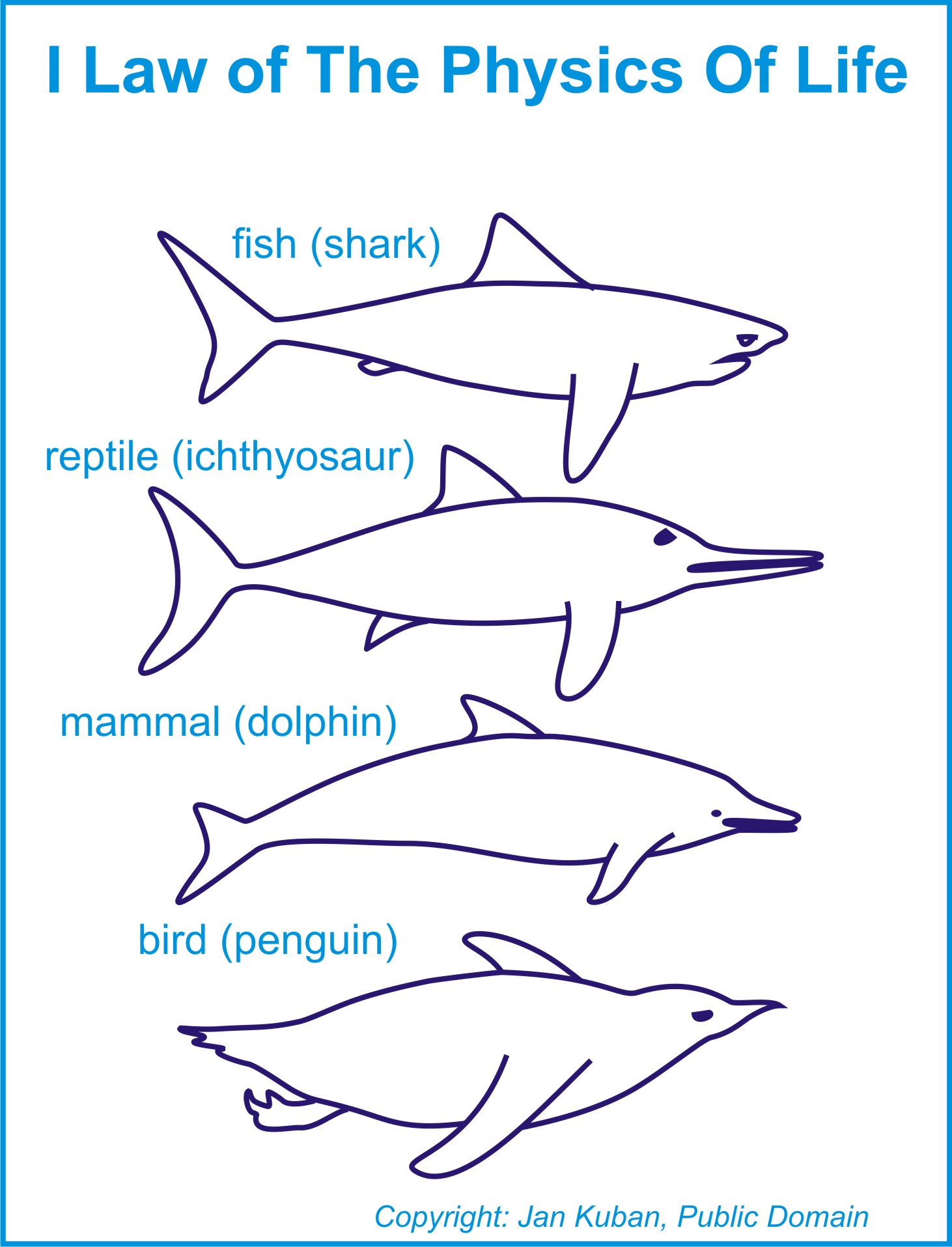
The action shot from the film "Black Fathers Matter" [https://youtu.be/FszQelEQ2KY]
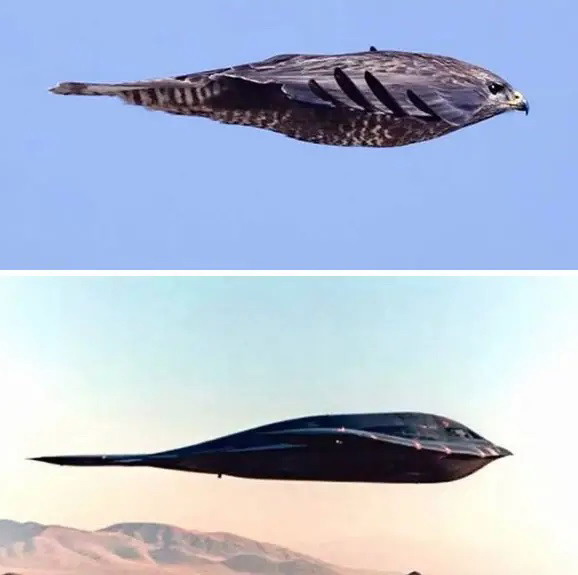
Remarks:
-
Facebook post 2019.03.27 FUNDAMENTAL QUESTION 003: Is evolution purposeful?
Look at the picture above. There are four very similar animals from four different families. Admittedly, one is extinct. How did this similiarity happen? Was it by accident or by design?
The answer from The Physics of Life is simple: the source of resources required to fulfill the life purpose of a living object gradually, from genereation to generation shapes the physiology of the living objects expressed in their tactics of stucture and tactics of behaviour. All four of these creatures had similar sources of resources and, thus, they became very similar in shape over time.
This purposefulness is the First Law of The Physics of Life.
This does not only apply to biology. It so universal that wherever you are in the world you can look at somebody and make an educated guess to name their profession. A politician will act in a certain way regardless of whether they are in Australia, Mozambique, Napal or America. They will pull the same faces, use the same body language and say the same phrases to persuade you to believe in them. Because, for them, being elected is the source of resources required to fulfill their Life purpose.
Associated concepts:
Fixed-action patterns
♥ Definiens:
Behaviour patterns "built-in" to a living object from birth. They are shaped over the course of biological evolution.
Fixed-action patterns can involve intricate sequences of behaviour, such as entire courtship or mating rituals. A fundamental characteristic of these patterns is that the behaviours comprising them occur in virtually the same fashion and in the same order every time. It is almost as if the patterns were recorded on tapes within the animals. When a situation calls for courtship, a courtship tape gets played; when a situation calls for mothering, a maternal behaviour tape gets played. Click and the appropriate tape is activated; whirr and out rolls the standard sequence of behaviours.
[Quote from the book "Influence. Science and Practice"]
Robert Cialdini identified just six fixed-action patterns which guide human behaviour, as far as selling is concerned:
- Reciprocity
- Scarcity
- Authority
- Consistency
- Liking
- Consensus
Remarks:
- The term proposed and widely described by Robert Cialdini in the book "Influence. Science and Practice"
Links:
- Book "Influence. Science and Practice"
- Robert Cialdini's website Principles of Persuasion, broadly discussing the fixed-action patterns mentioned in the definition.
Associated concepts:
Flow system/object
♥ Definiens:
A system or object whose structure is a temporary state created by flowing streams of energy, material or information.
Full definition of a Flow system.
Remarks:
-
Examples of flow systems: a flame, a vortex, a bank account, a company and the most complex one a living object.
-
The scientific term for this system is open system
-
Peter Mitchell (1920–1992), a British biochemist awarded the 1978 Nobel Prize for Chemistry, called this kind of systems "fluidics".
Quotes from literature:
- in Polish related with the concept Flow system
Free market
♥ Definiens:
The free market is a market in which the exchange of goods takes place as a result of voluntarily concluded transactions between buyers and sellers, at a price which they voluntarily set. In the free market, both buyers and sellers are not subject to any restrictions or coercion by external entities (e.g. public authorities), and the terms of the transaction - in particular the price - depend only on their mutual consent. - [Wikipedia, pol., 2011.04.07]
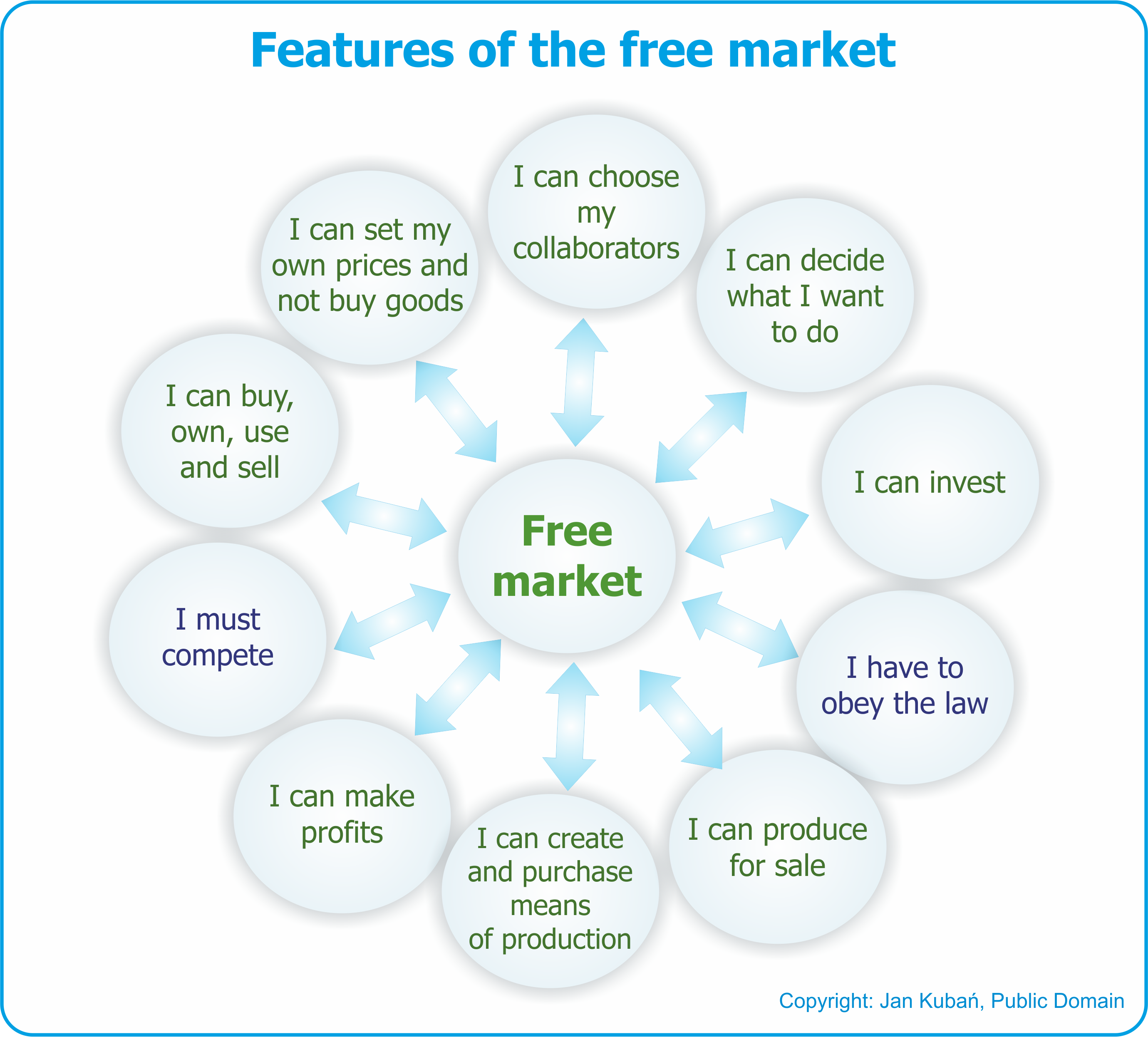
Remarks:
-
The free market is nothing but social consent to natural selection.
-
Usually "free", in the context of "free market", is understood as "free American" or allowing any scams. However, "free" should be understood as "the market of "free" or, better, uncoerced choice.
-
The free market transforms natural human greed into a disciplined creative production process based on a follow-up analysis of the needs of others. [paraphrase by John Freeslow of the George Gilder's quote]
-
Why do people not like the free market? Because it compels them to compete.
-
Conditions that must be met by the market to be considered free:
- I can set my own prices for my products and no one forces me to buy
- I can choose my co-workers and pay them as much as I want and as little as they agree
- I can decide what I want to do
- I can invest
- I can buy, own, use and sell anything I want
- I can make profits, see --> Basic factor of development of societies
- I can create and purchase means of production
- I can produce for sale
- I have to compete
- I have to obey the moral principles (this point includes regulations such as: that you cannot steal, you cannot inflate money,…)
All these conditions must be met simultaneously. The free market is therefore characterized by Conjunctional non-linearity. -
The negative mechanism of the free market is Saint Matthew's ratchet, leading to the creation of monopolies. In other words, the free market contributes to the elimination of competition.
-
PAFERE's Academy: Economics and the role of the free market part 1
(English subtitles)
PAFERE's Academy: Economics and the role of the free market part 2
(English subtitles)
Associated concepts:
Quotes from literature:
- in Polish Free market
Foundations of morality
Definiens:
- Harm-care We bond with others, we care for others, feel compassion for others, especially the weak and voulnerable. It gives us very strong feelings about those who cause harm. The influence of this component is estimated at about 70%.
- Fairness-reciprocity Foundations of religions. The influence of this component is estimated at about 30%.
- In-group-loyalty Ability to cooperate and join together into groups, groups that are united to fight other groups. Even if we don't have tribes, we go ahead and make them, because it's… fun
- Authority-respect Authority in humans is not so closely based on power and brutality, as it is in other primates. It's based on more voluntary deference and even elements of love, at times.
- Purity-sanctity It is about any kind of ideology, any kind of idea that tells you that you can attain virtue by controlling what you do with your body and what you put into your body.
Remarks:
Associated concepts:
Four ways of spending money
♥ Definiens:
Milton Friedman (1912-2006) described the four basic ways to spend money, to be more precise, four types of optimization used depending on the conditions in which a person spends money:
I. Spend your own money on yourself.
When you do that, you pay close attention to what you’re doing, and you try to get the most for your money.
We spend sparingly and wisely, so we want as much as possible for the least amount of money. As a rule, we do not take the decision lightly, we consider, consult with professionals, look for information, advice, special offers and discounts.
We spend purposely and economically
The Physics of Life adds here two more sub-points:
- When you receive undeserved money
- When you earn your money through hard labour
II. Spend your own money on somebody else.
For example, I buy a birthday present for someone. Well, then I’m not so careful about the content of the present, but I’m very careful about the cost.
This way includes, for example, spending on gifts, costs incurred to support the family or salaries for employees. We spend as before: sparingly and wisely so, for example, the cheapest gift that would have the best impression. However, since we do not know the real needs of the recipient and how much it is needed, we can be led by the influence of advertising, suggestions, ideology and concern about our relatives or by being a scrooge. We can spend irrationally: buy unnecessary things or, for example, in the case of employees, not pay them enough.
We spend unpurposely but economically
III. Spend somebody else’s money on myself.
If I spend somebody else’s money on myself, then I’m sure going to have a good lunch!
There is no incentive to save - we spend all that we can, and our needs increase dramatically. We do not check prices as vigorously as when paying with our own money. And as a rule we find intelligent justification for large expenditures.
We spend purposely but not economically
Expenses are not optimized. As a rule, in such transactions, we are trying to indirectly fulfill our own interests. For example, to show how generous we are and suggest that other people should act in the same way towards us.
We spend unpurposely and not economically
Function
♥ Definiens:
This word came from Latin. It means: mapping, transformation, the way of assigning each element of an input set to the element of an output set, operator. In the simpliest way: "how to convert, how to change".
Other definientia:
-
Also called correspondence, map, mapping, transformation. a relation between two sets in which one element of the second set is assigned to each element of the first set.
[dictionary.com, 2017.08.29] -
A function is a relation between a set of inputs and a set of permissible outputs with the property that each input is related to exactly one output.
[Wikipedia, 2017.08.29]
Remarks:
-
Functions should not be identified with a graph or a pattern, because they are merely a means of visualizing or recording functions.
-
There are many ways to describe or represent a function. Some functions may be defined by a formula or algorithm that tells how to compute the output for a given input. Others are given by a picture, called the graph of the function. In science, functions are sometimes defined by a table that gives the outputs for selected inputs. A function could be described implicitly, for example as the inverse to another function or as a solution of a differential equation.
[Wikipedia, 2017.08.29]
Function of process
♥ Definiens:
Function of process is a function which transforms the input set of a given history of states of properties of a system.
Other definientia:
-
A thermodynamic function which depends on the history of the system (thermodynamic process). The change in the process function value depends on the way the change was implemented. Examples of process functions are heat and work.
Associated concepts:
Function of property
♥ Definiens:
Function of system's properties. It's special case in thermodynamics was called a function of state. In The Physics of Life it cannot be called like that, because it is not a function of the state of properties (e.g. 100 MPa), but just a function of properties (e.g. pressure).
Associated concepts:
Function of state
♥ Definiens:
Function of state is a function which transforms the input set of given states of properties of a system.
Other definientia:
-
In thermodynamics, a state function or function of state is a function defined for a system relating several state variables or state quantities that depends only on the current equilibrium state of the system.[1] State functions do not depend on the path by which the system arrived at its present state.
[Wikipedia, 2017.08.29]
Remarks:
-
Imagine a flower growing in your garden. If you take a picture at one particular time it will represent a function of state of this flower.
Associated concepts:
Game
♥ Definiens:
-
A game is a set of various structural or behavioural activities performed by an object aimed at acquiring a resource also desired by others.
-
A game is accomplished by a set of many subtle and complicated operations, performed by one object (or a group of objects), to reach (or do) something whilst, another object (or another group of objects) tries to prevent the operations being successful.
Remarks:
-
A game is any conflict situation and a player is one of its participant. For example, the player may be a human, an enterprise, a bacterium or an animal. Each player undertakes a certain strategy, then, depending on this strategy and the strategies of other participants, each player receives a payout of some kind. Depending on the game, these payouts may represent money, the chance to pass on their genetic code, or anything else, including pure satisfaction.
[Wikipedia pol.: Teoria gier, State 2014.12.10]
Associated concepts:
- Game's characteristic elements
- Game within a group
- Mathematical game theory
- Strategy
- Tactic
- Game session
Game session
♥ Definiens:
Geme session is a defined sequence of games played between players.
Additional definienda:
-
A game session may be complete when it ends after a certain number of games played or after a certain time, or a participant(s) is unable to continue. An example of a complete game session are sports tournaments.
-
A game session can be endless when the game between players never ends. An example of an endless game session is life - some players fall out, but new generations of players are still entering the game.
Associated concepts:
Game within a group
♥ Definiens:
 Processes occurring in a social group (even when seemingly dynamic), due to the Nature of an Honest Man and such phenomena as Natural Pressure for Social Exploitation and Prisoner's dilemma.
It concerns an individual using the group they operate within for their own purposes. An individual or a social subgroup may abandon cooperating towards achieving the goal of the social group it belongs to, and start using this group for its own purposes.
Examples are:
- People like President Maduro of Venezuela, who ruined his own country, but significantly increased his own fortune.
Examples:
- The goalkeeper of one team taking bribes to allow the other team to score a specific amount of goals.
Quotes from literature:
- in Polish Game within a group
Game's characteristic elements
♥ Definiens:
Common features occurring in all kinds of games. These include, amongst others:
-
Common tactics:
-
Profilelessness: playing in such a way that the opponent can not recognize distinctive sets of tactics.
-
Tactics of disinformation: pursuance is a process based on a feedback mechanism from which decisions are made based on the information collected about the adversary. Disinformation tactics distort the feedback information received by the opponent.
-
Breaking the rules: gaining advantage by conscious or unconscious violation of the rules of the game.
-
Forcing a rule change: when one of the players, or group, changes the rules for their own benefit. Of course, this leads to everyone else losing.
-
Double-threat: when the attacker puts themselves in a position where any countermove will still lead to a deficit for the defender. In chess it is called a "fork". In basketball, commonly occurs triple-therat.
-
Sacrifice: to lose one member or piece for the benefit of the whole.
-
Innovation: introducing a completely new element to the game, one that the rules do not prohibit.
Examples include:- the Fosbury Flop in the high jump, introduced by Dick Fosbury,
- the ski jumping "V", introduced by John Boklöv,
- during the 1908 Olympics in Paris, a Chinese contestant in the pole vault was innovative. An acrobat, he placed his pole next to the barrier, climbed it to the top and jumped over the bar. The referees stated that it was illegal because he was supposed to run. The Chinese participant took his pole, ran with it, placed it on the ground and repeated the previous actions. After this, the law was changed so each contestant in the pole vault is not allowed to change the grip of one hand.
-
Common elements of pursuance:
-
Ju-do: a way to defeat en enemy by using its own resources. Examples are: when the opponent pushes, pull them, to use the opponents force against them. This name is Japanese in origin, meaning "gentle way" of winning. This definiendum in The Physics of Life is written with a hyphen to differentiate it from the sport.
-
Snooker: blocking an opponent in such a way that they can only perform complex or senseless actions.
-
Fork: execution of a single movement, causing two or more simultaneous threats to the enemy.
-
Unbalancing: when concentration plays a very important role, this method secures an advantage by disrupting the opponents decision-making processes. It attacks emotions to overcome rational thinking or learned habits. Examples include: time-wasting or calling them names.
-
Counter-attack: an automatic response to a predictable attack from an opponent to put them on the defensive or to lose.
-
Dummy: a feint which causes a typical reaction from an enemy which allows an immediate counter-attack.
-
Combination: a series of counter-attacks and dummies.
-
Speculative attack: collecting information on the characteristics of an opponent by performing attacking actions, designed to recognise typical reactions, and from this develop an effective plan of attack.
-
Euphoria from success: by performing perfectly, gradually becoming over-confident and allowing the opponent to gain the upper hand and eventally become victorious.
-
Pyrrhic victory: achieving victory by using nearly or all resources. However, the level of resources used make it like a loss.
-
-
Common elements of team games:
-
Cohesion in play: predicting how your partner will perform and act accordingly. In rugby, a pass should be thrown into the space ahead of the receiver. Both players will know that the receiver will perfectly intercept the flight of the ball. A good hockey player plays where the puck is. A great hockey player plays where the puck is going to be. - Wayne Gretzky [by the Official Encyclopedia of the NHL, Gretzky is "the best player ever"].
-
Game anticipation: predicting how your opponent will perform and act accordingly. Again in rugby, the defender predicting the pass and moving to intercept it and stop it reaching the opposing player. Commonly known as to out-think or out-plan an opponent.
-
-
Characteristic concepts:
-
Overachiever: a person who achieves/wins more than they would expect.
-
Underachiever: a person who achieves/wins less than they would expect.
-
Overconfidence: a state of mind where a person believes they will win with no effort. Usually, it leads to misfortune.
-
Underconfidence: a state of mind where a person believes they will lose regardless of the effort they put in. Usually, it leads to misfortune.
-
Blame Transference: a characteristic behaviour of a person who has lost. The individual is never to blame, it is always the opponent cheating, the referee making the wrong decisions, a team-mate playing badly etc.
-
Lucky Bastard: usually, at a pivotal point in a game, a player undeservedly wins due to good fortune.
-
Quotes from literature: in Polish or Google English from Polish
- associated with Game's characteristic elements
Game theory thinking
♥ Definiens:
Game theory thinking is a way of analysing reality in categories related to conflicts of interest.
The hull definition of game theory thinking can be found on a separate website.
Associated concepts:
Gene expression
♥ Definiens:
Gene expression is the process by which information from a gene is used in the synthesis of a functional gene product. These products are often proteins, but in non-protein coding genes such as transfer RNA (tRNA) or small nuclear RNA (snRNA) genes, the product is a functional RNA. [Wikipedia, 2019.11.16]
Genetic chain of succession
♥ Definiens:
In gerpedelution (and thus in biological evolution) a chain of living objects, understood as a sequence of carriers of information, which survive. They do survive and produce descendents, because they carry the "fittest" information.
Remarks:
-
Each of us is a part of the genetic chain of succession, but many of us will be the final link.
-
There are as many human genetic chains of succession as there are people.
-
A family having three children splits its genetic chain of succession into three.
Associated concepts:
- Reproductive success
Genetic design
♥ Definiens:
The design of every living object. Its carriers are self-replicable organic particles, mainly DNA and RNA. Based on this design, the innate properties of structures and behaviours of living objects are shaped.
Biological definendum of this concept is genome.
Associated concepts:
Genome
♥ Definiens:
Genetic design. All necessary information to build a living object.
In order to standardize naming The Life Physics uses the name genetic design instead of genome.
Associated concepts:
Gerpedelution
♥ Definiens:
A cyclic process consisting of three consecutive and repeated stages:
-
Production of a set of objects based on a set of designs
-
Selection from the produced objects; those that fulfill certain criteria (the so-called selection criterion) are selected
-
Copying, (sometimes/always) with (slight/important) changes, the designs of the objects which have come through the previous stage. The resulting set of designs are directed to the next production stage.
Gerpedelution is the basic model of biological evolution.
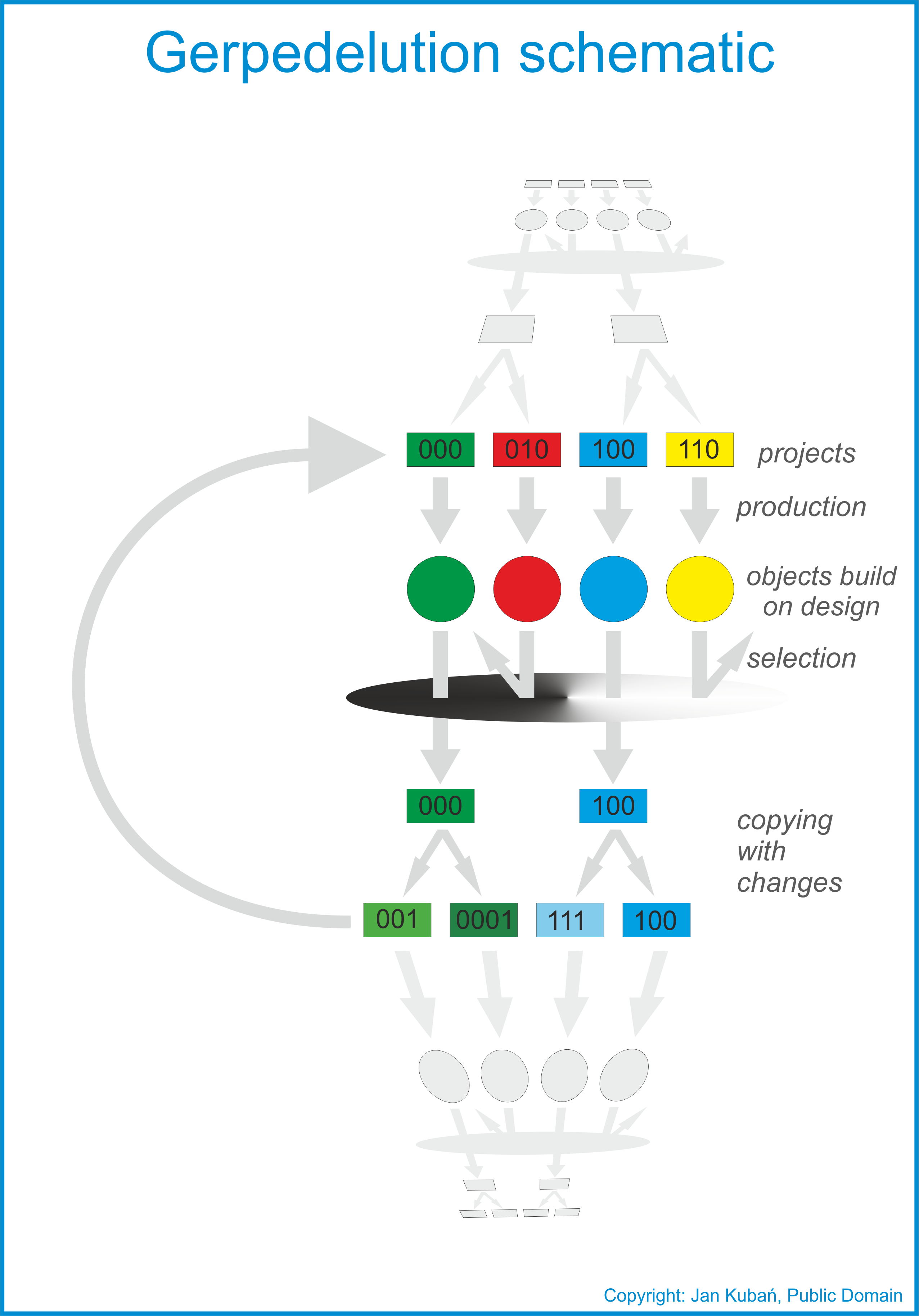
Full definition of gerpedelution.
Associated concepts:
Gibbs rule
♥ Definiens:
Nature's tendency to degrade the organized and to destroy the meaningful, the tendency for entropy to increase.
Remarks:

-
This rule was formulated by Norbert Wiener in his book "The Human Use Of Human Beings": In control and communication we are always fighting nature's tendency to degrade the organized and to destroy the meaningful; the tendency, as Gibbs has shown us, for entropy to increase.
-
It is interesting that this rule contradicts the process of emergence and development of life on Earth, described in detail by The Physics of Life.
Glubb cycle
♥ Definiens:
 John Glubb simultaneously studied the timelines of several empires throughout history and found that there were repetitive cycles throughout these empires. Empires are born, reach their peak, and then fall apart…
According to Glubb, the duration of the world's largest civilizations lasted on average for 10 generations, 250 years. These civilizations went through a process consisting of the following stages:
- The Age of Pioneers (outburst)
- The Age of Conquests
- The Age of Commerce
- The Age of Affluence
- The Age of Intellect
- The Age of Decadence.
Remarks:
-
Generation Characteristic behaviour Source of motivation Ideology, Religion Resources Age of Pioneers This generation is extremely motivated, wants to improve their material situation at all costs. Distinguished not only by victories in battles, but also by boundless enterprise in any field. Is ready to improvise and experiment, and draw immediate conclusions from defeats and setbacks. Not bound by tradition, is able to use everything that is available for their own purposes. If one method fails, they try something else. Strong sense of group belonging.
It is also the stage when leaders appear, a result of biological evolution. These leaders came from the fighters or strategists.
Members of this generation are very efficient in fulfilling pursuant processes.
The behaviour of the pioneers is characterized by incredible initiative and entrepreneurship, courage and boldness. These values cause that a formidable nation can rise from "barbarians", often quickly. Early victories are achieved mainly due to reckless courage and daring initiative.
Untrammelled by laws, traditions or textbooks [therefore, non-existant spate of messages], practical actions are applied as a method to solve any problem.
What motivates people the most is the hunger for resources.
This generation is vulnerable to any ideology that cements the hierarchy and legitimizes theft, looting and robbery, allows any atrocity towards outsiders and promotes sacrifice.
War is full of highly non-linear phenomena, and these are the initiators and constructors of religion.
This stage usually starts with a surplus in population and a lack of resources. These conditions are typical for biedocraticization, as well as creating a "lust to coerce" when fighting for resources. When an opportiunity to rob external territories arises, it leads to forced cooperation. So the resources are mainly acquired externally.
An attacked civilization defends itself using sophisticated weapons, military organization and discipline. However, the attackers quickly discover these qualities, appreciate them and adopt them. As a result, the second phase of expansion becomes more structured, disciplined and professional.
In other areas, the primary bold initiative is geographical exploration. For example, populating new countries, penetrating unknown forests, conquering wild mountains and sailing uncharted seas. This nation is confident and optimistic, and begins to treat those they have conquered as "decadent".
The methods employed tend to be practical and experimental, both in government and in warfare, for they are not tied by centuries of tradition [According to me, this is more a question of a spate of messages which block flexibility. - JF.], as happens in ancient empires. Moreover, the leaders are free to use their own improvisations, not having studied politics or tactics in schools or in textbooks.
Leaders are established and have already a strong power base, so they begin to create laws in order to ensure a long reign.
There is still a hunger for resources, but now they are at war and must hunger for intellectual development. To win in a pursuant manner, the invaders develop the skill of learning quickly.
Age of Commerce When the Age of Conquest is finishing, there is no way to become rich by conquering others. So it became obvious that people gained wealth and titles in a peaceful way. They did this by commerce and production. The invaders absorbed skills and technology of those they have conquered and created a business out of it. A good example of this is the colonisation of India by the British Empire. Money became more important than honour.
A consequence of this is the next period - The Age of Affluence.
The quest for glory has been replaced by the quest for money. Because the times were less physically dangerous, the highest earners were generally those who talked rather than produce or fight.
Age of Affluence The decline in courage, enterprise and a sense of duty is, however, gradual.
The first direction in which wealth injures the nation is a moral one. Money replaces honour and adventure as the objective of the best young men. Moreover, men do not normally seek to make money for their country or their community, but for themselves. Gradually, and almost imperceptibly, the Age of Affluence silences the voice of duty. The object of the young and the ambitious is no longer fame, honour or service, but cash.
Education undergoes the same gradual transformation. No longer do schools aim at producing brave patriots ready to serve their country.
Students no longer attend college to acquire learning and virtue, but to obtain those qualifications which will enable them to grow rich. The same situation is everywhere evident among us in the West today.
Money is in better supply than courage, subsidies instead of weapons are employed to buy off enemies. To justify this departure from ancient tradition, the human mind easily devises its own justification. Military readiness, or aggressiveness, is denounced as primitive and immoral. Civilised peoples are too proud to fight. The ability and the will to defend a nation gradually declines within the population.
The hunger for resources disappears and is replaced by the hunger for pleasure. Hedonism becomes the strongest motivator.
Age of Intellect The ambition of the young, once engaged in the pursuit of adventure and military glory, and then in the desire for the accumulation of wealth, now turns to the acquisition of academic honours.
However, although great discoveries are made which can benefit everybody, there is also a lot of inactivity.
Perhaps the most dangerous by-product of the Age of Intellect is the unconscious growth of the idea that the human brain can solve the problems of the world. Even on the low level of practical affairs this is patently untrue. Any small human activity, the local bowls club or the ladies’ luncheon club, requires for its survival a measure of self-sacrifice and service on the part of the members. In a wider national sphere, the survival of the nation depends basically on the loyalty and self-sacrifice of the citizens. The impression that the situation can be saved by mental cleverness, without unselfishness or human self-dedication, can only lead to collapse.
Another remarkable and unexpected symptom of national decline is the intensification of internal political hatreds.
One of the oft-repeated phenomena of great empires is the influx of foreigners to the capital city. These newcomers can constitute a weakness in many directions. First - they effect national policy. Second - they will be less loyal and protecting primarily their own interests in times of emergency and eventually they can turn against the host nation in order to dominate.
Hunger for titles and positions rather than real skills and knowledge. All about the theory rather than the practice.
Age of Decadence The people in power become accustomed to power. They become less productive yet give themselves substantial, but injustified, incerases in wages. They acquire more "toys" that they think they deserve. Those with power benevolantly try to meet all the needs of the people including healthcare, education and even payments for not working. All of this need money so those in power create (inflate) money, increase taxes, go into debt or have a war to boost the economy.
All of these lead to the eventual fall of the empire. As history shows, the fall may occur in different ways.
One thinks that they should be paid what they perceive they deserve. One must have the material goods that highlight their perceived greatness.
Remarks:
-
Civilizations die from suicide, not by murder. – Arnold Joseph Toynbee (1889-1975)
Links:
- Link to John Glubb's book "The Fate of Empires and Search for Survival".
Associated concepts:
Goethe's model of society
Definiens:
Nothing is more disgusting than the majority: because it consists of a few powerful predecessors, of rogues who adapt themselves, of weak who assimilate themselves, and the masses who imitate without knowing what they want at all.
Johann Wolfgang von Goethe
The majority are demanding, envious, greedy, hateful and ruthless…
Associated concepts:
Group versus tyrant
Definiens:
A set of causative factors related to self-organization of society, for example against self-tenancy or for building of the civil society.
Associated concepts:
Groupism
Definiens:
Characteristic for individuals belonging to a given social group, both internal and external. Charakterystyczne dla jednostek należących do danej grupy społecznej zachowania, zarówno wewnętrzne, jak i zewnętrzne.
Groupism includes: Grupizm obejmuje:
- mechanisms of cooperation
- set of norms and standards
- value system
- way of using objects
- dress code
- biases
- vocabulary
- ceremonies and rituals
Associated concepts:
Hasek's Law
♥ Definiens:
- There has never been a situation where there is no situation.
- Something always happens.
Associated concepts:
HeKroGram
♥ Definiens:
The schematic showing the creation of new species by biological evolution based on two orthogonal directions: conflict and cooperation.
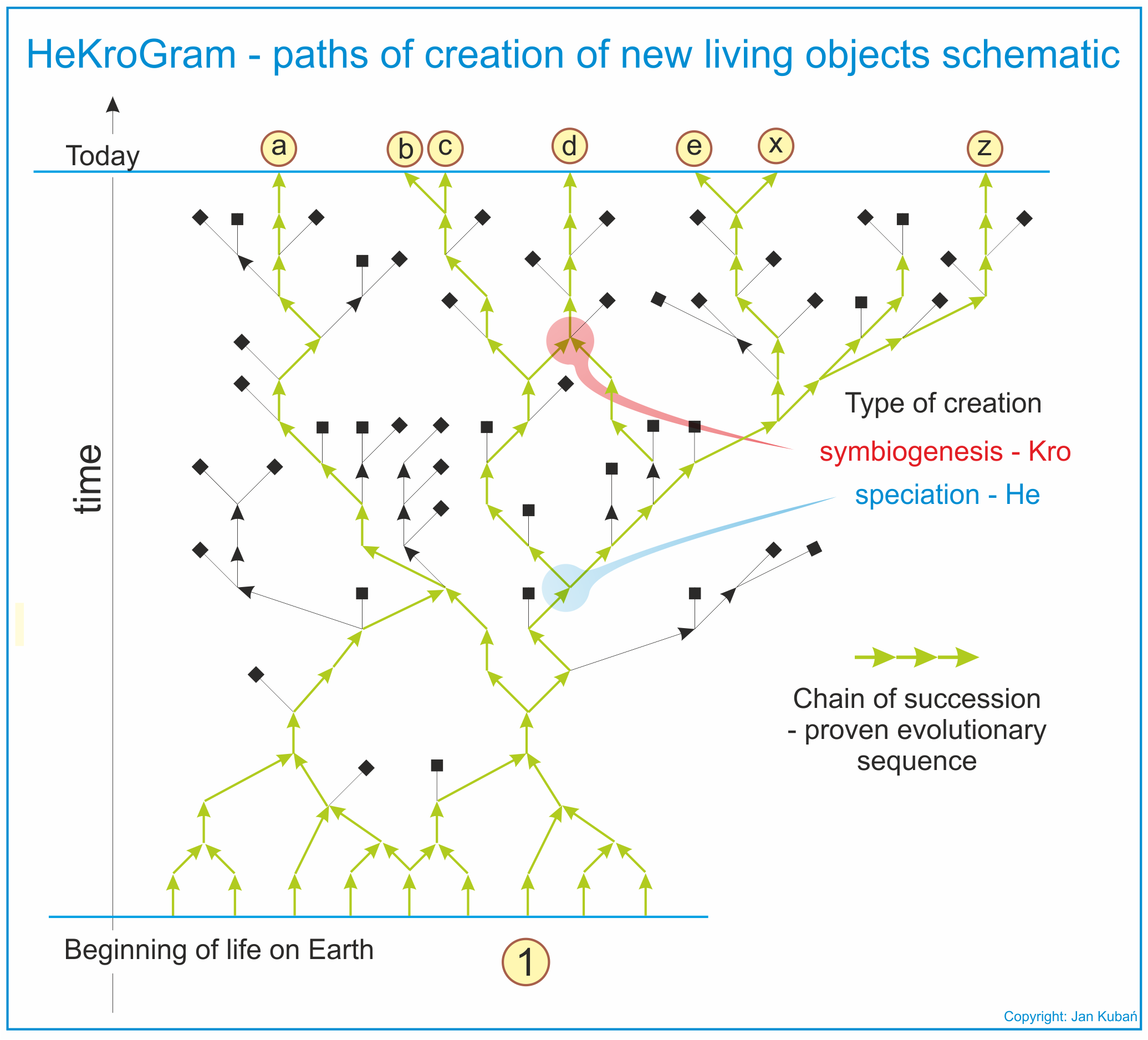
Remarks:
-
The nature of the CCR5-Δ32 sequence as a victory factor can be briefly described as “I have a special feature that others do not have”. This feature is a fragment of genetic information, on the basis of which specific white blood cells are built, constituting an impenetrable barrier for haemorrhagic plague.
Imagine now that we are dealing with living objects that are made of the same elements. Let one be a photosensitive particle and the other a particle transmitting an electrical signal. The first one, let’s call it a rod cell, when it receives light, produces an electric signal. The second one, let’s call it a neurone, is a kind of cable that transmits this signal further. Note that both of these elements can work independently or together.
The characteristics of these elements can differ. For example, one rod cell can produce a signal only when it is illuminated by 100 photons, and another by only 10. In turn, a neurone can transmit a signal faster or slower. A very important characteristic of each biological element is how many resources are needed for it to function – its cost.
A bird, whose eyes have more sensitive rod cells and faster transmitting neurones, will certainly have a better chance of survival and to have offspring. It is obvious, but how the rod cells are structurally ordered in the eye is also of great importance. If it allows you to see potential food from a greater distance, it also makes the goal of life easier to reach.
And here we come to the next conclusion: there are some victory factors whose characteristics can be described as “My elements cooperate better than yours”.
The aggregation of living objects is a natural process. The mathematical model of this phenomenon was developed in 1960 by Vernon E. Brock and Robert H. Riffenburgh. The researchers assumed that predatory fish were able to track and eat smaller fish only through an accidental encounter. Analysis of this model has shown that when the population of prey aggregate into larger and denser schools, the average distance between such schools is increasing. They are, therefore, less frequently distributed in space, and this reduces the probability of a randomly moving predator encountering such a school. When the predator does encounter a school, it is able to eat only a few fish. The size of the school must therefore exceed this value, and this provides most of its members with the opportunity to survive. Therefore, above a certain level, the increase in the size of the group leads to a statistical increase in the safety of its members.
When the distances between living objects, which are, as we remember, flow objects, decrease, eventually specialization and cooperation occur. This phenomenon explains the already discussed economic theory of comparative advantages.
Anglo-Saxon researchers emphasized the phenomenon of the struggle for existence, while Slavic researchers, in turn, pointed to examples of cooperation. And this is probably one of the most difficult issues of biological evolution to understand. One process which has two different, seemingly contradictory, directions of improvement: a path to improve mechanisms aimed at winning conflicts and a path to improve the mechanisms of strengthening cooperation. The proof of the direction of perfecting conflict is the emergence of more and more efficient tactics of structure and behaviour, aimed at a better absorption of resergy. The evidence for the direction of perfecting cooperation is that each person is a structure of perfectly cooperating cells. There is also a little-known phenomenon of symbiogenesis, that is, the emergence of new species of living objects through the gradual symbiotic integration of living objects of differing species over time.
Each eukaryotic cell contains mitochondria, which have their own DNA, resembling bacterial DNA. This encodes only part of the proteins necessary for the functioning of the mitochondrion, the others are encoded by the cell’s DNA. The American biologist Lynn Margulis developed a theory that eukaryotic cells were created as a result of the cooperation of different types of bacteria. Cooperation, which through the process of biological evolution, has been tightened to the point that mitochondria, which used to be independent bacteria, became organelles, largely dependent on the DNA of the cells they are in. The process of tightening cooperation by absorbing an equivalent element which becomes mutually dependent is called endosymbiosis.
The HeKroGram schematic shows the creation of new species by biological evolution based on two orthogonal directions: conflict and cooperation.
A contest between two teams is a very good model of the game for resources between two living objects. Every living object, like a hockey team, is a set of cooperating elements. In the case of multicellular objects, the cooperating elements are cells, and in the case of bacteria, that are single-cell objects, the elements of its cell. To win, the hockey players must improve their attacking and defensive tactics and tactics of cooperation among themselves. The process of biological evolution works in a similar way – it allows only the objects who better acquire resources, better protect them and use them more efficiently to multiply.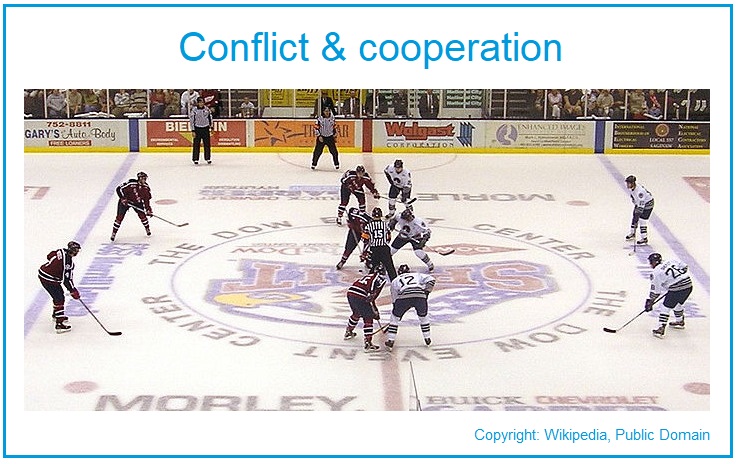
Two opposing teams of competitors act as a model
of the game for resources between two living objects[Source: "The 59 keys for understanding the beginning of life", page 101]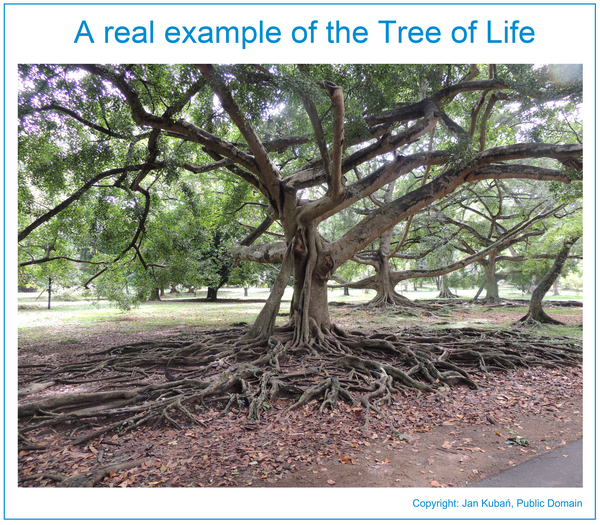
The roots and branches of this tree. in a more adequate way. illustrate the pathway of the development of life on Earth than considering only speciation, the Darwinian tree of life.
Hierarchy of needs
♥ Definiens:
In psychology - the sequence of the most basic needs (resulting from bodily functions) to the needs of a higher level, which activates only after satisfying the needs of the lower level.

How Life Is Competing model
♥ Definiens:
One of the Cognitive models of The Physics of Life, which serves to analyse the combat of two sets of different types of living objects, type A and type B.
Assumptions:
-
Population: Set of objects type A has Na members, and a set of type B objects has Nb;
-
Area: Both sets are placed into an enclosed area with surface S and shape K (combat takes place in a two-dimensional space, but can also go into spaces with more dimensions)
-
Movement ability: Objects move randomly. For example: type A objects move in the way Θa, and type B objects in the way Θb.
Θ must describe the speed of movement (eg.: constant with the value Va and Vb respectively, what happens when the trajectories of objects of the same type cross, and the way the object rebounds from the edge of the area. -
Combat: the combat takes place when two opposite types of objects are no further than Δs. The result of the combat may be achieved instantly or after Δw time;
if the combat is extended, more combatants may enter the fray. There may be more type A or more type B objects. All will mutually weaken, but it should be defined. -
Life energy: The ability of an object to act, expressed in points. Initially, each of the objects has a starting life energy of Φ, for example 100.
-
Destructive power: When a type A object encounters a type B object it weakens its life energy by a certain amount ηa expressed in points up to 100. A type B object also weakens a type A object by ηb points.
Example: after the combat, the life energy of A is Φa-ηb, and B - Φb-ηa -
Mortality criterium: an object dies when its life energy is 0 or less.
-
Fertility: Objects of type A multiply into Xa analogous objects of type A with a life energy of Φa after the time ΔTa and on the condition that their life energy is greater than Ψa, and the type B objects after ΔTb period and on the condition that their life energy is greater than Ψb into Xb progeny.
All the above elements in bold are the parameters of this model. One can change them and observe how this change affects the result of the simulation.
How Life Is Competing model is a simulation where two sets of living objects try to destroy each other. The curves characterize the numerical status of both populations and their respective total firepower. The simulation ends when one of the populations dies.
Remarks:
-
Parameters describing one individual are: the way of moving (Θ), Initial life energy (Φ), Destructive power(η), Fertility understood as: how many offspring (X) a living object may have compared to how often it progenates - quantum of time(ΔT)
Population parameters: number (N),
External conditions: Area (S,K),
Associated concepts:
How Life Is Competing and Evolving model
♥ Definiens:
Analogous model to the How Life Is Competing model with one more added assumption:
-
One Type A object, after being duplicated N times, undergoes mutation, as does a Type B object after M duplications. The mutation should be understood as a change to a slightly better or slightly worse version of one of the parameters attributed to a given individual.
Associated concepts:
Hoyle's Paradox
♥ Description:
The Physics of Life can not help but comment on the often-cited speculation regarding the probability of the emergence of life, such as, for example, described by F. Hoyle (1915-2001) and NC Wickramasinghe (1939-) in Evolution from space:
Proteins, necessary for life, are built of very complex molecules. What is the probability of an accidental creation of even quite simple protein molecules in the primordial soup? Evolutionists acknowledge that this probability is 1 in 10 to the power of 113 (1 in 10113). Meanwhile, mathematicians state that an event, which the probability of occurrence is lower than 1 in 1050 WILL NEVER HAPPEN. One can be convinced about the unprobability of such an event knowing that the number 10113 is greater than the estimated number of all atoms in the universe. Some proteins serve as building blocks and the others for the enzymes. The latter speeds up chemical reactions in the cell, without which it would die. To operate this process, it needs not a few, but up to 2000 different protein enzymes. What is the probability of an accidental origin of such proteins? It is one in 1040 000! "It is such an extremely small probability," says Hoyle, "that such an event would have been unthinkable even if the whole universe consisted of the primordial soup." Then he adds: "Even though one's belief or education, without prejudice, allowed him to accede to the notion that life arose on Earth [spontaneously], this simple calculation totally negates the concept."
It doesn't negate anything! Indeed, the calculated likelihood of such a protein is extremely small, but the assumption that each particle combination is equally likely is wrong. That is the first thing. Second, the process of evolutionary improvement is not a linear process, it has its accelerator characteristics (like the exponential or logarithmic), which in our terrestrial, sufficiently stable, conditions quickly (e.g. "only" a few billion years) brought into existence, and still shapes, not only proteins but also plants, animals and humans. The process of evolutionary improvement acts on all living objects and is not subject to discussion. However, that life arose on Earth or was accidentally brought here by a cellestial collision is not important for us. To reiterate: the mechanism of life seeks for an opportunity for an improvement over a long time, the solution is found by chance and quickly perfected. As we will show, life from outer space is much less probable than its emergence here on Earth and on any other, Earth-like, heavenly body.
To embarrass the quoted professors from the University of Cardiff, who have stated that the likelihood of the emergence of life on Earth is "a totally negated concept", let us respond to their simple calculation with an equally simple calculation of our own. Let us calculate the number of bacterium there would be in four and a half billion years, assuming that they reproduce once a day. [Replication of the elements within the cell runs a lot faster: DNA replication proceeds at a speed of one thousand nucleotides per second! Therefore, assuming that the rate of replication is, for example, one second, from one single replicator, after two days there would be 1052016 copies. It seems that the cited professors did not consider this phenomenon in their calculations. However the fastest cellular organisms reproduce approximately every 20-25 minutes in favorable conditions.] So, the first day there are two, the next - four, the third eight, and so on. The general formula is known even by schoolchildren: where n equals the number of days, their number should amount to 2n. So how many of them should there be, lets say after 1 642 500 000 000 days (equivalent to 4.5 billion years times 365 days)? The answer should amaze and give food for thought: 10500 000 000 000! It makes the "extremely small probability" (1040 000 to remind you) shown by the quoted professors pale into insignificance. Our simple calculation shows that with such a rate of reproduction (remember - one division per day, and the bacteria under favorable conditions - when all the necessary resources are available - can multiply up to seventy times faster) nature has 10500 000 000 000 trials to build "a totally random" chain of particles, such us human DNA. So, gentlemen professors, you calculated your probability wrong! We came to our results assuming total randomness of the event, but biological evolution has a powerful booster in the form of natural selection! To realize the speed of this process we need to do another calculation.
The average weight of a single bacteria is estimated to be about 1*10-12 of a gram, and the mass of the Earth is 6*1027 grams. A simple calculation shows that only 133 divisions are required, from one bacteria, to found a colony in excess of the mass of the Earth! Obviously this is not possible because the Earth does not have as many free resources as required. Let's imagine that we have a great tissue culture with the volume of Lake Baikal - the lake with the most volume in the world. In this arena, only 100 divisions are required to force bacterium to "struggle for existence". It could happen in less than two days.
Associated concepts:
"I/group" dilemma
♥ Definiens:
A key dilemma for game theory which refers to societies. Particular interests of individuals and social groups are so strong that all members of society are not able to behave pro-socially. Most profitable for the individual is to act selfishly when the rest of the society acts unselfishly.
The orthogonality of the I/group is reflected in the fact that the enrichment of individuals impoverishes society in which they operate.
In most cases, the so-called "life payout tables" are naturally arranged so that the selfishness of individuals causes (total) loss in society i.e. even those individuals lose in the long-term, and this is due to the impoverishment of society. For example, the holdings of the leaders of the communist countries of Eastern Europe at the end of the twentieth century was lower than the average citizen in the Western European countries such as Germany, England and France.
Remarks:
-
The description of this dilemma by Rafal A. Ziemkiewicz: Free market - the essence of the problem is that it is beneficial to the public as a whole, but unnecessary to anyone or any social group, unless both think about their own business. The free market is the best way to ensure the development of a civilization, providing prosperity and increasing the quality of life. But from the point of view of each individual: the worker, the farmer, the politician, and above all, the governmental clerk, it is convenient to spoil the free market, by receiving a governmental grant or by paying less due to social aid instead of producing and negotiating prices. Contrary to the stereotype, it is also convenient for the entrepreneur. The more he prospers, the less he likes that someone competes against him, forcing him to continuously strive for lower prices and higher quality, and may even make him a pauper. Everyone, including the rich man, wants to feel safe. So it is likely that he accepts the safety given to him by a brotherhood with power and getting sponsorship in return which guarantees that he will maintain his high position. As a matter of fact, amongst the supporters of the free market, are those that are enriching themselves and climbing up the social ladder. But this support only lasts while they are successful.
I sometimes think that the rearranging of this social Rubik's Cube (acceptance by the will of the majority of what is good for everybody, but it is bad for each individual or group) is a kind of maturity test, provided to us by fate or, if you will, some cosmic being, which we are failing at the moment. [Rafał A. Ziemkiewicz, "In brief"]
It's not a cosmic being, but pure Physics of Life. The natural tendency of social systems is to continuously oscillate. These oscillations are caused by this and other dilemmas.
-
Tragedy of the commons: discusses the concept of a microeconomic social trap in which the self-interest of one or more of the people in the community leads to a loss for the community as a whole. The concept leads to the conclusion that unrestricted access to limited public goods - such as pasture - leads to their overexploitation.
-
The selection takes place on several levels. On the one hand, we have a classic selection in the Darwinian sense, in which individuals compete with each other. But other than that, individuals form groups that compete with each other as teams. (…) This is absolutely fundamental(…) Homo sapiens was shaped by the interaction between individual and group selection, with individual selection responsible for most of what we call "sin" and group selection for most "virtues". We are in constant conflict between dedication to community and selfishness and the struggle for our own benefits. - Edward O. Wilson
Associated concepts:
Quotes from literature: in Polish or Google English from Polish
- associated with I/Group dilemma
Ideology
♥ Definiens:
Ideology is a collection of beliefs held by an individual or a social group. It can be described as a set of conscious and unconscious ideas which make up one's behaviours, goals, expectations, and motivations.
Remarks:
-
The one who believes in something, even if it is false, is still in front of the one who does not believe in anything. - A. Hitler.
Inflation
♥ Definiens:
To increase the size or value of something artificially, like adding tin to gold coins to reduce cost and keep value
Latin. inflatio - inflate
Full definition of inflation
Remarks:
-
In 1984-85 - the currency of Bolivia, which was then experiencing a period of hyperinflation, lost 23 454% of its worth,
and Nicaragua, within 58 months of hyperinflation raging there from 1986 to 1991, 13 109%.
Meanwhile, in Venezuela, inflation has already reached 980 000% in the last 12 months.
Links:
-
Avoid the Fiscal Cliff - Economic Freedom Speech - Pierre Poilievre
-
Milton Friedman - Understanding Inflation 71 017 views up to 2016.03.12 and 222 465 views up to 2018.06.12
11.51 - The truth is that inflation is created in one single place - in the national money-printing houses. -
Milton Friedman - The Nature Of Inflation 23 355 views up to 2016.03.12
2.25 - inflation is always and everywhere the result of too much money. And only the government decides how much money there is on the market -
Nicolaus Copernicus quote about the spoiling of money
Though innumerable defeats, as a result of which kingdoms, duchies and republics fall down in plain sight, according to my opinion, four have the biggest impact: discord, mortality, infertility of the earth and depletion of the coin. The first three are so obvious that no one denies them, but the fourth, concerning the coin, is recognized only by a few, and those with deeper wondering because it affects the failure of the state not immediately and violently, but slowly and secretly.

Associated concepts:
Quotes from literature: in Polish or Google English from Polish
- associated with Inflation
Information
♥ Definiens:
(Interpreted) sequence (or structure) of states.
More about the concept of
Other definientia:
-
Information, in its most restricted technical sense, is an ordered sequence of symbols. [Wikipedia-eng, State 2014.03.16. On 2019.09.15 this record was not available on Wikipedia]
-
Information, in its most restricted technical sense, is an ordered sequence of symbols that can be interpreted… [Wikipedia-eng, State 2019.09.15]
Remarks:
-
Information may arise spontaneously in a natural way.
-
The word "interpreted" was deliberately included in brackets, because a sequence of states is (potential) information, and the (potential) information only becomes (appropriate) information only when it is interpreted.
Informative replicator
♥ Definiens:
RPD-type objects, which not only absorb resources and split, but also constitute information.
Remarks:
Associated concepts:
Initiators
♥ Definiens:
Factors bringing an object into existence.
Remarks:
-
In other words: a triggering stimulus
-
Initiators of the object "fence" include: demand, threat, safety, decision, aesthetics.
Associated concepts:
Intelligence
♥ Definiens:
It is a measure of the efficiency of the accomplishment of pursuance.
Other definientia:
-
Intelligence is what you use when you do not know what to do. - Jean Piaget, a Swiss biologist and psychologist.
-
General intelligence is the ability to adapt to new conditions and to perform new tasks by the use of thinking. - William Stern, a German psychologist and philosopher.
-
Intelligence is the ability to quickly find appropriate solutions in a situation that seems (to observers) to require an enormous research effort. - Douglas Lenat, Edward Feigenbaum, researchers dealing with artificial intelligence.
-
Intelligence is the ability to optimize the use of scarce resources - including time - to achieve profits. - Raymond Kurzweil, inventor and futurist.
-
Ability to achieve real results.
Quotes from literature: in Polish or Google English from Polish
- associated with Intelligence
Iterated cooperation dilemma
♥ Definiens:
A key model in mathematical game theory to illustrate that the trust and cooperational behaviours of the members of a group are essential to guarantee the survival of the group.
Iterated cooperation dilemma occurs when two players play consecutive prisoner's dilemma games and change their strategy according to the previous actions of their opponent. The fundamental conditon of this game lies in that both players must stay alive, which means that they cannot have zero points or less.
Associated concepts:
Iterated prisoner's dilemma
♥ Definiens:
A key cognitive model in mathematical game theory to illustrate the dependency of economical development of the group on the trust and cooperational behaviours of its members.
Iterated prisoner's dilemma occurs when two players play consecutive prisoner's dilemma game and change their strategy according to the previous actions of their opponent.
Full description of "Iterated prisoners dilemma"
Associated concepts:
Jones' experiment
♥ Definiens:
One of the most important sociological experiments for The Physics of Life, showing that a group of young ordinary people can be programmed to hold extreme views and behaviour (fascist) within only five days.
Ron Jones, a history teacher in an American high school, explained how the German population could accept the actions of the Nazi regime during the Second World War. During his "Contemporary World History" class, Jones found it difficult to explain how the German people could accept the actions of the Nazis, and decided to create a social movement as a demonstration of the appeal of fascism. Over the course of five days, Jones conducted a series of exercises in his classroom emphasizing discipline and community, intended to model certain characteristics of the Nazi movement.
[Wikipedia 2015.05.12]
This experiment shows how easy it is to transform a group of ordinary teenagers into extreme fascists using simple methods, in only five days.
Description of the experiment made by Ron Jones.
Links:
- http://www.thewavehome.com/ - the website devoted to this experiment.
- A documentary about the whole process
- The Wave - Israeli Educational Television.
- A direct description of Ron Jones' experiment made by Ron Jones himself.
- Ron Jones talks about The Third Wave, Fascism, Ukraine and relationship with Russia 2017.08.13
Associated concepts:
Journalists
Definiens:
 A journalist is a person who collects, edits and spreads news and information.
Journalists, like any other professional group, behave in their own characteristic way. There are also certain stereotypes associated with them.
Remarks:
-
The power of persuasion:
Savonarola developed a violent, harassing and threatening style of preaching, and this further attracted crowds who began to follow his recommendations, e.g. women changed to more modest clothes and the rich gave back the money they had shelled out.
[Wikipedia pol. 2020.02.15] -
In 1880, John Swinton, a New York journalist, was the guest of honour at a banquet given by leaders of the media craft. When one of the attendees proposed a toast to the independent press, Swinton delivered the following "thoughtcrime" speech:
There is no such thing, at this date of the world's history, in America, as an independent press. You know it and I know it. There is not one of you who dares to write your honest opinions, and if you did, you know beforehand that it would never appear in print. I am paid weekly for keeping my honest opinion out of the paper I am connected with. Others of you are paid similar salaries for similar things, and any of you who would be so foolish as to write honest opinions would be out on the streets looking for another job. If I allowed my honest opinions to appear in one issue of my paper, before twenty-four hours my occupation would be gone. The business of the journalists is to destroy the truth, to lie outright, to pervert, to vilify, to fawn at the feet of mammon, and to sell his country and his race for his daily bread. You know it and I know it, and what folly is this, toasting an independent press? We are the tools and vassals of rich men behind the scenes. We are the jumping jacks, they pull the strings and we dance. Our talents, our possibilities and our lives are all the property of other men. We are intellectual prostitutes.
Associated concepts:
- Professional groups' features
- First Law of The Physics of Life
- Professions' macroscope
- Journalists'_macroscope
Quotes from literature (in Polish):
- on the concept of Journalists
Diary:
Journalists macroscope
Definiens:
The journalists macroscope is the professions macroscope of journalists and the professional group they constitute.
In other words, the macroscope of journalistic incompetence, arrogance and, at the same time, enormous influence.
-
Profile of people employed/working as journalists
- Mainly, so-called, humanistic education - i.e. lack of logical reasoning
- There are very few people who studied technical studies
- There are hardly any people with management practice
- There are no practitioners in the field of the management of financially self-sustaining systems, i.e. selling goods produced on a voluntary basis to consumers and generating a profit. In short, real enterprises = free-market enterprises, benefiting from neither subsidies nor bailouts.
- Dependent journalists. e.g.: W. Duranty, W. Falska
- Fairly independent journalists: G. Orwell, G. Jones
- The less someone knows, the more chance they will have to become a journalist, 2, 3, their education is not always the best, 5
To sum up: the over-representation of ill-educated people who have no idea about economics, managing people or a real business, and who speak on these subjects in a public forum, thereby conveying their opinions to the masses.
-
Motivant of a journalist
- Earn
- Be popular
- To be recognised
- To be rewarded
-
Motivant of a media centre
- Earn
- Gather a wide audience
- Achieve what the funding body requires
- In the free market: to attract advertisers
- In the socialist-totalitarian gravitational field: to be favoured by those in power
-
Methods used by a journalist
- They select their interviewees (according to their own level)
- They sucking up to those who they should suck up to, 2
- They discredit those who they think should be discredited, 2, 3
- They standing for a thesis they have to support
- They refute claims that are able to be refuted
- They create absurd legends
- They hear what they want to hear
- They build a career on criticism
- They build a career on defamation, 2
- They create images, 2, 3
- Looking for an exact method, some universal recipe, that can always serve people
- They build widespread beliefs
- They foster passionate debates which do not lead to any conclusions, 2, 3, 4
- They hide behind higher ground, 2, 3
- They influence society
- They are vulnerable to corruption, 2, 3
- They have specialised journalistic areas of focus
- They select on the basis of their own perception, 2, 3
- They tell you what and how to think
- They have the power over the "microphone"
-
Methods used by the media centre
- Selection of journalists
- Selection of titles
- Methods of establishing credibility
- Remuneration of journalists
- Addictions of journalists
- Being a propaganda tube
- Giving people not what they want but what the media centre thinks they should get
- Chains of false quotations, 2, Mirror-image method, Levelling the hierarchy of importance
- Creation of rumours, 2
- Promoting affairs and scandals, 2, 3
- Inducing the desired response, 2
-
The external environment in which the journalist operates
- Remuneration of salaried employees
- Remuneration based on the number of impressions
- The so-called editorial ideological line
-
External conditions in which the media institution operates
-
Natural phenomena
Remarks:
-
A so-called "top journalist" who has been weaned off sponsorship cannot create a self-financing news portal.
-
By what criteria do so-called "top journalists" judge the qualifications of a new ambassador.
Associated concepts:
Key dilemma of management
Definiens:
Dilemma occurring in the management of a country. On the one hand, we do not want to hurt anyone, on the other, the driving force of progress is the selection of the best, and therefore rejecting (hurting) the worst (See Creative Destruction).
Description:
Once an acquaintance of mine, a director of a public hospital, complained that doctors were leaving to other hospitals, going to hospitals immersed in debt. I The doctor said that he does not want to put his own hospital in debt. Most people go where they are payed more, and they don't care whether the facility is in debt or not; they only want a higher salary - he added.
The key dilemma of management lies in deciding what to do with institutions that are so much in debt that there is no possibility that they are able to manage this debt themselves. The essence of this dilemma is illustrated in the table which represents the balance of losses and benefits, individually and socially, of both decisions:
| Order to keep the contract and pay off the debt | Clear the debt |
|---|---|
|
|
|
|
|
|
|
|
|
|
Remarks:
- In essence, this dilemma comes down to the key dilemma of biological evolution - dilemma of the proportion of losses.
Key dilemma of ruling
♥ Definiens:
When creating a government that gives one the power over another, there are two main problems: what kind of power and how much the government should have to be able to fairly run and control the society, and what kind of power and how much for the society to have a means of control over those in power to stop them abusing their position.
Remarks:
-
Among the best ordered and governed kingdoms of our times is France and in it are found many good institutions on which the liberty and security of the king depends. Of these, the first is the parliament and its authority. The person who founded the kingdom, knowing the ambition of the nobility and their boldness, considered that there needed to be a way to control them. On the other side, knowing the hatredof the people, founded in fear, against the nobles, he wished to protect the people. However, he did not want this to be the particular responsibility of the king. Therefore, to take away the criticism which the king would face from the nobles for favouring the people and from the people for favouring the nobles, he set up the parliament which would be one who could beat down the great and favour the lesser without the king being blamed. You could not have a better or more effective arrangement, or a greater source of security to the king and kingdom.
- Niccolò Machiavelli (1469-1527), "The Prince", Chapter 19. -
This dilemma was also formulated by James Madison (1751-1836), one of the authors of the constitution of the United States:
“If men were angels, no government would be necessary. If angels were to govern men, neither external nor internal controls on government would be necessary. In framing a government which is to be administered by men over men, the great difficulty lies in this: you must first enable the government to control the governed; and in the next place oblige it to control itself. A dependence on the people is, no doubt, the primary control on the government; but experience has taught mankind the necessity of auxiliary precautions.” -
If the Constitution and the awareness of the citizens do not provide this balance, it contributes to the development of tyranny.
-
Governance, then, is an example of an orthogonal phenomena.
-
Another description of this dilemma:
[…] it is an attempt to answer the question of how to manage relations between the state and the individual, so that the state does not devour human freedom, for which it always has an undaunted appetite. On the other hand - that human wilfulness does not destroy the state - because it is also needed.
[…]
mutual recognition of freedom required to refrain from offending the others. This offence I call willfulness.[St. Michalkiewicz, "Freedom and willfulness", Najwyższy Czas 9/2011, str. XLV]
Quotes from literature: in Polish or Google English from Polish
- associated with Key dilemma of ruling
Law of bad governance
Definiens:
Those in power who use the following methods are leading the country to economic downfall and civilizational collapse:
- Centralization of power: Limiting social participation in the governance
- Manual control: those in power are destroying the economy by interfering in the mechanisms of the free market
- Destroying institutions so that they cannot control the actions of those in power. Making institutions dependent on nepotism and employing people who are on a financial leash
- Institutional theft: Inflation - spoiling your own currency
- Institutional theft: Continued levies and/or tax increases
- Bad investments from social funds
- Actions leading to the destruction of social capital
- Compradorism: Making their own country dependent on foreigners - auto-colonialism
- Corruption of the authorities - a derivative of destroyed institutions
- Putting the country in debt
- Self-propaganda
- Restricting freedom of speech
- Pumping public money into various social projects, without mechanisms for their effective use and control. By giving a fish, not a fishing rod.
- Creation of state monopolies for the purpose of a/. creation of wage places and b/. sucking and pushing public money to those in power so that they can spend it outside the social control
Associated concepts:
Law of Comparative Advantage
♥ Definiens:
The Law of Comparative Advantage says that the set of flow objects, naturally develop specializations in production/consumption exchanges of resources, provided that there are relative differences in the cost of their production.
It is a natural tendency of such systems, which results from the fact that they are submitted to biological evolution. These differences in the cost production are the result of disturbances in duplication.
The third essential feature of biological evolution is due to the Law of Comparative Advantage.
Associated concepts:
Law of Concentration
♥ Definiens:
All matter in the Universe tends to concentrate, each astronomical object is a centre of concentration. Larger objects absorb smaller ones. The most concentrated matter is called a black hole. When concentrated matter reaches its certain critical value an explosion occurs, for example, The Big Bang.
The phenomenon caused by this law also occurs in Earthly conditions. Some chemical particles tend to concentrate (creating objects with a certain structure), and when they exceed certain limits, they break down. This phenomenon has been called the RPD-type phenomenon.
Associated concepts:
- Another definiendum of this law is called Duality of nature.
Law of dependency of life
♥ Definiens:
Features and behaviours of a living object are dependent on:
- external conditions,
- its species evolutionary history, and
- its own experiences.
Associated concepts:
Law of Social Rebellion
Definiens:
There is a certain threshold of existence above which society is unable to initiate a grassroots rebellion against the government
Associated concepts:
Law of universal gravitation towards socialism
Definiens:
The law according to which social systems, at some level of development, naturally tend towards socialism. It is due to the natural causative factors built into human beings by biological evolution.
-
We are born as consuming takers and a few evolve into producing makers
-
Most people do not want freedom because it implies responsiblity. Most people will pass governance to somebody else. This increases in crisis situations.
-
Suitable education is required to transform human beings into makers, if this is not provided, we stay as takers. But purely theoretical education not supported by pressure to acquire experiences in achieving goals and competing is not sufficient.
-
A taker accepts any kind of ideology which allows him to take from those who are richer or different
-
It is easy to convince a taker to such ideology by promising him: freedom from worries, freedom from exams at universities, freedom from work, freedom from competition, rewards without effort and a good salary.
-
A taker only thinks of what he can get and is unaware of those who are poorer than him
-
It is based on the Nature of an Honest Man and Ahamkara:
- we are lazy
- we overstate fear
- we prefer to listen to what pleases us: poor people deserve to get something for free = I deserve to get something for free
- we consider every rich person as a looter and never as a producer
- the red eye syndrome - greed
- Most of us are equipped with a mechanism of socialist hypocrisy, in which we proclaim slogans such as: "People must be helped", "People have to be respected", "People shoud be well rewarded". But in fact we neither help nor respect them, and when it comes to paying them we try to pay as little as possible. In fact, we demand that someone else does it, but we use these slogans to cover our true attitude that contradicts them.
-
Those who cannot or do not want to work are vulnerable to socialist ideology: young people, lazy people, the sick, the victims of fate.
-
Being in constant close contact with others in overpopulated areas and/or spate of messages, which cause a lack of social engagement.
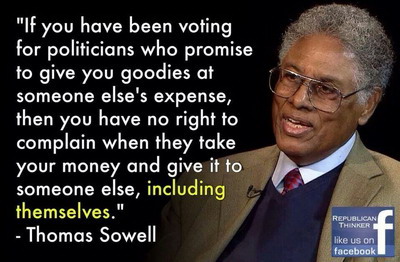
Remarks:
-
The definiendum of this law should be "Universal Human Gravity towards Socialism".
Associated concepts:
Laws of life
Definiens:
Laws which describe the relationships between chemical particles and living objects which are created from them.
-
The law of the formation of life - the terrestrial life processes which may have been initiated by chemical particles having the 5 fundamental properties of chemical particles to initiate biological evolution.
-
The law of improvement of life in subsequent generations - disturbances, selection, optimization of absorbtion of resources.
-
The law of the optimization of absorbtion of resources
-
The law of balancing of resources
-
The law of population's force
-
The law of reaction to external conditions
-
The rule of dependence
Laws of The Physics of Life
♥ Definiens:
-
The First Law of The Physics of Life - the law of shaping the tactics of behaviour and the tactics of structure by the source of resergy and external conditions.
-
The Second Law of The Physics of Life - the law of increasing the efficiency level of a body's given characteristic as a result of increasing its use, and in reverse, reducing its efficiency due to inactivity.
Associated concepts:
Leftist
♥ Definiens:
a man preaching general, indisputable, moral ideology, without making people aware and using the mechanism of Natural Pressure for Social Exploitation, in order to get their resources. Theoretically, distributing to the needy, but in practice he gives only what remains after taking his share, which he considers due to him. The Nature of an Honest Man causes that the Leftist takes as much as possible.
Remarks:
-
As Stefan Kisielewski (1911-1991) said: "Socialism is perfectly suitable for falsifying collective consciousness because it is the intellectual temptation for quasi-intellectuals". Democrats are mostly socialists, because it is a nice-sounding utopia that is caught up by these quasi-intellectuals, the majority of whom are in society. Socialists say what people want to hear, they are "pro-social", they give away almost everything, for everyone and "for free", which is why they are better received than the right-wing politicians who promise nothing, but induce people to work ("Windy" the rightists are!). Of course, before this free distribution, in more or less hidden form, they take money from people in the form of tax. They waste most of this money, they steal some, they build something for the rest and brag about how much they did to their constituents. Unfortunately, voters mostly catch these socialist promises, not understanding that nothing, ablolutely nothing, in this world is for free. In democracy, "everyone has equal stomachs", as some say, and therefore national goods are evenly divided. Thus, those who work hard, persistently and effectively are burdened with large taxes to satisfy the idle and the loafers. In this way pathologies arise, leading even to the imbalance of the role of the family in society. If work and its effects are punishable by high taxes and inactivity rewarded by unemployment benefits, a reversal of value occurs. Therefore, a mother with a child who lives in a civil partnership and does not marry, and one who is married fakes a divorce only to claim the benefits for single mothers. Democracy does not understand that "even" does not mean "fair" at all. This system degenerates the value of work, activity and creativity, raising a lazy and demanding society.
-
If someone is not able to produce anything that anyone else would like to buy, Leftism starts.
-
The test for a leftist is a penny widow - in fact, a balance sheet, in which it does not count how much someone gave, but what value the donation was for him.
-
It is a person who goes from milking from the mother when young to milking society as an adult.
Quotes:
-
None of the people shouting "Welcome refugees" has prepared their own home or tents in their own garden to welcome even a few of them. – Dietrich Mateschitz, co-founder of the Red Bull energy drink company.
-
…generally: lazy inside and a dodger, usually riding on somebody's achievements and work. This is a core principle.
-
When, in 1995, the Adam Smith Centre investigated the amount of confiscation of the income of a family of non-agricultural workers, it turned out that the government confiscates as much as 83% of such a families income. Then it gives back some of the confiscated money in the form of so-called socialist collective consumption, i.e. - state medical, educational or social services. But - as researched in the US by Prof. Walter Williams and as Jacob Goldsmith says in the book "Trap" - only 28% of funds allocated to the "poor" under social programmes launched in 1965 by President Johnson, indeed, went to the poor - and 72% were intercepted by bureaucratic apparatuses that administered these programmes and grew all the time - just like in our National Health Fund or other institutions favouring us.
Because our bureaucracy is no better than the American one, it probably wastes more than 72% on its own needs. Some of this funding is used to corrupt the media, which keeps poor, naive people in the belief that if the state did not take 83% of their income from them, everyone would die on the streets. Because of naivety, and probably dullness, these people cannot understand that they are currently financing, from their own money, not only all the benefits that the state gives them, but also a growing army of bureaucrats who, after all, also eat. If these bureaucrats were not there, it would be much cheaper to pay for the same benefits. For example, for a medical service, the taxpayer pays $100. Of this $100, the bureaucracy takes $72, while direct contractors get $28. So, if the privatization of the healthcare sector, that is - if the money went TO THE PATIENT, and not somewhere else unknown, even if hospitals, doctors and nurses demand twice as much, it would be only $56, not $100!
[St. Michalkiewicz. "Column for normal people" - translated into English] -
Let us not be fooled by their generosity from our pockets and at the cost of our personal security. - Margaret Todd
Associated concepts:
Quotes from literature: in Polish or Google English from Polish
- associated with Leftism
Life
Definitions:
Defined 2018.04.16
Life is a never-ending competition of a set of replicating information carriers, absorbing the external resources necessary to build themselves and their protective systems up, and for reproduction.
The set of replicating information carriers that have triggered a process of biological evolution which, in turn, brings changes to the information stored within these carriers and, in certain conditions, selects the most favourable changes from the point of view of absorbing resources, building its protective systems and reproduction. These are then passed on to further replications and adverse changes, like in a competition, are rejected.
[Definition developed after writing the content of the book "59 keys for understanding the beginning of life"]
Defined on 2015.05.23
Life is a never-ending competition between units of information, which actively absorb the external components necessary to build themselves and multiply. The set of units of information which triggered the process of biological evolution, and this process changes the subsequent generations of theses units.
[I named this definition "Saint John/Dawkins definition of life", the former spoke of information from nothing (which became flesh), the latter talked about selfish information.]
Defined on 2015.03.07
Life is a side product (a result) of a tangle of an unimaginably large number of processes, not necessarily nice and pleasant for humans, generated by the RPD phenomenon.
Defined on 2015.03.06
Life is a game for acquiring resources led by self-replicating objects. [Note, this definition applies to objects that are traditionally considered to be alive. There is a high probability that self-replicating computer viruses or other self-replicating alien objects undergo a process similar to biological evolution. It will probably fulfill the conditions of this definition, but would compete (play) for different kinds of resources than liposomes, nucleotides and amino acids. Then this kind of "life" would need to be clarified using different adjectives. If it happens, our life would have to be termed as "terrestrial life".]
The simplest self-replicating objects are RPD-type chemical particles, which we know as: liposomes (spherical membrane built with free phospholipids), RNA (linear, unbranched polymers of nucleotides built with deoxyribose) and DNA (linear, unbranched polymers built with ribose nucleotides). These particles, playing for resources, which are needed for them to (re)build, generate the process of biological evolution on the principle of self-excitation. The basic model of this process is gerpedelution, which consists of three cyclically repeating, consecutive, stages of: building of objects, selection of objects and the duplication, with possible alterations, of the designs of selected objects. Biological evolution, with the (living) objects submitted to it, constitute an autodynamic system. In short, a system that changes features of the objects submitted to it, and these, in turn, change the features of the process itself.
Self-replicating objects need resources to build themselves, and because they replicate, sooner or later, the resources will start to run out and the objects will be forced to operate in an environment of limited resources. Their strategy is to acquire the necessary resources to build themselves. They use two main tactics within this strategy: tactics of structure - better acquisition of resources is possible due to the placement of elements; and tactics of behaviour - better acquisition of resources is possible due to given actions and reactions. If the selection is strong enough, only the objects absorbing resources in an optimal way can pass through. It means that biological evolution becomes a process of perfecting both of these tactics only when there is strong selection. Because the game has a lot of objects competing for the same resources at the same time, this improvement is carried out simultaneously in two orthogonal (perpendicular) directions: better at winning conflict situations and/or better collaborating. And this means that biological evolution transforms RPD-type chemical particles, in its subsequent generations, into the following organizational levels: see Organizational levels of living objects.
Defined on 2009.12.14
it is a feature of a set of synthesizing replicators absorbing external resources to (re)build themselves by assembling and placing its elements based on the information contained within them, until division. This behaviour of synthesizing replicators generates the process of biological evolution, which in turn, shapes subsequent generations of synthesizing replicators.
A bit wider:
Synthetising replicators (which are RPD-type objects) together with biological evolution (the basic model of which is gerpedelution) constitute an autodynamic system which constantly changes subsequent generations of synthetising replicators, changing them into living objects.
According to the Principles of The Physics of Life the dynamics of intergenerational changes in tactics of structure (how one is built) and tactics of behaviour (how one behaves) of living objects results from the influence of two characteristic components of biological evolution: aggregation of cooperation and escalation of conflict. These intergenerational changes have resulted in:
-
5 distinguishable Organizational levels of living objects
-
that most advanced living objects pursue the life purpose in a pursuant way. In other words they are Self-reliant pursuant objects.
Problems with the definition of life:
The process of biological evolution is crucial to understanding and defining life. This process, which was initiated by replicators, not only created living objects but is still shaping them. This process was triggered by informative replicators and, cooperating with them, non-informative replicators, such as phospholipid memebranes.
One of the characteristics of biological evolution is, apart from aggregation of cooperation and conflict escalation, the production of novelty due to disturbances of information replication . It is most likely that protein synthesizing replicators emerged as a result of such novelty production and aggregation of cooperation.
And now the key philosophical question: since when can we say that a given object made of chemical particles is biological - that is, when did it become alive? If, at the dawn of biological evolution RNA and DNA particles, replicating in the primordial soup, should be considered as living objects. The same can be said about viruses, which are considered, by some, not to be living objects. However, if we consider the turning point being the emergence of synthesizing replicators, then RNA, DNA and viruses cannot be considered as alive.
Therefore, everything in the definition of life depends on our decision. However, the process of biological evolution, from its very beginning, remains the key issue.
Other definientia:
I quote some of the Wikipedia definitons of this concept which, however, are not logically correct, because the definiendum is defined by the definiendum itself (the logical error idem per idem):
-
Life is a characteristic that distinguishes physical entities that have biological processes, such as signaling and self-sustaining processes, from those that do not, either because such functions have ceased (they have died), or because they never had such functions and are classified as inanimate. Various forms of life exist, such as plants, animals, fungi, protists, archaea, and bacteria. The criteria can at times be ambiguous and may or may not define viruses, viroids, or potential synthetic life as "living". Biology is the science concerned with the study of life. [State 2020.01.14]
-
property of certain physical systems (so-called organisms) in which life processes take place [State 2012.02]
Remarks:
-
The Physics of Life deals with the creation and analysis of cognitive and predictive models related to life.
Lifecycle of a human
♥ Definiens:
Division of human life into stages characterized by a given motivation and given tactics of behaviour. From the perspective of the balance of resergy, the most fundamental division for The Physics of Life is as follows:
Consumer's period - childhood
Producer's period - optional (see Atlases/Looters)
Consumer's period - old age
From a practical point of view, the best seems to be the Human Life Cycle represented in a Buddhist temple in Sri Lanka::


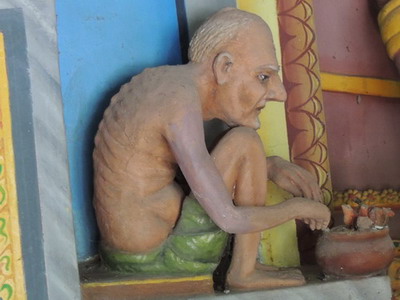
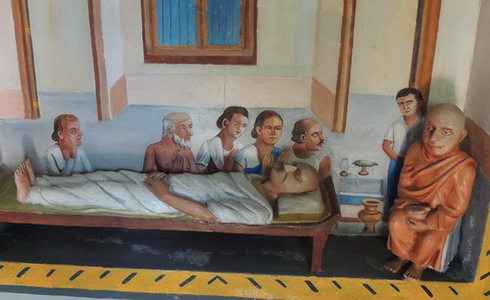
Other definientia:
- The lifecycle of humans is distinguished by the following periods of development:
- embryonic period,
- fetal period,
- neonatal period,
- period of infancy,
- toddler period,
- childhood,
- puberty,
- maturity period,
- middle age,
- old age
Remarks:
-
In The Physics of Life, the most important criterion for classification is the reference to social resergy. Each of us is always a consumer of individual resergy.
-
Depending on the length of life and the environmental conditions, it may be that a person skips producer's period or will not live to the consumer's old age period.
Links:
- The Twelve Stages of the Human Life Cycle
- "The Life Cycle" by Ken Wilber: http://www.kheper.net/topics/Wilber/Wilber_II.html
Quotes from literature: in Polish or Google English from Polish
- associated with Lifecycle of a human
Lifespan of an object - LOAO
♥ Definiens:
The period of time between when an object begins to fulfill the criteria of objectivity to the point where it ceases to do this.
Remarks:
-
Time elapsed since the creation (initiation) of the object until it transforms so much that it is no longer an object (termination).
-
The measure of permanence of an object.
Life purpose
♥ Definiens:
Primary: Absorb until division;
Secondary*: Survive and multiply
Remarks:
- * - "Secondary" means "Primary transformed by biological evolution"
-
In general, the term "life purpose" is not logically correct, it is more appropriate to talk about the purpose of living objects or the natural tendency of biological evolution.
Associated concepts:
Life thinking
♥ The full definition of the concept of Life thinking is on a separate subpage.
Associated concepts:
Living object
♥ Definiens:
is a flow system (object) of a set of synthesizing replicators interacting with each other belonging to a chain of information succession.
The current form of living objects is formed by the process of biological evolution, which is spontaneously initiated in any space where there is a Duality of Nature.
There are several organizational levels of living objects.
There are 5 fundamental properties of living object:
- it absorbs external resources to build itself
- it multiplies
- it builds itself and its properties on the basis of a design
- it contains the design on the basis of which it is built
- the design also undergoes multiplication, during which it may be changed
Other definientia:
-
John von Neumann: a machine containing sufficient information is able to build efficient copies of itself from the elements available in its environment
In the language of The Physics of Life, it would sound a bit different: the object spontaneously building efficient copies of itself from the elements available in its environment, on the basis of the information contained therein.
Remarks:
- A flow system actively absorbing resergy (resources necessary to achieve its purpose which is the purpose of a living object), changing over subsequent duplications its building material (faster) and structure (slower).
-
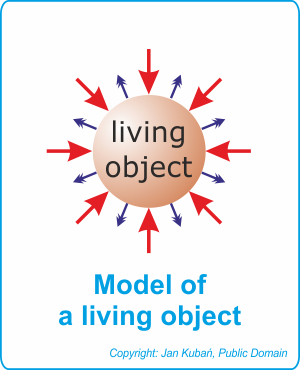
A general model of a living object
- Relationships between living objects are Transactional interactions.
Associated concepts:
Magis
Definiens:
The attitude of full commitment and passion in relation to what you are doing:
- giving more than expected,
- searching for new and better questions and solutions,
- strong attention to important details,
- striving for self-actualization
- elimination of negative traits,
- making a product which will pass the examination of time
- doing better than expected by those around you,
- discovering the general patterns and accumulation of knowledge for the future,
- gaining experience so as to be more efficient in future situations,
- sharing knowledge with others,
- sharing feedback with others,
- anticipating positive / negative effects of their actions
Remarks:
-
A concept coined by Ignatius of Loyola the principle founder of the Society of Jesus.
-
Magis is a Latin word that means "more" or "better".
-
A term coined by St. Ignatius Loyola. […] St. Ignatius does not allow satisfaction of mediocrity or stagnation at any level. The idea is to make "more" and "better" to closer to God.
[based upon Wikipedia, Pol., 2015-04-17]
Mathematical game theory
Definiens:
The branch of mathematics dealing with the study of the characteristics of participants in a conflict of interest.
It comes from the study of gambling and hence the name. This theory is applied in the practice of sportsmanship, war, economics, biology (especially in sociobiology), sociology, computer science (artificial intelligence) and politics. The use of game theory in biology by John Maynard Smith (1920-2004) has resulted in the emergence of evolutionary game theory and memetic.
Associated concepts:
Matrix
Definiens:
 Matrix is an environment of false messages produced by other living objects. The sources of the matrix include social engineering, propaganda techniques used by people who want to use us, common misconceptions, and the use of von tactics by people and social groups.
The false images of reality created in our brain result from:
- external factors: matrix, barriers to objective observation, information processing barriers, and
- internal factors: built-in filters that distort information reaching the brain from our receptors (erroneous perception) and algorithms that misinterpret this information (cognitive biases), and
- external factors that become internal: learned patterns of thought, stereotypes and the current level of thinking that a person follows.
Remarks:
- In Far East philosophy, instead of the "Matrix" definiendum, "Dense Forest of Illusions" is used
Quotes from literature: in Polish or Google English from Polish
- associated with Matrix
Matter
Definiens:
In classical physics, general chemistry and The Physics of Life, we consider matter as having mass and volume.
Remarks:
-
Matter belongs to the group of imprecisely defined concepts.
Mechanism of life
Definiens:
The mechanism involved in the rise and the subsequent development of life. The foundations of this mechanism are the three principles of the Physics of Life.
Meme
Definiens:
Any form of information (pattern information) for used for creating non-genetical designs which affect the process of biological evolution of living objects. These memes form memetic designs.
Other definientia:
-
A unit of culture analogous to a gene.
Remarks:
-
from the ancient Greek word mimeme – "imitated thing"
-
Examples of memes:
- words
- pictures
- classifications
- ideas
Associated concepts:
Quotes from literature: in Polish or Google English from Polish
- associated with Memes
Memetic design
Definiens:
Designs composed of memes, from which modifiable properties of living objects are formed, notebly their structure and behaviour.
Associated concepts:
Remarks:
- Some examples of memetic designs:
- written words (books, encyclopedias, …) together with a method so it can be read and repeated
- behavioural patterns - institutionalised racism, for example
- fairytales and myths passed orally from generation to generation
- movies and theatre
- scientific knowledge and educational systems
- educational methodology (i.e. rites of passage)
- knowledge and experiences of ancestors passed down from generation to generation
- ideology
- imprinting
- a cognitive training routine with physical effects, i.e. body building.
- …
-
Memetic designs compete for carriers of memetic information so they can spread to a wider environment and/or be more influential. These carriers may be books, films and human brains. The English language is a meme and overwhelmed other languages. Sudovian language is an extinct language because nobody knows it and nobody speaks it. Latin is a dead language as there are no native speakers whereas Sanskrit is considered to be endangered because only approx. 3,000 people speak it as a mother tongue.
-
The human mind likes a strange idea as little as the body likes a strange protein and resists it with a similar energy.
[…]
The mental resistance to new ideas is partly due to the fact that they have to displace established ideas. New facts are not usually accepted unless they can be correlated with the existing body of knowledge; it is often not sufficient that they can be demonstrated on independent evidence. Therefore premature discoveries are usually neglected and lost. An unreasoning, instinctive mental resistance to novelty is the real basis of excessive scepticism and conservatism.Persecution of great discoverers was due partly to mental resistance to new ideas and partly to the disturbance caused to entrenched authority and vested interests, intellectual and material. Sometimes lack of diplomacy on the part of the discoverer has aggravated matters. Opposition must have killed at birth many discoveries.
“The Art of Scientific Investigation” W. I. B. Beveridge (1908-2006)
Quotes from literature: in Polish or Google English from Polish
- associated with Memes
Memplex
Definiens:
Much of the study of memes focuses on groups of memes called meme complexes, or memeplexes. Like the gene complexes found in biology, memeplexes are groups of memes that are often found present in the same individual. Applying the theory of Universal Darwinism, memeplexes exist because memes copy themselves more successfully when they are "teamed up".
Examples include:
Belief Systems and Ideologies:
Religions, philosophies, political alignments, worldviews.
Organizations and Groups:
Churches, businesses, political parties, clubs.
Behavioral Patterns:
Musical practices, ceremonies, marriages, festivities, hunting techniques, sports.
Compared to inherited gene complexes, memeplexes have comparatively less pressure to benefit the individuals expressing them in order to replicate. Because memes and memeplexes replicate virally (i.e., by horizontal transmission), they are not entirely dependent on the success of their hosts in order to succeed. Memes and memeplexes do not have to be useful or true, physically or mathematically, to replicate.
Associated concepts:
Methods of the elimination of distortion
of observation
Definiens:
Methods which can be used to validate the streams of information that come to you.
List of MEDO - methods of the elimination of distortion ofobservation:
-
The method by defining
Before we can use concepts such as "justice," "fairness" and "wisdom", we have to define their meaning. Try to write down a detailed definition of the concept you are using. The best result will if you manage to create such a definition, which will be accepted by all your peers. It is not as simple as it first seems.
Use this method to create a precise definition of evolution or inflation. -
The meticulous mathematical method
It is based on a careful record of data, finding out the relationship between them and discovering one, unique and mathematically logical explanation.
Try to discover the rate of inflation by recording the prices of a variety of necessary products on a given day each month over a multitude of years. -
The method of emotional distance and adjectivelessness
Rejection of emotions and not using adjectives to describe an event makes it that the observation is closer to reality because the description does not enforce a particular interpretation. -
The method of parameter changes
This simple method is to change the pieces of a given information to the analogous ones. For example, consider how the meaning of a message would change if the value of 10 would be replaced by 1000, or the word "we" by "they" or "Palestinian" by "Israeli". This method also includes a mental experiment involving personal reflection, which answers the question How will I behave if I were in your position?
When you argue with your beloved try put yourself in their shoes, change you to I. -
The method of verifying the source
Always check the credibility of the source from which the information originates. Try to find at least three contrasting sources for the same event.
An example is the case involving Gerad Depardieu leaving France for Russia because he wanted to avoid to pay increased taxes. In France, he is a traitor, in the UK - uninvolved observer - his private problems are emphasised and in Russia he is a tool for propaganda. -
The uninvolvement of the observer
It is based on the analysis of whether an observer, from which the information came, can benefit from altering it.
Some experts employed by some companies (e.g. the state) can manipulate information to make it seem that the company (the state) is going well. -
Criterion of timelessness
"The real truth" stands the test of time. "The today's truth" usually turns out to be a false message altered for the benefit of someone. -
The method of eliminating self-bias
We should be aware of this issue and we must always remember that we are not objective observers. In a very important way we distort information that reaches us. The reason for this is embedded in our evolutionary mechanism of ahamkara.
Associated concepts:
- Ahamkara
- Barrier in processing of information
- Naturally false messages
- Artificially false messages
- Matrix
Minimal system
Definiens:
A minimal system model retains the basic features of the modeled system/object, even though it is composed of a minimum number of elements or subsystems - disconnecting any part causes its basic properties to disappear.
Remarks:
-
 The concept was proposed by the Hungarian biochemist Tibor Ganti (1933-2009). Based on this definition, Ganti created a model of a "minimal living system", which he called a chemotone. The equivalent of a chemotone in the Physics of Life is a particle that meets the 5 fundamental properties of particles necessary to initiate biological evolution. A chemoton is a theoretical model, but a particle having these 5 fundamental features is very real.
According to Tibor Ganti the minimal system of a living object must meet the following criteria:
Real (absolute) criteria of life:
- Inherent indivisibility
- Metabolism
- Inherent stability
- Having a subsystem carrying information
- Control
- Growth and reproduction
- Capacity for hereditary change and evolution
- Mortality
Associated concepts:
- Fraktal
- A particle that meets 5 fundamental properties of chemical particles to initiate biological evolution
Milgram's experiment
Definiens:
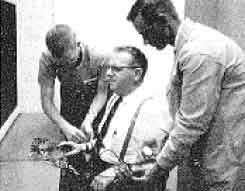
Detailed description of Milgram's experiment on obedience.
One of the most important sociological experiments in The Physics of Life, showing that:
-
Ordinary people are likely to follow orders given by an authority figure, even to the extent of killing an innocent human being.
Obedience to authority is ingrained in us all from the way we are brought up.
-
People tend to obey orders from other people if they recognize their authority as morally right and / or legally based. This response to legitimate authority is learned in a variety of situations, for example in the family, school and workplace.
Links:
- Stanley Milgram website
- The Milgram Experiment 1962 Full Documentary: https://www.youtube.com/watch?v=1HcMWlnTtFQ
Associated concepts:
Model
Definiens:
A simplified representation of an object (or part of reality), which eliminates those characteristics, relationships or other items which, at least theoretically, are of little importance. Analysis of a model allows you to:
-
explain the causes of phenomena or the behaviour of an object - so-called cognitive model.
-
exact or approximate prediction of the future course of events or the future behaviour of an object - so-called predictive model.
The quality of a model is measured by how precise an explanation or prediction it gives.
Associated concepts:
Model KSP: King, shaman, people
Definiens:
The KSP model is a universal model with a certain degree of generality, on the basis of which one can build more accurate models, explaining the behaviour of various social groups.
The king has full power, so can threaten everyone to do what he wants under the pain of death. The shaman, to some extent, is the person who is able to control the king and uses it for his own benefit. The people are subjected to the whims of both the king and the shaman.
Remarks:
- Biological evolution transformed a one-man king and and a one-man shaman into multi-person groups.
- Fight between swords and words
Associated concepts:
Model of a board
♥ Definiens:
The emergence of solidarity and cooperation mechanisms between group members when the group's manager wants to discuss the mistakes made by one or more of its members. This cooperation arises in a natural and unconscious way, because everyone is afraid that sooner or later the manager will want to discuss their own mistakes.
Remarks:
- The model of a board belongs to the group of the Cognitive models of The Physics of Life
Model of a gardener
♥ Definiens:
The model of a gardener shows the natural tendency to capture the control of a social group by a privileged individual or another social group.
A group of house owners find it cheaper if they employ a gardener as a group to care for their gardens. And so in the initial phase, the gardener who got such a large contract is very pleased and works hard. Over time, however, when the group does not set up appropriate regulatory feedback mechanisms, the nature of an honest man prevails and the gardener will try to earn as much as possible for the least possible effort. He will invent that he needs additional machinery and people to help, that gardening is difficult and dangerous, etc. First, the goals will be justified, but as soon as the gardener convinces himself of his persuasive abilities, he will come up with less and less meaningful goals, until they end up being completely fictitious.
Other definientia:
-
People who think rationally […] often notice that there are common goals that are easier to satisfy by a central decision than to wait for the right private group to organize. Bah! Sometimes it is cheaper to make such a decision than to pay for the examination, whether it is worth spending the money collectively - or not.
That's it!
However, once we agree to it and a body has the right to spend common money, it will try to demonstrate - that is, it will want to spend as much of our money as possible. First, for legitimate purposes, then for less justified ones - and finally for unjustified ones.
Because this is the logic of every office, every body has the right to spend someone else's money.
What's more, this body will have - living on its work - experts, convincing the general public that this money is worth spending, and indeed: you have to.
And even the body itself will start to believe it! [JKM, blog 2011.06.03]
Associated concepts:
Model of comparative advantage
Definiens:
David Ricardo developed the classical theory of comparative advantage in 1817 to explain why countries engage in international trade even when one country's workers are more efficient at producing every single good than workers in other countries. He demonstrated that if two countries capable of producing two commodities engage in the free market, then each country will increase its overall consumption by exporting the good for which it has a comparative advantage while importing the other good, provided that differences exist in labour productivity between both countries. It is widely regarded as one of the most powerful yet counter-intuitive laws in economics.
The model of comparative advantage shows that exchange (international, intercellular, inter-objective) can be advantageous for both parties of exchange, even when one of them generates the majority of products cheaper than the other. To obtain comparative advantage, it is enough to have relative differences in manufacturing costs on both sides. Exchange is beneficial for both parties, if each of them exchanges products, in the production of which he has a comparative (relative) advantage.
Let's see how the Law of Comparative Advantage works. Imagine two tropical states - the islands of Bahiti and Cohiti. The king of the first one is Bob Bahatma, Cob Cohatma is the king of the second. Bananas and coconuts are produced in both countries. In both countries there are the same number of workers - 20, the other young people work in offices. The table below shows the labour productivity of each employee and how many of them collect bananas and how many coconuts. The last line shows the total production.
| Bahiti | Cohiti | ||
|---|---|---|---|
| Labour productivity | |||
|
1 worker picks 2 bananas/hour 1 worker picks 2 coconuts/hour |
1 worker picks 1 bananas/hour 1 worker picks 1.5 coconuts/hour |
||
| Labour distribution | |||
|
10 workers pick bananas 10 workers pick coconuts |
10 workers pick bananas 10 workers pick coconuts |
||
| Total | |||
| Bananas | Coconuts | Bananas | Coconuts |
|
|
|
|
|
| Combined total | |||
|
|
|||
Bahitians are more efficient in the production of bananas and coconuts.
Cob Cohatma proposes: "Let's trade".
Bob Bahatma: "Why should we trade if we produce the same, and we are better than you?"
Tom odpowiada: "OK, let's not trade for now, but let's do like this - move two people from your coconuts to bananas, and I will transfer four of mine from bananas to coconuts."
| Bahiti | Cohiti | ||
|---|---|---|---|
| Labour productivity | |||
|
1 worker picks 2 bananas/hour 1 worker picks 2 coconuts/hour |
1 worker picks 1 bananas/hour 1 worker picks 1.5 coconuts/hour |
||
| Labour distribution | |||
|
12 workers pick bananas 8 workers pick coconuts |
6 workers pick bananas 14 workers pick coconuts |
||
| Total | |||
| Bananas | Coconuts | Bananas | Coconuts |
| Combined total | |||
|
|
|||
Bob Bahatma states: "I have 4 bananas more than before, but 4 coconuts less."
Cob Cohatma proposes: "Let's exchange 5 of my coconuts for 4 of your bananas."
Bob agrees.
Let's analyze the three subsequent tables: the table of initial harvest, the table of harvest after the change of the assignment of tasks and the table of harvest after trade.
|
Initial harvest
|
|||
|---|---|---|---|
| Bahiti | Cohiti | ||
| Bananas | Coconuts | Bananas | Coconuts |
| Hours worked | |||
| 20 hours | 20 hours | ||
| Combined total | |||
|
Harvest after the change of the
assignment of tasks |
|||
|---|---|---|---|
| Bahiti | Cohiti | ||
| Bananas | Coconuts | Bananas | Coconuts |
| Hours worked | |||
| 20 hours | 20 hours | ||
| Combined total | |||
|
|
|||
|
Harvest after trade
|
|||
|---|---|---|---|
| Bahiti | Cohiti | ||
| Bananas | Coconuts | Bananas | Coconuts |
| Hours worked | |||
| 20 hours | 20 hours | ||
| Combined total | |||
Bob notes: "My people are more productive than yours and have the same performance at bananas and coconuts, yours are worse at both, but relatively they do better with the coconuts harvest. Cob, move another 4 from bananas to the coconuts harvest, and I will transfer 2 of my coconuts pickers to bananas and let's see what happens?"
| Bahiti | Cohiti | ||
|---|---|---|---|
| Labour productivity | |||
|
1 worker picks 2 bananas/hour 1 worker picks 2 coconuts/hour |
1 worker picks 1 bananas/hour 1 worker picks 1.5 coconuts/hour |
||
| Labour distribution | |||
|
14 workers pick bananas 6 workers pick coconuts |
2 workers pick bananas 18 workers pick coconuts |
||
| Total | |||
| Bananas | Coconuts | Bananas | Coconuts |
| After exchange of 10 Cohitian coconuts for 8 Bahitian bananas | |||
| Combined total | |||
|
|
|||
Note that the labour productivity of any employee has not changed, that all of them worked the same amount in each case, but thanks to the fact that they were assigned the tasks in which they were relatively most efficient, the combined production increased, and after the exchange both islands benefited.
A similar analysis can be carried out by "freezing" the level of production and then it can be seen that they reduce production costs - employees can work less.
Remarks:
-
Robert Torrens formulated the theory of comparative advantage for the first time in 1808. He included the most important elements of this theory, which he then presented in a modified version in an edition of "The Treaty on Foreign Trade in Cereals", published in 1815. He described an example of the exchange of industrial and agricultural goods between England and Poland. He came to the conclusion that England can gain significant benefits by selling industrial goods to Poland in exchange for grain, even when grain production is cheaper in England than in Poland.
The theory, however, was much more widely popularized by David Ricardo, who explained the concept behind it in the book "Principles of political economy and taxation", published in 1817. The popularisation of the theory by Ricardo attributed the authorship of this theory to him. Although Ricardo was not the first to formulate the concept of comparative advantage, his undoubted contribution was to develop it in a scientific form (though without in-depth analysis) and to popularize it so much that it became the dominant theory of international trade and is still an important point of reference for contemporary trading theories.
[Wikipedia 2012.06.10] -
The Polish mathematician Stanisław Ulam once asked Paul Samuelson, an economist and Nobel laureate, to mention one theory from the field of social sciences, which would be true and at the same time not trivial or obvious. After a few years, Samuelson mentioned the theory of comparative advantage of David Ricardo with an appropriate commentary:
It is not necessary to convince mathematicians that it is logically true; the fact that it is not evident is testified by thousands of important and intelligent people who could not understand it or believe it, even when it was explained to them.
[Wikipedia 2015.12.06]
Associated concepts:
Model of governance
Definiens:
Lord Acton said: Power corrupts, absolute power corrupts absolutely. This is the simplest formulation of the model of governance. However, the issue is wider. The use of typical instruments of governance by people of power leads to the following processes:
Striving to maintain power and expand its scope.
-
The increasing use of von-type disinformation tactics by the rulers, aimed at facilitating their objectives.
-
Increasing the exploitation and robbery of subjects (for example, by imposing ever greater tax burdens and inflation).
Increasing the use of direct coercion - an increase in all kinds of security services.
-
Creating privileged groups subordinate to authority and granting them more and more privileges. These groups, in return, support the leaders.
-
The aristocratization of people belonging to power structures and the simultaneous process of enslaving those who do not belong to these structures. This enslavement unleashes the process of biedocraticization.
-
The constant process of bringing memebers of the society who are not in the structures of power, to a lesser or greater extent, into slavery. Single acts of tyranny may be ascribed to the accidental opinion of a day; but a series of oppressions, begun at a distinguished period, and pursued unalterably thro’ every change of ministers, too plainly prove a deliberate, systematical plan of reducing us to slavery. - Thomas Jefferson "Draft of Instructions to the Virginia Delegates in the Continental Congress (MS Text of A Summary View, &c.), [July 1774]".
Remarks:
-
They govern until the economy collapses, then they are looking for an external enemy - Ernest Hemingway.
-
Wake up. By inflation and taxation of your meager income, you finance the "elites" Byzantine style of life. This "elite" contains people such as: their faithful Praetorians and relatives, the etatist's mafia, pseudomanagers living on giant earnings, their loyal law enforcers, the corrupt judiciary, the legions of their esteemed servants and the media - they are all on a financial leash. What was possible was sold or stolen. Now they finance their prosperity with foreign loans that will be paid by patients and pensioners for decades. - Blogger ~Cartofel 27.09.2013
Associated concepts:
- Cognitive models of The Physics of Life
- Model SDC: Shepherd, dogs, cattle
- Degeneration of power
- Typical instruments of governance
Quotes from literature:
- related to the concept of Model of governance in Polish.
Model SDC: Shepherd, Dogs, Cattle
Definiens:
The SDC model is a universal model with a certain degree of generality, on the basis of which one can build more accurate models explaining the behaviour of various social groups.
This model illustrates the mutual relations between the governing and the governed. The master milks the cows, but he strokes the dogs, which do not give milk. However, they keep the cows under control by biting them on their ankles. So the master appreciates the dogs more than the cows, despite them not providing any resources.
Associated concepts:
Money
Definiens:
Remarks:
-
Definition from Wikipedia 2020.05.05: Money is any item or verifiable record that is generally accepted as payment for goods and services and repayment of debts, such as taxes, in a particular country or socio-economic context. The main functions of money are distinguished as: a medium of exchange, a unit of account, a store of value and sometimes, a standard of deferred payment. Any item or verifiable record that fulfils these functions can be considered as money.
Associated concepts:
Quotes from literature: in Polish or Google English from Polish
- associated with Money
Morality
Definiens:
A set of rules and norms evaluating the behaviour of living objects forming a social group. Morality determines what is good and what is bad for the development of this group.
Remarks:
-
Generally the definitions of morality contain no clear explanation of what "good" and "bad" mean.
-
Threats to the group include conflicts between its members and lack of cooperation (See Game within a group). Natural cooperation of social insects is programmed in their genetic designs, while humans require additional support from memetic designs. Morality is, therefore, an addition to genetically programmed behaviours. They, by changing the behavioral repertoire of individuals belonging to the group, enable the group, at least, to exist. Otherwise, conflicts resulting from maximizing the individual's own interest would destroy the group's ability to maintain its existence.
Mosca's law on dominance of organised minority
Definiens:
In reality the dominion of an organized minority, motivated by a common impulse, over the unorganized majority is inevitable.
Uwagi:
-
The law formulated by Gaetano Mosca in his book "Elementi di scienza politica" from 1895:
In reality the dominion of an organized minority, obeying a single impulse, over the unorganized majority is inevitable. The power of any minority is irresistible as against each single individual in the majority, who stands alone before the totality of the organized minority. A hundred men acting uniformly in concert, with a common understanding, will triumph over a thousand men who are not in accord and can therefore be dealt with one by one. Meanwhile it will be easier for the former to act in concert and have a mutual understanding simply because they are a hundred and not a thousand. It follows that the larger the political community, the smaller will the proportion of the governing minority to the governed majority be, and the more difficult will it be for the majority to organize for reaction against the minority.
Mosca's law on governance
Definiens:
In all societies, from very underdeveloped societies that have barely reached the beginning of civilization, to the most advanced and powerful societies, two classes of people naturally emerge: the ruling class and the ruled class.
Remarks:
-
The law formulated by Gaetano Mosca in his book "Elementi di scienza politica" from 1895.
Motivant function
Definiens:
A function, which at a given moment and in given circumstances, clearly defines how the living object will behave. Depending on: external conditions, evolutionary history, the history of the object itself and random influencing factors.
Remarks:
When pilots make mistakes, it results in their own deaths. When a doctor makes a mistake, it results in the death of someone else. That is why pilots are better motivated than doctors to reduce mistakes. - "Black box thinking" by Matthew Syed page 57.
Multiplication rule
Definiens:
In good external conditions, living objects invest in themselves, in bad - in offspring.
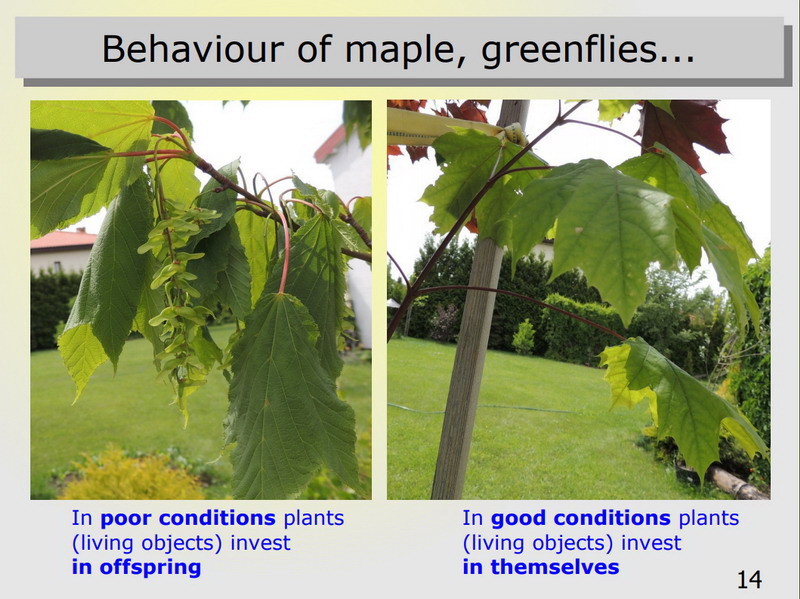
Couch grass when it grows in fertile soil becomes large and lush, but has almost no seeds, when it grows in a narrow gap between paving stones, it is meager but has plenty of seeds.
Natural tendency
Definiens:
is a characteristic behaviour of the system, which tends to be in one of its possible attractors
Other definientia:
- Goal-directedness - Michael Rothschild "Bionomics" page. 71
Associated concepts:
- System
- Teleology or finality -τέλος, telos (root: τελε-, "end, purpose") and -λογία, logia, "a branch of learning" - is a reason or explanation for something in function of its end, purpose, or goal. [Wikipedia 2018.10.14 More]
Natural Pressure for Social Exploitation
Definiens:
Natural mechanism functioning in social groups which favours unproductivity.
Imagine a group of hundred people who have decided to live in the ideal community. They want to work and devote themselves to the community, sharing their production equally. Each of them produces goods worth 100 oro every month, and thus the community can share in 10 000 oro. Common goods are shared equally, in accordance with established rules, and everyone gets all kinds of goods with a value of 100 oro. It is easy to note that the expenses and revenues are balanced - the balance is zero (I produced and gave a hundred, I got goods worth a hundred).

Let's apply sensitivity analysis and introduce a disturbance to this model of the perfect community. Imagine that one person has not worked at all. The reason, as usual, in the sensitivity analysis, is not important - it could be a disease or laziness, it does not matter. This time, the community has developed 9 900 oro, and, after the split, each got 99, including the one that did nothing. His balance is +99 oro (produced 0, gained 99). The balance of the remaining people of the community is -1 oro (developed 100, gained 99) - the value of goods received by each of them is down by 1 oro. Note that the profit of the non-working is very large in relation to the loss of the others, and moreover, the profit for non-working will be larger if the community is larger.
Let us now examine the effect of the opposite disturbance, and assume that one of the members is devoted to enriching the community. Therefore, the member has decided to work hard, working day and night, and managed to produce twice as much as the others - generating 200 oro. This time, the community has 10 100 oro to share, so everyone gets 101 oro. So now the balance for this hard worker is -99 (produced for 200 and gained only for 101), while the balance for the others is +1 (produced for 100 and gained for 101).

Now compare the situation of both perpetrators of these disturbances - The balance of the first one was 0 outlays and 99 profit - which translates into the statement that by doing absolutely nothing, he was ahead almost as if he had worked normally. However, the balance of the second, hard-working person, who put in 200 and received 101 oros, shows a deficit of 99 oros. As we can see, the benefits of not working outweigh those accrued by working twice as hard. It is a natural mechanism which is inherent to social systems.
On the other hand, as we remember, each of us optimizes the balance of profit and loss, or simply speaking, we prefer doing less for more.

Remarks:
-
Aristotle: the larger the number of owners has the property, the less the others take care of it
-
Garret Hardin: the history of great fortunes shows that the tactics of those who built them was clandestine, socializing the costs and privatizing the benefits
-
Frederic Bastiat: If a move will result in the loss of one franc for each of the thousands of people and gain a thousand francs by one person, the latter consumes a lot of energy, while the former would rather put up little resistance, it is therefore likely that the person who makes the effort gaining one thousand francs will gain them successfully.
-
It occurred to me that there is an additional factor that can be introduced where, in a democracy, all people have an equal vote. But if a percentage of the population is too lazy to work, they will vote for the party that allows the social exploitation to continue. Thus, even more people are tempted to stop working and do nothing, creating a bias in the voting of the population toward the political party that gives them the most free stuff (not actually free—those who are still working are funding it). Essentially, (and this is the case in Canada) a political party can bribe all the non-workers to vote for them. The overall effect, however, is a decline in the productivity of the country, a bias against the work ethic, and inflation as the government has to print more money to make up for the shortfall that results from so many people doing nothing.
In the end, the party that bribes the population with the most free stuff, wins, paid for by either printing money, or by increasing the taxes on the remaining people who are still working or going further and further into debt.
I did some projects in the USSR shortly before it collapsed. The number of perfectly healthy people doing nothing, or staggering down the street drunk, was astounding. Nobody cared about anything at all, except where to find bread. The city buses were almost wrecks that barely worked. When social exploitation reaches its bitter end, the productivity is so low, there is no food and nothing works.Kirk Durston
-
Last week we were at a lecture from a very brilliant mind from Switzerland. He explained Democracy in great detail and how it works or why it doesn't work as it should. He made a statement which made sense to me.
He said that the society is divided up like a curve of Gauss. On the left side you have the guys that you describe in your video - powerlusters who want to exploit and people who don't want to work. On the right side you have the real good people who really want the best for the country. Both of these two are minorities. In the middle of the curve you have the big bunch of people who are not really interested in politics etc. (in your words: They are the ones who give away 1 EUR as they don't see the damage they cause). This guy said that there is nothing wrong with this big group, even if they are not taking really part in the democracy. They are even a protection in this system. Then he went on and said, that these good people on the right side, they don't go into politics. It is a rare exception if he goes into politics but the chance is high, that he gets corrupted with power and money.
So he said, that we have to find a solution to prevent these guys on the left side to get up to power. He showed his theory.
When I look at your video the solution is also very clear: small entities --> federalism - break all the countries down into small entities down to the size of villages where everybody knows everybody. Then the guys on top have no chance to make this brilliant game that you showed. As it would be evident immediately.
Beat V.
Associated concepts:
Natural Brainwashing Process
Definiens:
People, who are possessed by the desire for profit, are incited by others, who know human weaknesses, to agree to participate in immoral undertakings. Sometimes they realize the immorality only when a great tragedy occurs.
Remarks:
-
It is amazing how people are sitting in the grip of profit. For them to do something more than that, it's a huge barrier. They usually explain that they are incompetent, they lack the discipline, that it would be ridiculous and that it would be hopeless. And hence, the people in power can do what they want with society. - Tomasz Maciejewski
Naturally false messages
Definiens:
The phenomenon of the natural formation of messages which affect the processes of observation. Naturally fake messages are one of the elements of the barriers to objective observation.
Examples:
-
Human society naturally generates messages that miraculously escape death (there are usually those who are the only survivors of a crash), but does not generate messages in the same way about a trifling death (of course there are messages that one was killed by such a trifle but these messages are weaker in reception because they do not originates from the source, as opposed to cases of miraculous survival).
-
In photographs from Western Europe from the seventeenth to the nineteenth centuries, we often see kids working hard in factories. For the observer, the message is very clear: the exploitation of children. But if they had not got jobs, they would probably starve to death. There is no chance to take a picture of starving children, because they did not die in the same place and time. Working children worked in shifts of a dozen or more hours in groups - the photographs we see today. However, the mortality statistics before and during the Industrial Revolution would explain whether these children were slaves or survivors. But these statistics in opposition to the photographs of hard-working children are non-existant.
Statistics from 10 London parishes show that at the turn of the 17th and 18th centuries, child mortality was 92%! Out of the 2073 children born, only 166 survived up to the age of five. The end of the haemorrhagic plague that collected the huge harvest of death had already come to an end. It lasted from 1350 to 1670. This is when the employment of children in inhumane working conditions began. The thesis is: the conditions were indeed inhuman and that is unquestionable, but it turned out that child mortality fell. It means that the welfare of children was better secured in "inhumane factory conditions" than at home. Welfare should be understood as a life purpose - survive and multiply. Population statistics have shown that despite this exploitation, the population grew.
More on this: Paradox of industrialisation.
-
Commercial media, which are cashing-in on advertising, are rather reluctant to inform people about the negative sides of taking credit. Their finances are supported by the banks they advertise, so they do not want to bite the hand that feeds them.
Associated concepts:
- Ahamkara
- Barriers to objective observation
- Barrier in processing of information
- Artificially false messages
- Matrix
- Methods of the elimination of distortion of observation
Quotes from literature: in Polish or Google English from Polish
- associated with Naturally & artificially false messages
Nature of an Honest Man
Definiens:
The main factor of human motivation. Man consciously and subconsciously is doing everything possible to maximize the balance of his benefits and losses to realize his life purpose.
Remarks:
-
People, if they can, want to live and prosper at someone else's expense. This lust is rooted in the nature of man, in a primitive, universal, and unadorned instinct to satisfy his own needs with minimal effort. - Frédéric Bastiat
-
It is not only human nature, but every living object.
-
Of course, a lot of people (authorities) do not want to agree with this. Those who are saying that this is not true, simply apply the von Neumann tactics and/or von Sociall tactics in order to better maximize their own balance of benefits and losses.
-
Polish proverb: You can only rake to yourself.
-
According to Boy Zelenski, the main motive of Maxims by François de La Rochefocauld was - Selfishness, narcissism, fear or desire for benefits, he found these components whenever he undressed any human action. Only this remains when you take away appearances.
-
If theft (robbery, plunder) is in our interest, we agree to theft (robbery, plunder).
-
It is typical of people to think themselves more honest and moral than others.
-
It is amazing how people are sitting in the grip of profit. For them to do something more than that, it's a huge barrier. They usually explain that they are incompetent, they lack the discipline, that it would be ridiculous and that it would be hopeless. And hence, the people in power can do what they want with society. - Tomasz Maciejewski
-
François de La Rochefoucauld (1613-1680) broke the optimistic view of the nature of humanity, pointing to the hypocrisy, selfishness, weakness and vanity of all people. Honesty and kindness is a game of appearances…
-
Conflict erupts around power, money and prestige. - possibly said by Max Weber or Peter Blau
Quotes from literature: in Polish or Google English from Polish
- associated with Nature of an honest man
Nature of Things
Definiens:
What happens, happens.
Remarks:
-
Although we do not know why, there is a logic/reason in it
Nazism criteria of objectivity
Definiens:
What conditions must a country fulfil to be similar to National Socialist Germany
-
Ideology/Cult
- Cult around a single leader
- Achieving an all-mighty and ideal state through violence - Cult of violence
- Cult of brave ancestors and former greatness
- Ideology of conquest and struggle
The leader
- The leader knows everything, the leader knows best, and I trust him unconditionally
- The boundless worship of the leader
- Peoples willingness to sacrifice their own life and the lives of their loved ones for the leader
- The leader is a God
- The leader is the state
- The leader is forever
- One nation, one state, one leader!
-
The state
- The state above all
- State size mania - we are the best
- The state is the leader
-
Ethatism
- State ethatism as an effective tool for programming people through propaganda and the education system
- Self-perpetuating state ethatism in worship
-
Propaganda
- There is always one version, it may change over time, but at any given time the version is the only one
- There is no debate, the state's opinions are pushed into the heads of the people
-
Human emotions
- We are surrounded by enemies
- A sense of injustice-a desire for revenge
- Hatred of enemies
- Antipathy to all foreigners
- Anyone who does not think like us is an idiot, a fool, a mortal enemy
- Anyone who is not with us is against us
-
The mind programming system
- Swastika as the ubiquitous integrating sign
- Uniform as a distigusher of important people in the society
- Dumbing down to Kali's thoughtlessness (if someone stelas from me it is bad, but when I am stealing from someone it is good)
- Ideology that deprives inner freedom, convinces to kill, and people remain happy and joyful
- Ideology that reprograms even the instinct of self-preservation and the ability to think
- A system of indoctrination from an early age
- The Nazi school is an auxiliary institution of the military
-
Patriotism
- Patriotism in its simplest, clearest and most indubitable signification is nothing else but a means of obtaining for the rulers their ambitions and covetous desires, and for the ruled the abdication of human dignity, reason, conscience, and a slavish enthrallment to those in power. - Leo Tolstoy
Remarks:
Associated concepts:
Non-informative replicator
♥ Definiens:
RPD-type objects, which only absorb resources and split. They do not constitute information.
Remarks:
-
An example of such replicators are phospholipid membranes.
Associated concepts:
Non-linearity
Definiens:
This phenomenon is when a small factor causes large changes in the system. The definition is not precise because the concept of "small" and "large" are not well defined in mathematics.
An example of non-linear effect
Remarks:
-
An example, illustrating problems with linearity and non-linearity , is driving a car.
Linearity phenomenon: the faster (within reasonable speed) you drive, the sooner you get to your destination.
Non-linearity phenomenon: missing you exit junction on the motorway, a lapse of only a few seconds, causes a significant delay.
Associated concepts:
- Linearity
- Sensitivity analysis
- Conjunctional non-linearity
- Recursional non-linearity
- Disturbance
- Butterfly effect
Quotes from literature: in Polish or Google English from Polish
- associated with Non-linearity
Object
Definiens:
a material or abstract separate element, having:
-
identity,
-
a set of properties which, at a given time, have a current state. Changes in this state, over time, we call behaviour or a mathematical process.
-
interaction interface - virtually any value or behaviour of a given property can affect the state(s) and/or behaviour(s) of another object(s), so, interaction interface can be identified as the set of properties of this object.
Full definition of object.
Associated concepts:
Opposing factors
Definiens:
Factors influencing a system belonging to the same qualitative dimension but having opposing directions.
Remarks:
-
The intensity of the flame depends on the stream of reinforcing factors - constructors (eg. fuel supply) and weakening factors - destructors (eg. fuel reduction).
Associated concepts:
Quotes from literature:
- related to Opposing factors
Optical illusion
Definiens:
Misinterpretation of an image by the brain under the influence of various factors (e.g. contrast, shadows, colors, lines) that automatically put the brain into a wrong course of thought.
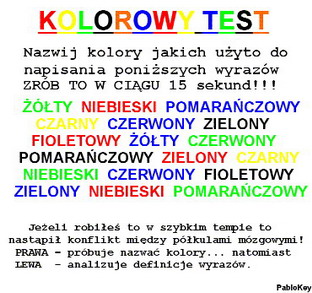

Remarks:
Associated concepts:
Optimization
Definiens:
The process of finding the best solution from the point of view of a particular quality criterion.
Organizational levels of living objects
Definiens:
If we agree that a living object is a set of interacting, replicating elements, then we can distinguish several organizational levels of living objects, depending on the elements of which it is composed.
| Level | ||
|---|---|---|
| RPD-type particles |
RPD-type particles having the 5 fundamental properties of chemical particles to initiate biological evolution.
Because these particles are "purely chemical" they are the output objects for future generations of objects that we consider to be alive. They can be considered as zero level of life. |
|
| Synthetizing replicators | Synthesizing replicators, which are particles or groups of cooperating particles which not only rebuild themselves after division, but also, on the basis of a natural design, which they themselves are (on Earth, these are also RPD-type particles RNA & DNA), produce new chemical entities (on Earth - proteins or RNA particles) from the available elements (on Earth - amino- and ribonucleic acids). Due to this, tactics of structure and tactics of behaviour used, became more and more advanced over subsequent generations. | |
| Cellular replicators - procariotic cells | Next are mitochondria and bacteria, which are forms of the second organisational level of life. They are objects composed of cooperating elements of the first and zero levels. | |
| Eucariotic replicators - eucariotic cells |
Objects built from the aggregated elements of organisational levels zero, one and two.
These are eukaryotic cells. The principle of nesting elements is similar, to some extent, to a Russian Doll. |
|
| Multi-cellular replicators - organisms | Multicellular WSS-type objects (object subjected to selection as a whole), such as humans, built of from the aggregated elements of zero, first, second and third organisational levels. | |
| Social replicators - superorganisms | WSS-type communities of living objects (communities subjected to selection as a whole), such as ant colonies or bee hives. Object built of from the aggregated elements of zero, first, second, third and fourth organisational levels. |
Remarks:
-
Insect communities are not a single entity, and this may raise doubts that the community can be considered as a living object. This observation is right, but from the perspective of systems theory, a community of insects can be considered as an entity, because "entity" does not depend on how its elements are linked, but how they are interacting (coupling occurs between them)!
-
Note: The n-level objects are not exclusively made from the elements of n-1 level (suggested name: hierarchical cascade), but some elements can be from lower levels, for example n-2 and n-3 (suggested name: hierarchical nested cascade)
Orthogonal factors
Definiens:
Numerous factors influencing the system at the same time, however, belonging to different qualitative dimensions.
Remarks:
- The boiling point of water depends on both the temperature and the ambient pressure. So, the temperature and the pressure are the orthogonal factors for determining the boiling point of water.
Associated concepts:
Quotes from literature in Polish:
- connected with the concept of Orthogonal factors
Orthogonal pairings: Reasons-Emotions
Definiens:
People act on the basis of decisions taken as a result of thinking (understanding) or under the influence of emotions. Emotional reactions are generally similar to rational decision making, yet can have a different impact on the lives of individuals and social groups.
Remarks:
-
Reason and emotion is an example of orthogonal factors.
Quotes from literature: in Polish or Google English from Polish
- connected with Orthogonal pairings: Reasons-Emotions
Orthogonality
Definiens:
Def. mat.: perpendicularity
Def. PoL.: unaffiliation (eg. of causative factors or effects) to the same dimension
Remarks:
-
In The Physics of Life, examples of orthogonality are:
-
Two fundamental components of the life purpose of living objects: absorption and division. To be more precise: quality of absorption and quality of division. Orthogonal pairings: absorb-divide
-
Short and long-term profit. If I plant some of the grain today, in the far future I will have much more grain, but if I plant all of the grain today, in the near future I will probably starve.
-
-
Orthogonality (from the Greek ὀρθός (orthos) – upright, γωνία (gonia) – angle) – generalized concept of perpendicularity
Examples of orthogonal issues:
- Madison's Dilemma - Key dilemma of ruling
- "I/group" dilemma
- "Short-/long-term benefit" dilemma
Paradigm
♥ Definiens:
A set of concepts, postulates, theories and research methodsf that lays in the foundations of a given science.
Associated concepts:
Paradigm of The Physics of Life
A paradigm is a set of concepts, postulates, theories and research methods that lays in the foundations of a given science. Therefore, the best introduction to The Physics of Life is to get acquainted with its paradigm, which is as follows:
Objective:
-
The objective of The Physics of Life is to provide the best cognitive models and, if possible, predictive models. The models for understanding and for anticipating phenomena and processes associated with life.
Key concepts:
-
Object – replacing and expanding the philosophical concept of being. Related concepts, such as:
- an object's properties and their states;
- criteria of objectivity: answering the question whether the object remains to be the same object as it used to be;
- causative factors, which include the initiators, constructors, destructors, and terminators of an object.
-
System – with the concept of its natural tendency.
-
Living object – an object with the following 5 properties:
- it absorbs external resources to build itself
- it multiplies
- it builds itself and its properties on the basis of a design
- it contains the design on the basis of which it is built
- the design also undergoes multiplication, during which it may be changed
-
Resergy – the required resources essential for a living object to reach its life purpose, which is to absorb and multiply.
-
Tactics of structure and tactics of behaviour – used by living objects to reach their life purpose.
-
Victory factor – any change in the design of a living object resulting in a change of its tactics of structure and/or its tactics of behaviour, which improves the ability of this object to achieve its life purpose.
-
Three basic types of resergy: matter, energy and information, with special attention to information, which is neither additive nor conservative.
-
Pursuance – the most general model of interactions between living objects. Pursuance constitutes The Third Principle of The Physics of Life.
Postulates, laws, principles:
-
Duality of Nature – alternatively named as the Law of Concentration, which constitutes the First Principle of The Physics of Life.
-
RPD phenomena – which is the manifestation of the Law of Concentration in terrestrial conditions.
-
The self-excitation of biological evolution initiated by the RPD phenomenon – the basic model of this process is gerpedelution. Biological evolution, with its 5 characteristic features, constitutes the Second Principle of The Physics of Life.
-
The second characteristic feature of biological evolution – the aggregation of cooperation and the escalation of conflict in the process of acquiring resources by RPD-type objects. This process leads to the gradual aggregation of RPD-type objects into synthesizing replicators, which are living objects of the first organizational level.
-
The evolutionary ratchet – the perfecting and adding of a novelty mechanism, which is supported by emergence, design changes during replication and a strong selection. It perfects structural and behavioural tactics in subsequent generations of resource absorbing and self-replicating objects, which are playing for resources in an environment of other living objects. The simplest model of this game is the How Life Is Competing model.
-
The First Law of The Physics of Life – stating that the source of resergy shapes the tactics of behaviour and tactics of structure used to implement them, rewarding them with duplication in the third stage of biological evolution.
-
These constant perfection of tactics of behaviour transformed mutual interactions of living objects from chemical affinity to pursuance. Pursuance constitutes the Third Principle of The Physics of Life.
-
The absorption of resources creates conflicts of interest between all types of living objects, and leads to the conclusion that life is a game for resources, in terms of mathematical game theory.
-
The fifth characteristic feature of biological evolution which is selection and cloning those living objects which have increasingly better internal cooperative differentiation. This is due to the Law of Comparative Advantage.
-
Von Neumann tactic and related von tactics – John von Neumann, founder of mathematical game theory, explored issues relating to conflict of interest. This proved that the best tactic is to deceive an opponent in such a way that they are convinced that a bluff has not been used. This type of tactic, in The Physics of Life, is called von Neumann's tactic.
-
The issue of perfecting von Neumann's tactic and other kinds of von tactics by humans, who, as the supreme living object (of the fourth organizational level), have driven them to their present position. The consequence of which is that we live in a Matrix – a space inundated with false messages. The result of which is that we very often take the false messages as reality.
Research approach:
One who wants to understand life should change their way of perceiving, from a reductionist one to, at least, a game theory one and even a multitudinal one.
In short, it means that solutions to the riddle of life should not be sought out in the form of a simple rule (reductionism), but it is necessary to understand what dilemmas, iterated dilemmas, paradoxes and other issues of this type, which mathematical game theory deals with, are.
There are no simple solutions in life sciences, everything is a tangle of mutual interactions, and non-linear phenomena play a very important role in it. Multitudinal thinking is needed to be able to grasp the huge number of living objects and the even bigger number of their elements. The order of magnitude of this number is 1030. Is it big or not? Big, but modern computers deal with such numbers with ease. So, it seems that there is no problem.
And yet there is, because the number of duplications of genetic material, during which modifications might have occurred, is simply shocking in this respect. Its order of magnitude is 10500 000 000 000. Even the most expensive computers cannot process such large numbers.
Abstract thinking which is the ability to perceive life processes at a fairly high level of generality and the ability to see distant analogies are also important.
Research methods:
-
Mathematical game theory methods.
-
System analysis with flow diagrams of resergy. Resergy conversion methods.
-
Sensitivity analysis, called disturbance calculus in The Physics of Life.
-
Balance of resergy, based on answers to the following questions: "Who benefits?", "How much does it cost?" and "Who pays for it?".
-
Searching of general patterns in the apparent chaos of the multitude of pursuant interactions between living objects, and the multitude of interactions within themselves.
Associated concepts:
Paradox
♥ Definiens:
Paradox is a logical ststement: based on seemingly true assumptions that lead to surprising or contradictory conclusions or based on real assumptions leading to seemingly surprising or seemingly contradictory conclusions.
Associated concepts:
Paradox of industrialisation
♥ Definiens:
A phenomenon, which leaves a completely unreal image of itself in the minds of successive generations of humans. This is due to the fact that certain witnesses die and do not communicate their testimony to be passed on.
There is a lot of negative things written about child labour in eighteenth century England during the Industrial Revolution (from 1760 to sometime between 1820 and 1840). This period is widely considered as to be intrinsically linked with the inhuman exploitation of children. Statistics drawn from 10 parishes around London show that, at the turn of the eighteenth century, child mortality was approximately 92%! From these, it shows that from 2073 children born in one year, only 166 reached the age of five. This was after the Great Plague of London, which lasted from 1350 to 1670.
From 1760, children begun to be employed in industry. The thesis is this: although working conditions were indeed very bad, and this does not need to be discussed, it turned out that child mortality decreased. So the paradox is that the child's welfare was better protected in the "inhuman" factories than at "home". "Welfare" in this case should be considered strictly and unambiguously, as the fulfillement of their life purpose. Population statistics show that, despite this exploitation the population grew.
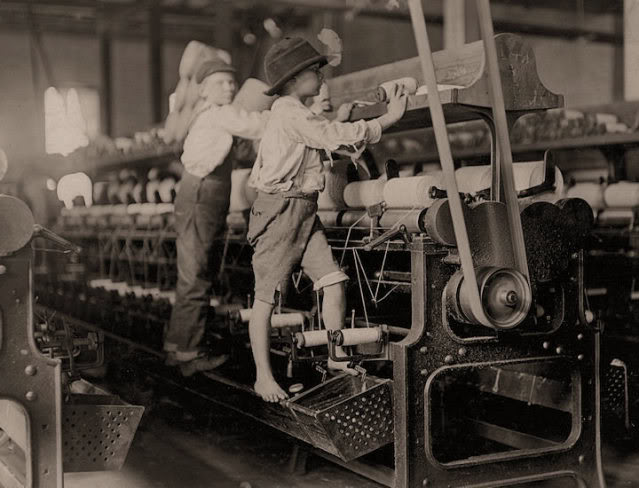
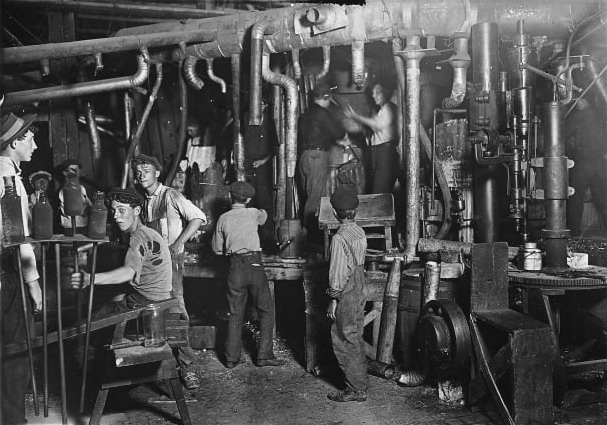
The paradox lies in the following:
-
although living objects (people) operated in inhuman conditions, these conditions helped save many of those living objects.
-
there are many survivors who can witness the inhuman conditions, but there are few or none who can witness that they died because they have no opportunity to work in these inhuman conditions.
Remarks:
-
This kind of expoitation is highlighted by left-wing politicians to emphasise their opinion that capitalism is evil. It is a good example of Von Neumann tactics and Von Croesuss tactics.
Associated concepts:
Links:
-
Link to the short paper titled "Capitalism in the nineteenth century. Awakening of humanity." in Polish
Perception
Definiens:
Perception - is the process of identifying stimuli (visual, auditory and sensory), which is transformed (by sense organs, nerves and the brain) and are interpretation by the brain. Perception aims to understand the surrounding reality.
The set of stimuli reflects a fragment of the surrounding reality to the observer at a given moment.
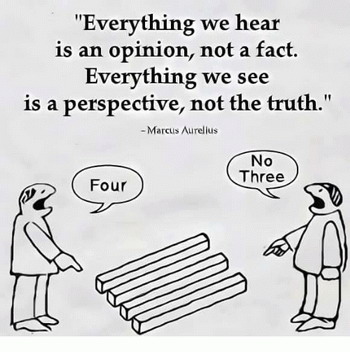
Remarks:
-
A film How we see color - Colm Kelleher.
-
It turns out that people living in different language areas have a different mentality. They vote differently in elections and referendums, they also have a different approach to work and many other matters. Generally speaking, German-speaking Swiss work harder and longer, but are also more distrustful of foreigners who come to settle in their country. The reverse can be said of the part where French dominates. French-speaking Swiss are more open to immigrants and slightly less willing to go to work. Interestingly, even if a given canton is bilingual, these differences can be seen within regions using different languages. So it's not a matter of the difference between the cantons. You can also clearly see different results of referendums in various parts of the country on topics related to the economy, unemployment rates (higher unemployment is where French is spoken), etc.
Quote from the book "The world through the eyes of young economists" - By Anna Balawejder and Krzysztof Dudzic. -
How do we receive information?
Imagining how we perceive reality, how we understand phenomena and processes depends, among other things, on how we receive information, how we analyze it, and what conclusions we draw. Based on conversations, contacts and discussions, I can risk saying that in terms of receiving information, an average, statistical person is characterized by:- One-sidedness of perceived information
- Reluctance to confront it with other sources
- Certainty about own resistance to propaganda and the influence of the media
- Non-reflective acceptance of the opinions of "media" and "moral authorities"
- Lack of independent inference - accepting ready explanations and opinions
- Acceptance of cliches as own views
- Bipolar view of politics [see Reductionist thinking]
- Belief in democracy as a source of all good and a natural regulator of transients
- In the analysis of historical and political issues (and not only), the broken cause-effect relationship
- Avoidance of conclusions that can alter preconceived images
- Belief that "everyone can't be wrong" [see Conformity]
- Loss of interest in media coverage - "everyone lies" [see Matrix]
The order of the points is not accidental - it shows the path from one-sidedness to indifference. Why is it like that? The answer is more complicated than showing how it is. Generally, I divide causes into internal and external. The first are related with human nature and the conditions in which one grew up and functions. They are due to the following reasons:
- Man in the "educational process" is usually formatted by the views of educators and the environments in which he revolves
- Man is usually a lazy creature and all analyses, considerations and searching for sources cost a lot of effort
- A man especially entangled in the hardships of everyday existence does not want to think deeper - he adopts simple and seemingly obvious solutions, matching his own imaginations
- Two, and God forbid, more points of view, introduce cognitive dissonance, which puts stress - you have to adopt some attitude and this is tiring (point 2), and sometimes even impossible if it requires a re-evaluation of previous worldviews.
- Linking specific views with economic, political, social, family positions - in other words - conformity
- Traits such as: credulity, vulnerability to others, lack of opinion, ignorance
- The result of mental heaviness. [see Curse of knowledge]
The second reason described as external is the conscious action of the media owners preventing free access to the information. For now, it is not possible for one person (or group of people) to say something to another (large group) without the permission of a state authority, i.e. a third person in the form of a state official. One small exception is the Internet, but that will probably change soon, because it becomes a considerable source of unconcessionable information and facilitates the free exchange of thoughts.
Quote from the Afterword of the book "Masking the Smolensk's crash".
Associated concepts:
- Barriers to objective observation
- Thinking
- Perception schematic
- Diagram of cognition
- Worldview
- Epistemology
- Juxtaposition of stages of cognition
Perception schematic
Definiens:
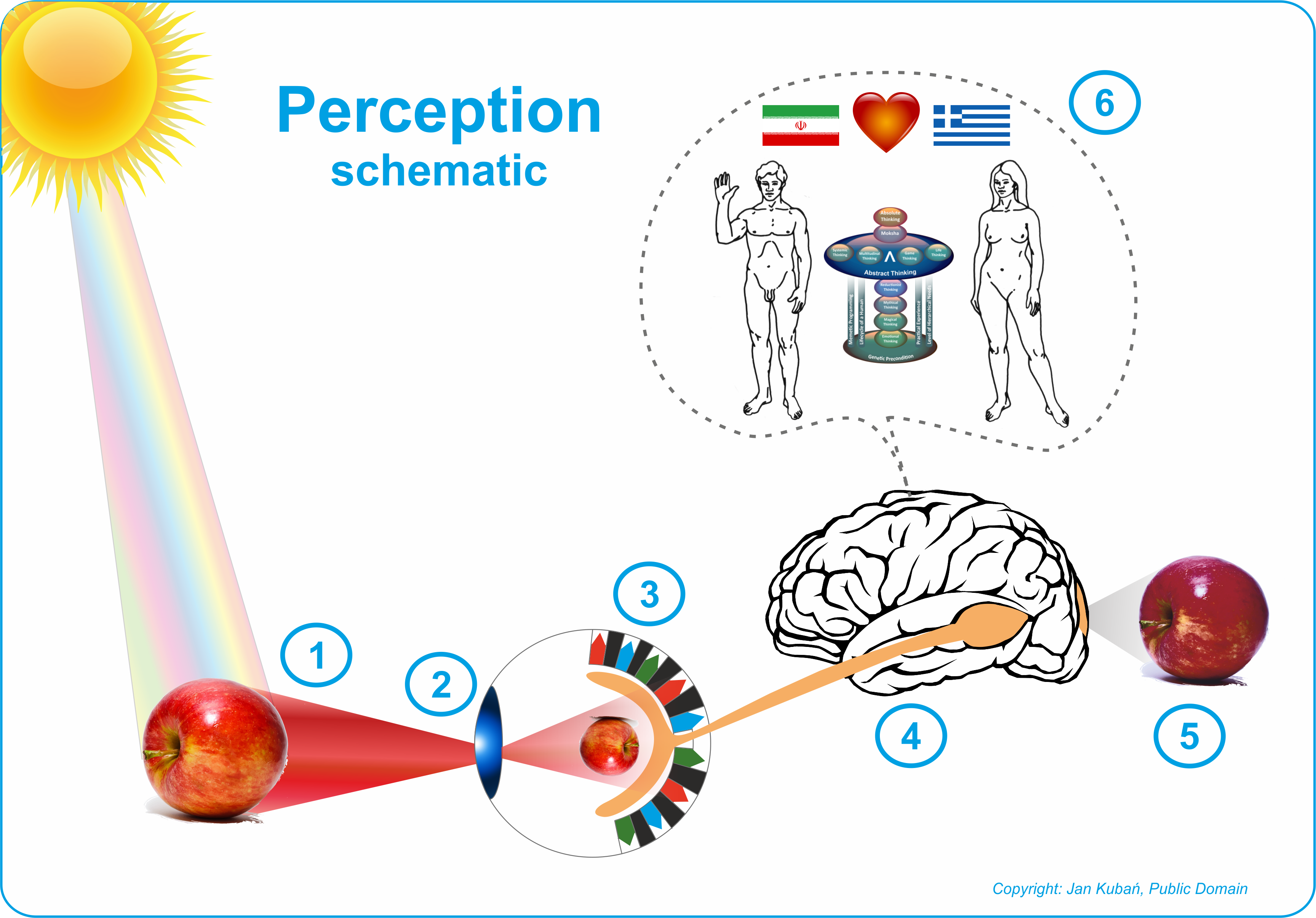
- The sun sends light waves of different lengths towards the observed object
- The observed object only reflects light waves of specified lengths
- The eyes receive these light waves and casts its inverted image on the retina
- The Retina is a matrix that converts the image into a signal. The matrix of cameras work on a similar principle as this (eyes emerged before cameras). The photosensitive element in the eye, which is a cone or rod, corresponds to a screen pixel. Each fibre of the optic nerve creates connections between the retina and the precisely defined place in the occipital lobes of the cerebral cortex, which are also a matrix, like a computer monitor.
- These signals are then reinverted by the brain to create an image in our mind.
- The signal from an external source is reflected from the object, or is emitted by that object.
- This signal acts on the sensor (the organ of the senses - the part of the body capable of receiving external stimuli).
- The sensor interpreter converts the signal that reaches the sensor into a nervous signal.
- This signal goes to the mapping area where the interpretation of the real object is created.
- And then it is analysed and remembered.
- The internal algorithms decide how it is interpreted, how it is analysed and whether it should be remembered. It depends, among others, upon gender, the emotions based on genetics, memetic programming and thinking patterns that a given individual is able to apply.
In this way, signals reaching the brain create in it cognitive models and predictive models by which a living object analyzes and reacts to the environment. In other words: reality is perceived using created imaginary models based on a set of signals received by the brain.
The set of cognitive models and predictive models can be considered, as what some philosophers define as, Qualia: In philosophy and certain models of psychology, qualia (singular form: quale) are defined as individual instances of subjective, conscious experience. [Wikipedia, date 20202.04.04].
Remarks:
-
Human imagination is dangerously limited: it actually only reaches for stereotypes. - French film director Jean Renoir, "My life, my films".
-
A great example is "hand-eye" coordination in snooker.
-
I sent an email to an ophthalmologist: I have a question about the structure of the eye, but I think that only you can give me the answer:
Below is a diagram of the retina. The incoming light arrow suggests that the light must break through the layer of ganglions, amacrins, bipolar and horizontal cells before it hits the cones and rods.
The question is, is this really the case? And don't these four layers absorb too much light?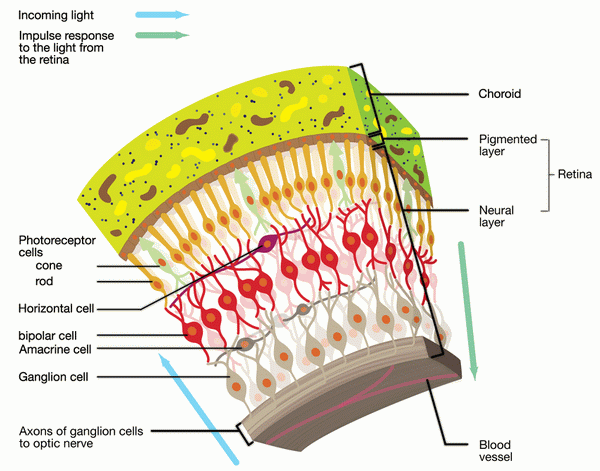
Retina diagram And here is his reply: This is really happening, the proof is that when one shines a light on people's eyes they see the retinal blood vessels. And the vessels are located above the photoreceptors, which is why the light passing through the layers of the retina cast a shadow and therefore we see the vessels. Amacrine and horizontal cells are designed to unify the signal across the entire retinal surface. The others also play an important role.
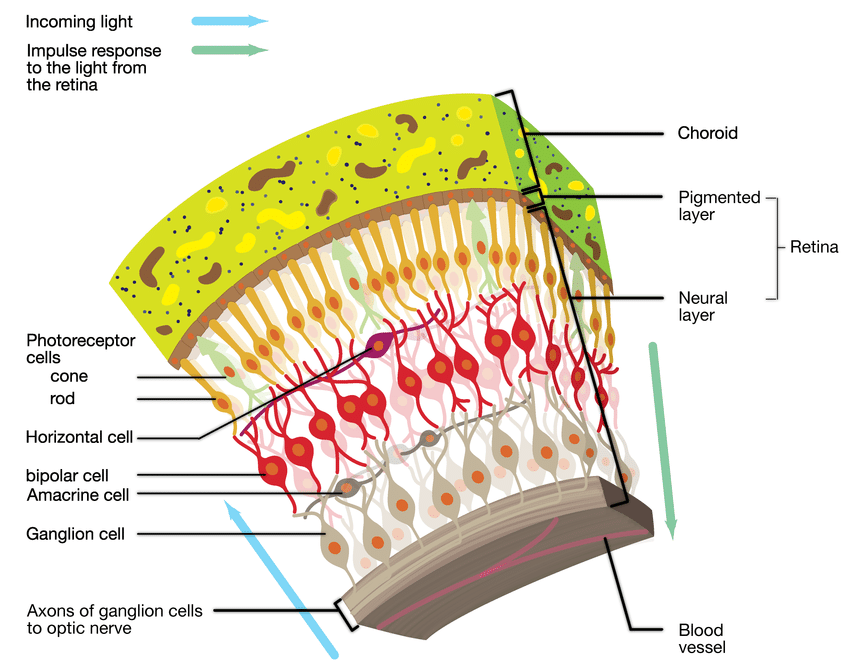
Associated concepts:
- Perception
- Barriers to objective observation
- Thinking
- Diagram of cognition
- Epistemology
- Absolute thinking diagram
Philosophy
Definiens:
Philosophy is the study of general and fundamental problems concerning matters such as existence, knowledge, values, reason, mind, and language. Philosophical methods include questioning, critical discussion, rational argument and systematic presentation.
Historically, "philosophy" encompassed any body of knowledge. From the time of the Ancient Greek philosopher Aristotle to the 19th century "natural philosophy", which encompassed astronomy, medicine and physics. For example, Newton's 1687 Mathematical Principles of Natural Philosophy later became classified as a book of physics. In the 19th century, the growth of modern research universities led academic philosophy and other disciplines to professionalize and specialize. In the modern era, some investigations that were traditionally part of philosophy became separate academic disciplines, including psychology, sociology, linguistics, and economics.
Remarks:
-
The presented above definiens came from Wikipedia state 2018.08.22
-
The definiendum philosophy came from Greek φιλοσοφία, philosophia, literally "love of wisdom". The term was probably coined by Pythagoras (c. 570–495 BCE)
-
Classic philosophical questions include: Is it possible to know anything and to prove it? What is most real? Philosophers also pose more practical and concrete questions such as: Is there a best way to live? Is it better to be just or unjust (if one can get away with it)? Do humans have free will?
Associated concepts:
Professional groups' features
Definiens:
Associated concepts:
- Professions' macroscope
- Bankers - cechy charakterystyczne
- Bezpieczniacy - cechy charakterystyczne
- Duchowni - cechy charakterystyczne
- Dziennikarze - cechy charakterystyczne
- Intelektualiści - cechy charakterystyczne
- Inżynierowie - cechy charakterystyczne
- Kasandryci - cechy charakterystyczne
- Lekarze - cechy charakterystyczne
- Nauczyciele - cechy charakterystyczne
- Naukowcy - cechy charakterystyczne
- Politycy - cechy charakterystyczne
- Rządzący - cechy charakterystyczne
- Pracownicy etatowi - cechy charakterystyczne
- Prawnicy - cechy charakterystyczne
- Sportowcy - cechy charakterystyczne
- Urzędnicy - cechy charakterystyczne
- Żołnierze - cechy charakterystyczne
- Pierwsze Prawo Fizyki Życia
- Błąd poznawczy skrzywienie zawodowe
Uwagi:
-
Sposób w jaki dana osoba jest wynagradzana powoduje, że przedstawiciele danych grup zawodowych zachowują tak, a nie inaczej.
Dziennik:
The Physics of Life
Definiens:
The science that studies the nature and characteristics of living objects (objects that absorb resources and replicate themselves) and the systems they create.
The main elements making up the paradigm of The Physics of Life are enlisted in the Paradigm of The Physics of Life.
Remarks:
-
The first issue discussed in detail in The Physics of Life was the comprehensive model of the emergence (from the essential chemical particles) and development of life on Earth.
-
The main factor in the development of The Physics of Life was absolute thinking.
-
The Physics of Life serves to create complete cognitive models associated with each area of life and proves that, because of the existence of the barrier in processing of information, it will never be possible to create a predictive model that is one hundred percent certain.
☛
Innovations introduced by The Physics of Life since 2009:
-
Unambiguous definitions of: an object, a system, a process in both the economic and mathematical senses and biological evolution.
-
Naming the RPD phenomenon.
-
Determining 5 fundamental properties of chemical particles to initiate biological evolution
-
Introducing the concept of a synthesizing replicator.
-
Introducing gerpedelution as a basic model of biological evolution.
-
Introducing the tools from the theory of stability (sensitivity analysis) to study models of biological evolution.
-
Introducing the concept of self-excitation to a biological arena.
-
Defining the concept of an autodynamic system and introducing it to biology.
-
Introduction of two new evolutionary games: "Small Evolution" and "Small Group Evolution"
-
Introducing the concepts of Victory factor and Evolutionary ratchet.
-
Defining certain styles of thinking, such as reductionistic, systemic and game thinking, and introducing the concept of "absolute thinking".
-
Introduction to the evolution tree of two creation paths: speciation and symbiogenesis. Replacing the evolution tree with HeKroGram.
-
Development of the definition of a living object.
-
Development of the definition of life.
-
Defining the concepts of resergy and its balancing methods.
-
Defining the concepts of tactics of behaviour and tactics of structure, in relation to achieving the life purpose (acquisition of resergy / reproduction).
-
Classifying typical human tactics of behaviour.
-
Determining the organizational levels of living objects.
-
Formulating the Three Principles of The Physics of Life.
 Plunder is the taking over of a resource from an reluctant object in such a way that the object is aware of it.
Politics
Definiens:
Politics is a set of activities associated with achieving and exercising positions of governance — organized control over a human social group, particularly a state.
Associated concepts:
Population analysis
Definiens:
All activities aimed at building an accurate model of a population. The main methods of population analysis are searching for emergent and concident properties.
Remarks:
-
In 2011, the Polish Minister of Health stated that "elderly patients go to the doctor to kill boredom", which of course caused a media storm. Both this statement and the storm is an example of non-thinking in terms of population analysis. Of course there is a section of elderly people who go to the (public & free) doctor for a conversation which the media tried to deny, but it certainly does not apply to everyone.
Thinking in terms of population analysis, we should be aware of the scale of the problem that we need to highlight. If two people in a million go to the doctor for a conversation, this is an irrelevant detail. However, if it concerns, for example, 15% of the population, it can be quite an important social issue.
Population calculus
Definiens:
A mathematical tool that allows to examine living objects as members of the population, understood as a set of objects with at least one of the same property. Population calculus studies a distribution of states of this property within the population and the variation of this distribution over time. It also takes into account the reproduction of living objects.
The base object of the population calculus is popsor and the typical operations are: hit of popsora, addition of popsors, streak of popsor, selective transformation of popsor, breeding of popsor, speciation of popsor, moovens of popsor.
Full description of Population calculus.
Populationally typical emotional reactions
Definiens:
Genetically stored tactics of behaviour typical of the majority of individuals within a given population. These tactics are emergent due to biological evolution. They emerged and are perpetually improved upon. They consist of the automatic launch, by a living object, of a set of specific reactions in response to a set of specific causal factors. Because they are launched unconsciously, for the bystanders they may seem to be incomprehensible or irrational.
Associated concepts:
- Fixed-action patterns
- Syndrome of attraction
- Syndrome of authority
- Syndrome of blindness
- Syndrome of criticism
- Syndrome of conforming
- Syndrome of context
- Syndrome of external blame
- Syndrome of groupthinking
- Syndrome of jamb
- Syndrome of Kali
- Syndrome of Machiavelli
- Syndrome of Mr John
- Syndrome of red eyes
- Syndrome of universal bullshit
Prevoluant
Definiens:
Every element in an evolutionary sequence which is before a given element.
Remarks:
- One of the strong arguments against the theory of evolution is the ridiculous statement that the monkey is the ancestor of man. Indeed, it carries a negativity. We subconsciously associate the word "ancestor" with a wise grandfather or possibly a famous antecedent from the Middle Ages, yet a monkey is usually considered as stupid or, at least, ridiculous. Many people do not even try to think about the essence of the evolutionary process as they do not want to be perceived as following in the footsteps of an ancestor thought of as stupid, ignorant or comical. However, when one says "monkey is a prevoluant of humans", it sounds better, more precise and hurts nobody's pride.
Associated concepts:
Primary class struggle
Definiens:
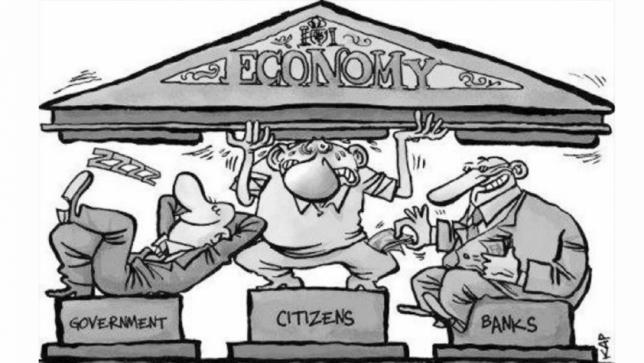 The original theory of class struggle was developed in 1820-30 by the Scottish philosopher, historian, politician and economist James Mill (1773-1836). It was probably heavily influenced by two French intellectuals, Charles Comte (1782-1837) and Charles Dunoyer (1786-1862). In a sense, it is the predecessor of Karl Marx's more famous, but extremely inconsistent, theory of class struggle.
The original class struggle is the struggle between the "ruling class" led by the state apparatus and the "ruled class" - a group burdened with taxes, regulations and governed by the ruling class. Belonging to the ruling class is determined by whether one belongs to the "state" or not. According to this theory, conflicts arise only in the aspect of ruling and being ruled. All other social problems are only derivatives of this original class struggle.
According to the theory of class struggle, within each society there is a set of opposing interests between the different social classes. Each class strives to satisfy its own needs, which puts it in opposition to other classes. Society is, therefore, the result of classes opposing each other. All societies to date have been based on the fundamental division into oppressor and oppressed classes. For millennia there has been a struggle between them.
Associated concepts:
- Characteristic features of those in power
- Socialism
- Model of governance
- Typical instruments of governance
Principle
Definiens:
Principle is a particular law of physics considered to be the most fundamental or the most important.
Associated concepts:
Principles of The Physics of Life
Principles that, combined together, encapsulate all knowledge concerning life. They define the relationship between matter, the processes that the matter generates and the feedback of these processes on the matter. They laid the foundation for The Physics of Life, and enable cognitive models to be built.
However, one should not expect that understanding these principles will allow people to precisely predict the future. This simply can not be done, just like you can not calculate the result of a lottery or predict who will win the finals of the World Cup. Many constructors and destructors which affect life are random and/or non-linear factors. The Physics of Life shows that precise prediction is not possible due to the existence of two barriers: barriers to objective observation and the barrier in processing of information.
Definiens:
-
First Principle of The Physics of Life.
Matter has a tendency to concentrate, the final effect of which is a loss of concentration (eg. explosion or division). The RPD phenomenon is an effect of this principle in terrestrial conditions.
See Duality of Nature and Law of Concentration
In other words: The Principle of Duality of Nature
-
Second Principle of The Physics of Life.
Generated by the RPD phenomenon, the process of biological evolution has a reverse impact on the objects which generated it. It means that biological evolution shapes subsequent generations of interacting living objects and they, in reverse, change the features of biological evolution.
Biological evolution and objects submitted to it compose an autodynamic system.Biological evolution has 5 characteristic features of biological evolution:
In other words: The Principle of the Improvement of Living Objects
-
Third Principle of The Physics of Life.
The interaction between living objects is pursuance.
Biological evolution, in subsequent generations, leads, inevitably, to the emergence of constantly changing tactics of structure and tactics of behaviour aimed at acquiring resources. However, periods of remission are part of this process. This leads to the situation where the acquisition of resources amongst living objects is carried out pursuantly.
Pursuance is the basic model of interactions between living objects in its most general form.
In other words: The Principle of Interactions Between Living Objects
-
Fourth Principle of The Physics of Life.
The more threatened a social group is, the more members of this group must cooperate.
See Small Evolution Model with a "Realistic" Payoff Matrix.
In other words: The Principle of Coercion to Cooperate.
Prisoner's dilemma
Definiens:
A key example in mathematical game theory to illustrate the orthogonality of the interests within a group.
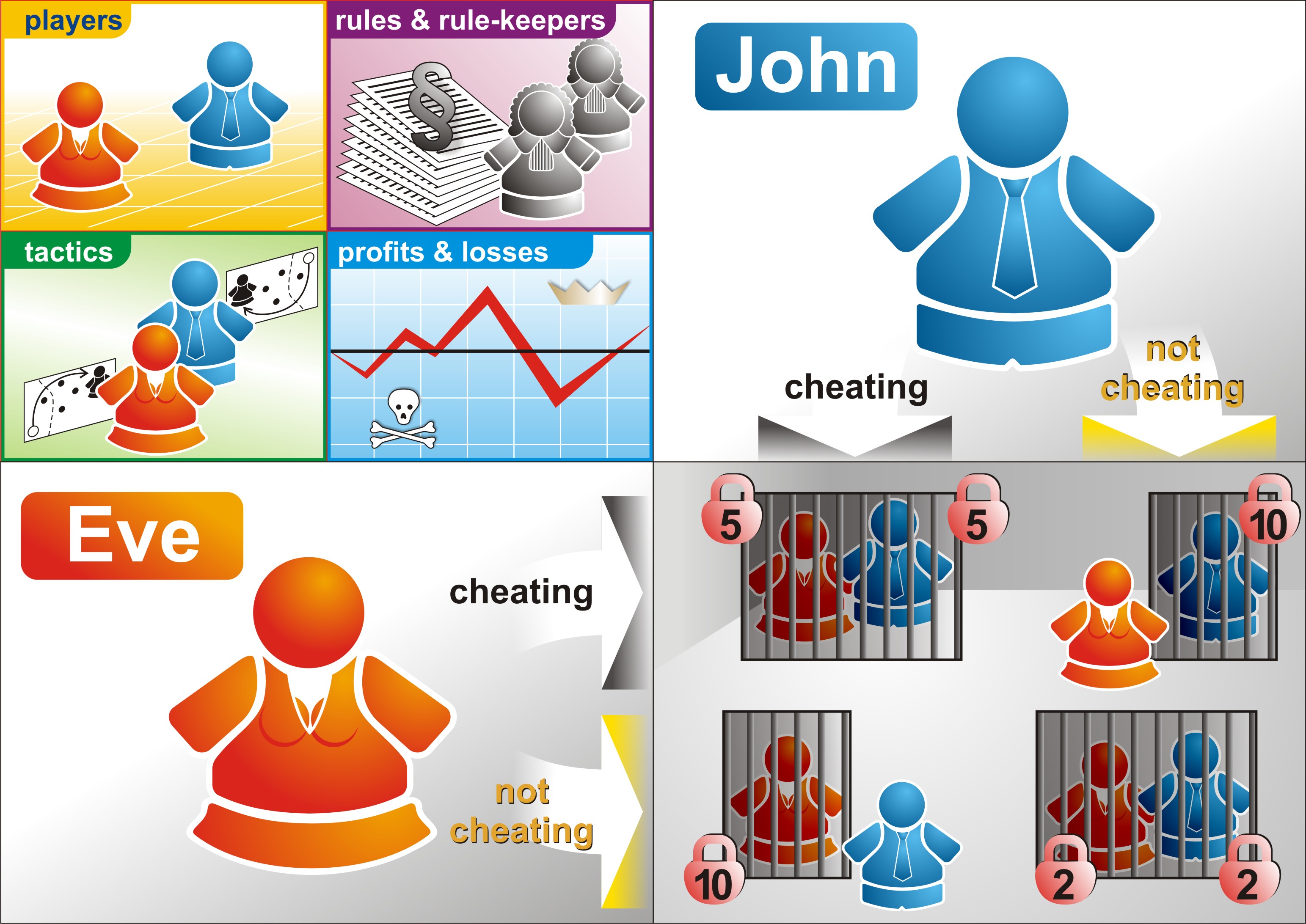
John and Eve - two members of a criminal gang are arrested and imprisoned. Each prisoner is in solitary confinement with no means of speaking to or exchanging messages with the other. The police admit they don't have enough evidence to convict the pair on the principal charge. They plan to sentence both to two years in prison on a lesser charge. Simultaneously, the police offer each prisoner a Faustian bargain. Here's how it goes:
-
if they behave loyally towards each other and will remain silent, they will be sentenced only to two years in prison for some minor crimes
Balance for the group =-4, Individual balance John=-2, Eve=-2;
-
if they do not behave loyally towards each other and both will testify, they will be sentenced to five years in prison for this crime
Balance for the group=-10, Individual balance John=-5, Eve=-5;
-
if one person will testify and the other remains silent, the former will be released and the latter will be sentenced to ten years in prison
Balance for the group=-10, Individual balance John=0, Eve=-10; (or vice versa)
After the two were arrested, they were placed in isolation. Neither of them will know what the other will do: testify or not. The dilemma lies in the fact that I, as a player, don't know what to do? The best situation for me occurs when I blame the other person and they say nothing. But I'm not stupid and I know that they know that too. What to do? Not to testify is risky because if they will charge me I will go to prison for 10 years. It is safe to charge him, because there is a chance, albeit small, that they will not charge me and I will be allowed to go free. The dilemma deepens when inmates are in the same cell and can communicate. Of course, both promise not to accuse each other, but what sort of stress would they undergo during the trial! "Cheat or not to cheat?" - that is the question.
The prisoner's dilemma is a good example that:
-
the result does not depend on a single player's action, but the actions of both of them,
-
in order to the group reachies the maximum benefit, all of its members must follow what they agreed,
-
the person who benefits the most is the one who breaks the agreement whilst the other(s) follow what they agreed,
-
information (in the form of a specific decision) influences the material world (the actual sentence).
Associated concepts:
Probabilistic paradox of occurrence
Definiens:
The fact that the probability of an occurrence of something is extremely low (or high) does not mean that it will not happen (or will happen). This leads to two mundane conclusions:
- No matter how (amazingly, shockingly) small the probability of an occurrence is, it does not mean that it will not happen.
- No matter how (amazingly, shockingly) high the probability of an occurrence is, it does not mean that it will happen.
Associated concepts:
Probability distribution
♥ Definiens:
In probability and statistics, the probability distribution is a function that, for a given domain of events, associates the probability of occurrence of each of these events.
For instance: in the experiment of tossing a coin, the possible outcome is "heads" or "tails". "Heads" and "tails" are, therefore, the investigated space of events and is the domain of the probability distribution function (for simplicity, hereinafter, let's call it PDF). It is equally probable for the coin to fall heads or tails; in other words the distribution of the probability of both events is the same, which means that PDF(tail)=0.5 and PDF(head)=0.5. In more practical terms, the probability distribution function provides the probablity of occurence for each possible event.
Probability distribution function is a theoretical concept serving for making decisions. This function is determined based on previous knowledge and experience.
| Space of possible events | Probability distribution function |
|---|---|
| A set of actions that a player can take at any given moment | The set of consequences triggered by each element from the set of actions |
| A list of candidates participating in the elections | Pre-election forecasts |
Probability distributions are generally divided into two categories:
-
A discreet probability distribution (applicable to the scenario where the set of possible outcomes is discreet, such as a coin toss or a roll of the dice) can be encoded by a discreet list of the probability of the outcomes, known as a probability mass function.
-
A continuous probability distribution (applicable to the scenarios where the set of possible outcomes can take on values in a continuous range (e.g. real numbers), such as the temperature on a given day) is typically described by probability density functions (with the probability of any individual outcome actually being 0).
Process
Definiens:
Process is a sequence of events/actions resulting in a particular state/purpose.
A set of activities that produce a specific result, service or product.
Other definientia:
-
System performing a specific sequence of changes.
Producers/Thieves
Definiens:
A fundamental classification of living objects for The Physics of Life is: Producers - producers of resergy [producers of required resources] and Thieves - absorbers of resergy [consumers of required resources].
Remarks:
-
An analogous division (into Atlases/Looters) was proposed and described by Ayn Rand in the book "Atlas Shrugged"
-
A similar division (into Ants and Grasshoppers), excellent for popularizing the idea of evolutionary games and building understandable social models, was proposed by Krzysztof Habich.
-
And probably the most contagious division: makers and takers.
Associated concepts:
Professions' macroscope
Definiens:
Professions' macroscope is the definiendum of the natural tendency of an autodynamic system which can be composed of:
- a person with a given professional profile
- the institution employing this person
- the motivant of this person and the motivant of the institution
- the methods used by this person and this institution
- the external conditions in which the person and the institution function
- the set of feedback imposed on that person and the institution
Associated concepts:
Pursuance
♥ Definiens:
The set of phenomena associated with the process of achieving a goal. From the viewpoint of mathematical game theory this is a branch of a decision tree. The branch which, up to this point, was taken and will continue to be undertaken from now on.
Full definition of pursuance.
Other definientia:
-
Anticipative feedback
Remarks:
-
Pursuance constitutes The Third Principle of The Physics of Life.
-
Achieving anything relies on a consequent urge to the goal, anticipation of adversor's movements and cohesion in play with teammates. See Game's characteristic elements.
This concept belongs to the Paradigm of The Physics of Life.
Quotes from literature: in Polish or Google English from Polish
- associated with Pursuance
Reaction of living objects to external conditions
Definiens:
In bad external conditions, living objects invest in offspring - in the reproduction of genetic information. In good conditions - they invest in themselves.
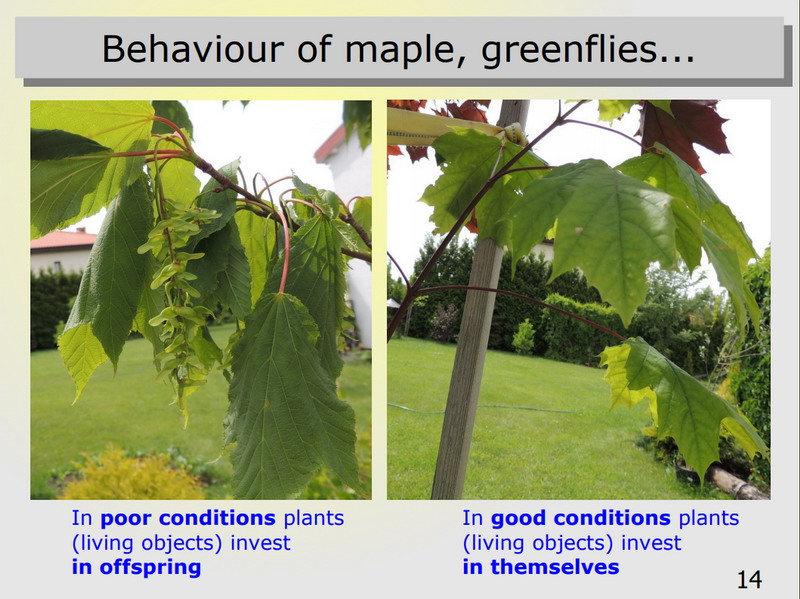
Reasoning from first principles
Definiens:
It is a methodology for solving scientific problems by breaking them down into the basic elements, studying each of the elements from its first principles without relying on already known assumptions, statements and conventions.
Remarks:
-
It’s one of the best ways to develop independent and innovative thinking, and unlock ones creative potential.
-
This way of reasoning was used by Aristotle, Henri Poincaré and now by Elon Musk and Charlie Munger.
-
I don’t know what’s the matter with people: they don’t learn by understanding; they learn by some other way—by rote or something. Their knowledge is so fragile! — Richard Feynman.
-
This method of going to the principles is used by children, unfortunately it disappears with age.
Links:
- Leonardo da Vinci also recommended working this way
- First Principles: The Building Blocks of True Knowledge
Reductionist thinking
Definiens:
Reductionist thinking is to take a complex structure and reduce it to its simplest form, taking into consideration its most important and/or influential components.
In a very general form, it can be said that reductionist thinking is to find a clear rule that fully explains the phenomenon and allows for prediction.
Remarks:
-
Using this method, Isaac Newton (1643-1727) discovered and presented in simple mathematical formulas the two fundamental laws: law of motion in the form of three principles of dynamics and the law of universal gravitation. Just a few equations are enough to fully understand the motion of planets. Due to this, scientists cemented the belief that the world can be seen as a mechanism governed by simple rules, and these, sooner or later, will be discovered and described in simple equations. The laws of conservation of mass, momentum and energy, later formulated by physicists, are other examples of successful conceptual reductionist thinking.
The physicists were followed by others, including naturalists, philosophers, economists and sociologists. All of them focused on the rejection of what, they thought, was negligible in the studied phenomenon, and on finding a fundamental, simple cause-and-effect relationship, preferably in the form of a concise mathematical formula. In the wake of the scientists were the engineers, who applied these newly discovered laws with great success. Moreover, it occurred that, in practice, this reductionist-isolationist approach became "the only correct" one [9788374840453, p.10, paraphrased by - JF].
This "only correctness" was proven by the most famous formula in the world: Enstein's (1879-1955) E=mc2. The fact that reductionist thinking was successfully proven so many times by scientists and engineers, it caused that the vast majority of people intuitively perceive it as coherent and logical. Moreover, it is relatively easy in teaching and therefore educational systems around the world use and teach it from the earliest ages. Thus it evolved into the dominant paradigm of knowledge. However, as science has advanced, it turns out that, while it explains many issues well, it unfortunately does not allow for a full understanding of the mechanisms of nature.
Associated concepts:
Resergy
Definiens:
Quantitive measure of a living objects survival (achieving its life purpose) potential.
Resergy consists of: matter, energy and information. Therefore, it is not additive nor able to be conserved. It depends on time, environmental conditions and, moreover, objects and their interactions: deer droppings are not included in the resergy of man, but it is the main source for the dung beetle (Geotrupes stercorarius).
Resergy is classified according to the organizational level of the living object, and therefore is distinguishable between the individual resergy required for the survival of an individual and the social resergy necessary for the continuation of the community.
Other definientia:
-
Resources necessary to a living object to achieve its life purpose.
Remarks:
-
The concept of resergy (resources needed) should not be confused with the concept of "desired resources".
Associated concepts:
Revolution's cycle
Definiens:
One of the real progressions of Tytler's cycle. Characteristic cycle of the progression of revolution. It consists of the following stages:
-
Decay: Development of numerous groups, better equipped with greater privileges, around the centre of power. These privileges come down to the fact that these people consume more while producing less and/or less useful goods - resergy. This causes a build-up of social inequality and discontentment of those who produce resergy.
-
Revolution: Revolt triggered by any factor affecting the lowest level of society, coming together to overthrow those in power. Centre of power and the privileged groups supporting it are moved away from power, often through annihilation. The revolution does not comply with man-made laws, but with natural law - if I can kill, I kill. Due to this production and free trade dies and theft, looting and robberies increase. The revolt centres around one of three doctrines: communist (if the centre of power is supported by religious structures), religious (if the religious structures were in opposition to the centre of power) and economical recovery (usually this type of rebellion is created by an intelligent individual).
-
Fight for power: Lawless period - the period of an animalistic struggle for power which results in the formation of groups fighting each other, until finally, one of them (usually the most radical) gets total power (usually by the annihilation of the others).
-
Return to decay: Return to the process of the formation of privileged groups around the centre of power.
Associated concepts:
RNA
♥ Definiens:
Ribonucleic acid (RNA) is a polymeric molecule essential in various biological roles in coding, decoding, regulation, and expression of genes. RNA and DNA are nucleic acids, and, along with lipids, proteins and carbohydrates, constitute the four major macromolecules essential for all known forms of life. Like DNA, RNA is assembled as a chain of nucleotides, but unlike DNA it is more often found in nature as a single-strand folded onto itself, rather than a paired double-strand. Cellular organisms use messenger RNA (mRNA) to convey genetic information (using the nitrogenous bases guanine, uracil, adenine, and cytosine, denoted by the letters G, U, A, and C) that directs synthesis of specific proteins. Many viruses encode their genetic information using an RNA genome. [Wikipedia, eng. acces 2018.04.02]
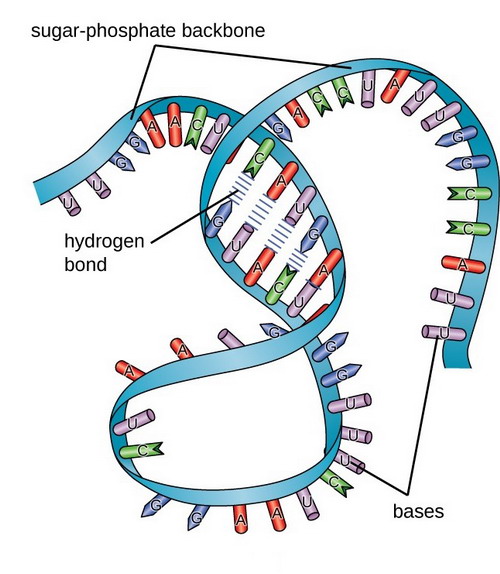
Source: https://microbenotes.com/rna-properties-structure-types-and-functions/
Remarks:
-
RNA particles have a unique feature: depending on its nucleotide sequence they have very different physico-chemical properties. They can, for example, act as an information carrier or play the role of a causative factor.
RNA - as an information carrier Type Abbr. Function Distribution Messenger RNA mRNA Codes for protein All organisms RNA - as a causative factor Type Abbr. Function Distribution Ribosomal RNA rRNA Translation All organisms Transfer RNA tRNA Translation All organisms Signal recognition particle RNA 7SL RNA or SRP RNA Membrane integration All organisms Transfer-messenger RNA tmRNA Rescuing stalled ribosomes Bacteria Telomerase RNA component teRNAc serves as a template for telomeres replication (on the principle of the reverse transcription) by telomerase Most eukaryotes Guide RNA gRNA mRNA nucleotide sequence modification Kinetoplastid protists
Associated concepts:
- DNA
- Design
- Transcription
- Translation
- 5 fundamental properties of chemical particles to initiate biological evolution
 Robbery is the taking over of a resource from an reluctant object using violence or aggression.
RPD
Definiens:
The phenomenon of the destruction and reconstruction of objects. This reconstruction is due to the natural tendency of particles to group, whilst the destruction is the result of reaching a certain, critical point of the cohesiveness of the (re)constructing object.
Examples of RPD-type particles are:
- Liposomes (spherical membrane structure) constructed from free phospholipids
- DNA (linear biopolymer) built from deoxyribonucleotides
- RNA built from ribonucleotides
The RPD phenomenon initiated Biological evolution.
Remarks:
-
The abbreviation "RPD" was created by combining the first letters of the Latin phrase reconstructo post dividere, which means "rebuilding after the division".
-
Many philosophers look for a basic factor which can explain our chaotic world. It seems that this factor is the RPD phenomenon, which instigated the process of biological evolution. Ergo, RPD generated biological evolution, which created and still shapes different forms of living objects. Life is, in fact, derived from the phenomenon of RPD.
-
Accurate reconstruction of RNA is possible, but in this process, there are a lot more errors than during the reconstruction of DNA.
-
It is worth noting that the RPD-type particles behave as if they implement the strategy: "absorb resources until division". Of course, it is not a strategy "invented" by them, but simply the physics of the phenomenon.
Associated concepts:
S-Nastu dilemma
Definiens:
A key dilemma for The Physics of Life which refers to species: either species is submitted to a strong natural selection (see S-Nastu improvement graph) and survives as a species or the species is submitted to a weak selection function (see S-Nastu reversion graph) gradually becoming less adapted to the external conditions.
In the second case, two dangers may occur:
- the constant rise of getting the necessary resources (resergy), and, in any given moment, the species may not be able to get them
- degeneration of the genetic designs within the population to such an extend that multiplication (sexual) becomes impossible.
Remarks:
-
John Calhoun's experiment confirms that the degeneration of memetic designs, caused by a safe environment with no external threats, leads to the situation that living objects are unable to achieve their life purpose.
Associated concepts:
S-Nastu hypothesis
Definiens:
There is a correlation between the percentage of individuals selected from the initial population to reproduce (in other words, the force of the selection function) and the quality of the properties of living objects in the next generation.
Full description of S-Nastu hypothesis
Remarks:
-
It is just that the strong multiply and grow, and the weak perish. Otherwise, the world would become home to the disabled, which would be an injustice. - Boleslaw Prus "The Doll"
-
Charles Darwin wrote in "The Origin of Species…" about a natural tendency to reversion to a less perfect state.
Saint Matthew's ratchet
Definiens:
Natural mechanism which functions in social groups that causes that the selection function becomes non-linear.
Remarks:
-
A description of the phenomenon caused by this mechanism is found in the New Testament, written by St. Matthew: For everyone who has will be given more, and he will have an abundance. Whoever does not have, even what he has will be taken from him.
-
This mechanism is best illustrated by the phenomenon of pre-harvest famine: survival of the peasants were dependent on wealth, intelligence, resourcefulness and luck. Those who were better managers had a better harvest in the previous year, and therefore, were better prepared for the pre-harvest period, they had enough supplies to feed themselves and their family. In turn, for those not so well prepared, it was a period of forced fasting, during which they consumed everything edible, including spoiled food or even plants which are not present in a normal diet (e.g. different types of weeds). Badly prepared farmers were unsuccessful and were forced to borrow from the well prepared farmers, compensating in either money or food. After the harvest, they were obliged to pay back the loan which saved their lives. Even assuming that in a given year, all the farmers harvest the same amount, it still ended up that in the following August is that the collections made by the good managers were increased by the repaid loans, and the least resourceful had their supplies depleted. So those that were better prepared were better and better off through the subsequent years whilst the least resourceful ones were gradually worse and worse off after each passing year.
Links:
-
Article "The Matthew effect in science" by Robert K. Merton
Quotes from literature: in Polish or Google English from Polish
- associated with Saint Matthew's ratchet
Sansara
Definiens:
A definiendum taken from the philosophy of the Far East, the definiens of which is: the process of changes which all objects are subjected to. The process of creation (as a result of initiators), duration (as a result of the interactions between constructors and destructors) and termination (resulting from terminators) of an object.
Other definientia:
-
In Hinduism, Jainism and Buddhism, the term literally means constant wandering, the cycle of birth and death, or the cycle of reincarnation to which all living entities, including divine beings (devas), have been subjected to for an indefinite period. After each subsequent incarnation, the next one is selected according to the accumulated karma.
The definiens mentioned above is called biological evolution in The Physics of Life.
-
In Buddhism, samsara also signifies the cycle of changes to which all beings and phenomena, including our thoughts, feelings, and bodies, are subjected to. It is an endlessly repeated process of creation and destruction.
This definiens is exactly the same as what The Physics of Life defines as a Lifespan of an Object.
Associated concepts:
Science
Definiens:
Science is the whole of activities aiming at understanding reality by building cognitive models and, if it is possible, to predict the future by building predictive models. These models can predict precisely (exact prediction) or estimate (trends).
Other definientia:
-
E.O. Wilson "On Human Nature":
The whole of activities to develop a theory.
The value of a scientific theory is measured by its ability to transform a small number of axiomatic theses into detailed statements about the expected course of observable phenomena. In this way, Bohr's theory enabled the emergence of modern chemistry, and this chemistry created a new cell biology. The measure of the value of the theory is, moreover, the extent to which the predictions based on it can victoriously compete with the predictions derived from other theories concerning the same phenomena - the Copernicus system, after a short fight, won the victory over the Ptolemy system. And finally, scientific theory gains influence and prestige among scholars as more and more facts allow us to include easy-to-remember and handy explanatory schemes and how newly discovered facts turn out to be in line with its theses - it speaks more for the probability that the Earth is round than it is flat.
-
Rodney Stark "The triumph of Christianity. How the Jesus movement became the world's largest religion"
Science is a method utilized in organized efforts to formulate explanations of nature, always subject to modifications and corrections through systematic observations. Thus science consists of two components: theory and research. Theorizing is the explanatory aspect of science. Scientific theories are abstract statements about why and how some portion of nature (including human social life) fits together and works. Of course, not all abstract statements, not even those offering explanations of nature, qualify as scientific theories; otherwise theology would be a science. Instead, abstract statements are scientific only if it is possible to deduce from them some definite predictions and prohibitions about what will be observed. Scientific research consists of making observations that are relevant to the predictions and prohibitions from a theory. If the observations contradict what has been deduced from the theory, then we know that the theory is wrong and must be rejected or modified. By “organized efforts” it is recognized that science is not merely random discovery. Instead, scientists pursue their efforts systematically, intentionally, and collectively—even scientists who work alone do not do so in isolation. From earliest days, scientists have constituted networks and have been very communicative.
Associated concepts:
Scientific law
♥ Definiens:
Scientific law, in The Physics of Life - a fundamental, well-defined, unambiguous, universally verifiable and indisputable cognitive model or predictive model.
Associated concepts:
Scientific rule
Definiens:
In physics, scientific rule is something like a weaker law - a law applicable in specific external conditions. When the conditions change, the rule may change, but the laws and principles do not.
Associated concepts:
Scientists
Definiens:
Remarks:
-
They both view the problems only from the angle of those pressure groups which are immediately favoured by the measure in question and disregard its ultimate social consequences. They are not economists, but expounders of government activities in a particular branch of the administration.
- Ludwig von Mises "Bureaucracy". -
Because of the success of science there is a kind of a… I think a kind of pseudoscience… Social science is an example of a science which is not a science. They don't do scientific… They follow the forms: you gather data, you do so and so on and so forth. But they don't get any laws. They don't haven't found out anything. They haven't gone anywhere yet. Maybe someday they will but it's not very well developed.
But what happens is, at an even more mundane level, we get experts on everything. That sounds like they are sort of scientific experts, they are not scientific. They sit as a typewriter and they make up something like… food grown with… fertilizer that is organic is better for you than food grown with fertilizers they don't get. Maybe true may not be true. But it hasn't been demonstrated one way or another. But they will sit there on the typewriter and make up all this stuff as if it is science. And then become an expert on foods… organic foods and so on. There is all kinds of myths and pseudoscience all over the place.
Now I might be quite wrong maybe they do know all this thing. But I don't think I'm losing. I have the advantage of having found out how hard it is to get to really know something. How careful you have to be about checking the experiments, how easy it is to make mistakes and fool yourself. I know what it means to know something. And therefore I can't… I see how they get their information. And I can't believe that they know it. They haven't done the work necessarily… the checks necessary and then the care necessary.
I have a great suspicion that they don't know, that this stuff is no… and they are intimidating people but… I think so, I don't know the world very well but that's what I think.
Richard Feynman on Pseudoscience https://www.youtube.com/watch?v=tWr39Q9vBgo
Associated concepts:
Links:
- "Richard Feynman on Pseudoscience": https://youtu.be/tWr39Q9vBgo
Quotes from literature: in Polish or Google English from Polish
- associated with Scientists
Second Law of the Physics of Life
Definiens:
The law of increasing the efficiency level of a body's given characteristic as a result of increasing its use, and in reverse, reducing its efficiency due to inactivity.
Associated concepts:
Selection
Definiens:
The transformation of a set of objects by the selection function into a set of selected objects.
Remarks:
-
Selection is the second stage of gerpedelution
-
In the case of living objects, those selected are the ones who have survived long enough to have offspring. The unselected ones are those which died before having offspring.
Quotes from literature: in Polish or Google English from Polish
- associated with Selection
Selection function
♥ Definiens:
The selection function is one which transforms an input set of objects into a set of selected objects. This function tests whether an object conforms to a given condition - selection criterion - and rejects those that do not meet this condition.
Additional definienda:
in relation to living objects depends on:
-
number of objects in the input set - the more there are, the stronger the selection function, because there are more options to choose from
-
proportion of the successful objects compared to the number of rejected ones - the fewer objects selected, the stronger the selection function
-
diversity of features of objects within the input set - the more diverse the input set of objects, the stronger the selection function
it is a condition which must be fulfilled in order for the selection function to select the object according to this condition. In the case of living objects, it may be a very simple criterion, such as: "can escape faster than…, further than…, stronger than…" or a very complex one, "Kill all the opponents in the tournament".
Competitive selection criterion
operates in these stages:
-
a session of games is played between objects,
-
each game results in gaining or losing points,
-
each object is ranked according to its total score,
-
the selection function selects, in a given moment (ie. after four rounds, at an undefined moment), the top n number of objects from this ranking
Associated concepts:
Remarks:
-
Competitive selection criterion is extremely strong when n=1, which means that there is only one selected from all the objects.
-
Competitive selection criterion is extremely weak when all the objects are selected, which means that the selection process hasn't occurred.
-
In the case of biological evolution, weak competitive selection criterion, according to the S-Nastu hypothesis, leads to the degeneration of genetic and memetic designs.
However, we can't say that an extremely strong competitive selection criterion is always the best for biological evolution. The final perfection (ie. wing) can arise as a sequence of temporary basic imperfections (ie. proto-wing which could cause inefficiency on land). It can be presumed that the optimum is somewhere close to an extremely strong competitive selection criterion. However, it is difficult to specify exactly because the game is a non-linear phenomenon.
Quotes from literature: in Polish or Google English from Polish
- associated with Selection criterion
Self-contagious label
Definiens:
The feature of a label (or slogan) which is quickly adopted by the general population.
Associated concepts:
Quotes from literature: in Polish or Google English from Polish
- associated with Self-contagiousness
Self-reliant pursuant object
Definiens:
The general model of an object which actively maintains its self-control and uses it for achieving goals in a pursuant manner.
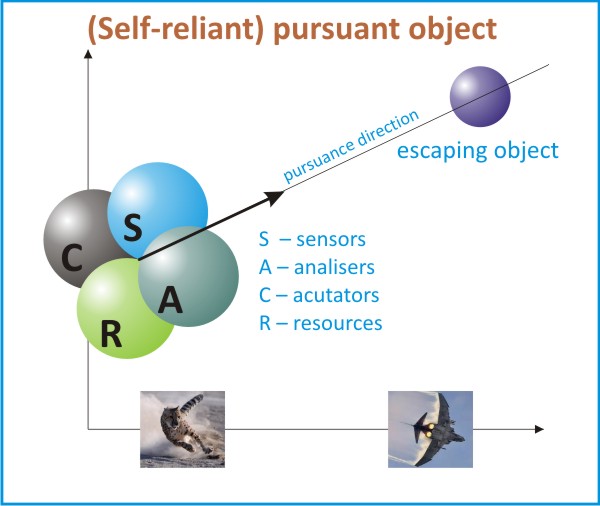
The model consists of four basic elements:
-
Sensors - e.g. eyes, ears, blood pressure monitor, speedometer, rangefinder, ammeter, observer.
-
Analyzers - e.g. brain, on-board computer, command center.
-
Acutators - e.g. muscle, pneumatic cylinder, electric motor, pump.
-
Stored resources - e.g. glycogen and fat accumulated in a body, battery, fuel tank.
Remarks:
-
The term "autonomous system" or "autonom" was introduced by Marian Mazur. In his first publications he used the term "independent system". The term "autonomous system" became the basis for the development of the Polish school of social cybernetics.
[Wikipedia, pol 2015.05.23. More] -
(Self-reliant) pursuant object is a simplified model of an autonom (autonomous system) proposed by Marian Mazur. An autonom has the ability to control itself and resiliently maintains this ability. To have these two features, it must, according to Mazur, contain, each of the following subsystems: receptors, effectors, correlator, alimentator, battery and homeostat.
[Wikipedia, pol 2015.05.23. More]
Self-spreadness
Definiens:
The feature (usuallly the victory factor) of an object, which causes that it multiplies and passes through the selection stage of gerpedelution process, causing the rise of numbers of it's offspring in subsequent generations.
Associated concepts:
Quotes from literature: in Polish or Google English from Polish
- associated with self-spreadness
Sensitivity analysis
Definiens:
This is a study of how a model of any system responds to different kinds of changes:
- initial conditions,
- system parameters,
- structure of the system,
- external conditions.
In particular, it is important to study the impact of the so-named disturbances - seemingly insignificant changes, rare or even unpredictable.
The most important thing in this analysis is to discover the nature of the reaction of the system. It may be, in fact, linear or non-linear, may only change the behaviour of the system or even change the system itself.
Other definiendum: Vulnerability analysis
Self-excitation
Definiens:
Self-excitation is the provocation (triggering, inspiring, animating, stimulating, arousing) which brings into existance new processes in the system. Self-excited processes are the result of supplies of energy and are initiated by destabilizing disturbances.
Remarks:
-
In technical science the concept of self-excited vibrations is well-known. This vibration occurs in a dynamic dissipative system which is fed back onto itself. The vibrations are maintained (or powered) by an external source of constant energy.
-
Self-excited vibrations can be destructive to the system, for example, when the frequency is close to the natural frequency of the system (natural frequency is the frequency at which a system naturally vibrates once it has been set into motion).
Examples of self-excited processes:
- swaying trees, ripples of fields of cereals, flapping flags, shaking towers, chimneys and bridges in the wind
- rocking electric cables
- vibrations of turbine blades in jet engines
- swinging pendulum in a clock
- creation of alternating current in generators
- hydrological cycle
- biological evolution
Links:
- Vibrations and Aeroelasticity author: Franciszek Dul
- Introduction to Aeroelasticity author: Franciszek Dul
Associated concepts:
Set
Definiens:
A well-defined collection of distinct objects.
One of the most fundamental concepts in mathematics. It is also considered as a primitive notion, a concept that is not defined in terms of previously defined concepts.
Short-/long-term benefit dilemma
Definiens:
Classical dilemma in which one has to decide whether to choose between "lower risk, low immediate benefit" or "higher risk, potentially high benefit in the future".
Small evolution
Definiens:
A classic evolutionary game for The Physics of Life - a model of a society consisting of independent objects, absorbing the available resources.
The game is imposed on a population composed of a number of players (n). For a period of time all the players are randomly matched in pairs and play against each other in a contest called a single-game meeting. Depending on the strategies used, each player gains or loses points. After each single-game meeting, each player adjusts his account, wins and losses, and prepares for the next meeting after the pairs are redrawn. The most important factors of this game are the rules of selection and duplication. Occasionally, sometimes after three single-game meetings, sometimes after a million (nobody knows when), the selection and duplication occurs. When it happens all the players are ranked according to points gained. Then the top 50% of players are selected for the subsequent games. The bottom half is rejected and no longer take part in the game - you can say that they are annihilated. Those who pass the selection are duplicated and gameplay restarts from the beginning. As you might notice, after this operation, the population remains at the same level of output. These cycles repeat ad infinitum.
To be exact, let's name:
-
round - the sequence of single-game meetings which started just after the selection & duplication number N till selection & duplication number N+1;
-
cycle - a round with the completed selection & duplication.
Full description of the game "Small evolution"
Remarks:
-
The analysis of this model with the payoff matrix "As in life," leads to the conclusion that communities fall into the so-called Tytler cycle
Small group evolution
Definiens:
A classic evolutionary game for The Physics of Life - a model of a society consisting of objects cooperating to form independent systems able to absorb the available resources.
The game is played exactly like the small evolution, but every single player is considered as a team of n players closely cooperating with each other, and selection involves the whole team.
Each player in this game is a team, consisting of individual elements working together to benefit the whole. Such a team is called the g(roup)-player and in small group evolution is considered to be a Wholly Selected System - WSS. When duplication occurs, the whole team is replicated.
Remarks:
-
An analysis of this game shows that each element of the team is compelled into perfect cooperation.
Social Capital
Definiens:
"the networks of relationships among people who live and work in a particular society, enabling that society to function effectively". It involves the effective functioning of social groups through interpersonal relationships, a shared sense of identity, a shared understanding, shared norms, shared values, trust, cooperation, and reciprocity. Social capital is a measure of the value of resources, both tangible (e.g., public spaces, private property) and intangible (e.g., actors, human capital, people), and the impact that these relationships have on the resources involved in each relationship, and on on overriding and adjacent groups. It is generally seen as a form of capital that produces public goods for a common purpose.
Wikipedia Eng. 2021.01.28
Remarks:
-
Putnam’s survey was able to distinguish two different kinds of social capital:
bridging capital refers to trust between groups, between people who have different values and identities, while bonding capital refers to trust within groups. Putnam found that diversity reduced both kinds of social capital.
Jonathan Haidt "The Righteous Mind: Why Good People Are Divided by Politics and Religion" page 315.
Associated concepts:
Social Cycle
♥ Definiens:
A natural cycle characterized by the interaction between the elements that constitute social systems PSS-type. It consists of the following stages:
| Stage I of Social cycle |
Scarcity of resources forcing a coercion of cooperation or a coercion to eliminate members of the population and take the resources belonging to them. Remark: sooner or later, elimination brings the society back to scarcity of resources. Cooperation leads to stage II of Social cycle. |
| Stage II of Social cycle | Undertaking cooperation or going to stage IV of Social cycle. |
| Stage III of Social cycle | Cooperation resulting in an excess of resources. |
| Stage IV of Social cycle |
Striving to improve the balance of benefits and losses at the expense of others. In the case of a shortage of resources, this is done mainly by robbery, in the case of an excess of resources, mainly by theft and plunder. |
| Stage V of Social cycle | Return to stage I. |
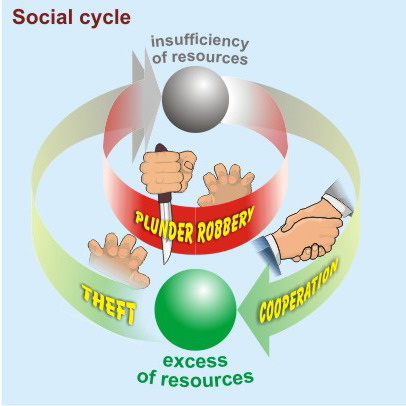
The social cycle was discovered during research on the issue of cooperation between living objects. The key question of this research was: "Why did designs of collaborative behaviour tactics arise and why were they written in the genetic designs of living objects?" They must have arisen at the second stage of the social cycle as it forced their emergence, ensuring that the entire population would not die out.
The most well-known people who discovered and described the Social Cycle were: Alexander Fraser Tytler (1747-1813) [see Tytler's Cycle], Thomas Cole (1801-1848) [see The Course of Empire (paintings)] and John Bagot Glubb (1897-1986) [see Glubb's Cycle].
The famous Calhoun Experiment also confirms that good conditions can lower Vivacitas.
Other cycles present in populations of living objects: Revolution's cycle, Cycle of failure and Lifecycle of a human.
Remarks:
-
Even Machiavelli (1469-1527) noted that the public makes decisions rationally only in moments of extreme danger, in times of normallity it selects those that interfere the least and are able to please the population.
-
A clear description of one of the many representations of this cycle, written by Marek Jan Chodakiewicz:
Marxism is the quest for absolute control over both: the totalitarian party in power (or in pursuit of power) and the society that has been already conquered (or in the process of being controlled). After the victory over the oppressed society, the party exploits them for the benefit of the parasitic elite. However, the foundation of Marxism-Leninism is strongly opposed to natural order, so real socialism/communism, put into practice, slowly begins to kill the social organism on which it feeds. Periodically, therefore, it ceases to suck out the juice, this is a period of so-called "liberalization", which is temporary and slows the process leading to real communism. Then people try to return to normal (e.g. economic, trying to restore the principles of free market). This is the time needed to strengthen the social organism to be able to go to the next stage - continuing the march to socialism.[NCZ 1048, str. XXXV] -
In a period of coercion, the community must have a positive-sum game or die. When there is affluence, scam and zero-sum games increase, and later a negative-sum game, and eventually everything falls apart.
- [unknown author - editor's note JF] -
Bad times create strong men.
Strong men create good times.
Good times create weak men.
Weak men create bad times.

Version 001 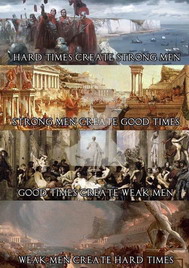
Version 002 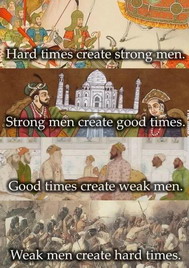
Version 003 -
The engine of cyclical history
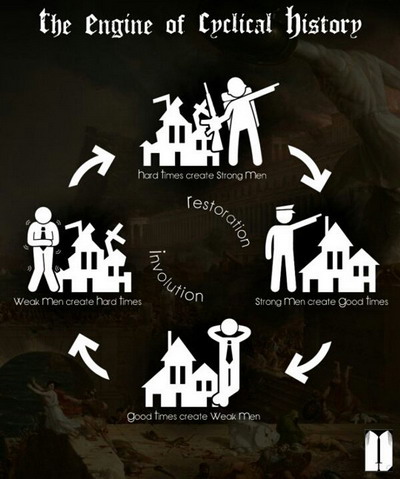
"Those who do not learn history are doomed to repeat it" [George Santayana]. We've heard this phrase time and time again, and it is more relevant than ever today. The tactics of instilling fear in the people, the problem-reaction-solution events, and the media acting as lapdogs to the governments by spewing propaganda that justifies ever-expanding bureaucracies have all been tried in the past by previous world leaders and governments. Malcolm X explained how they use the media to trick the people into loving the oppressor and hating the oppressed. They create the caricature of a boogeyman in order to justify taking away our individual rights and increasing mission creep overseas. They tell you why it's better to be a slave living in "peace" rather than a free individual living in a risky and dangerous world. This slave peace always leads to the downfall of moral principles and economic decline.
"Good times create weak men. Weak men create bad times. Bad times create strong men. Strong men create good times." This cycle of history is prevalent whenever we look back at society's past…
The question then arises: why do people always choose slave stability and allow the social cycle to be repeated every time?

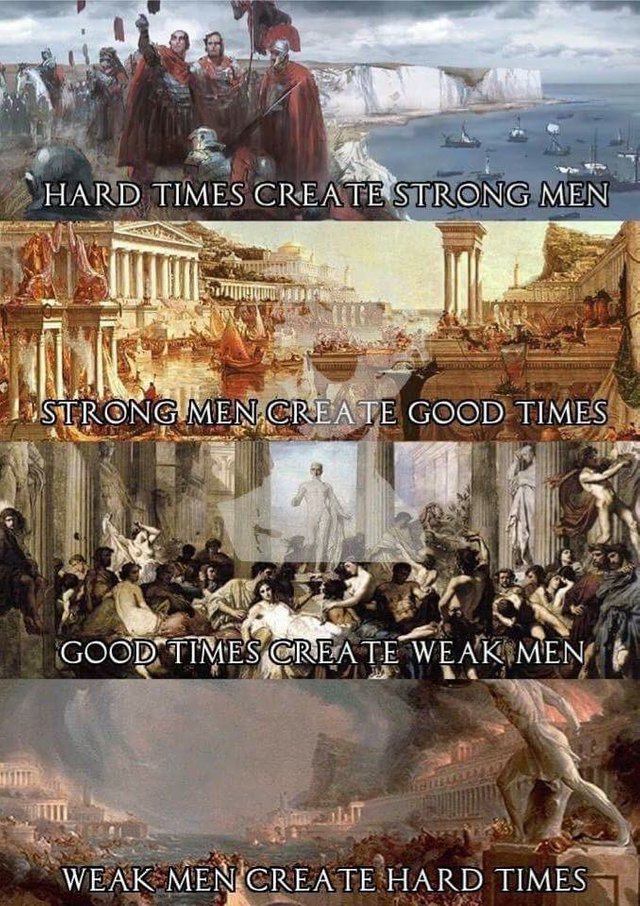
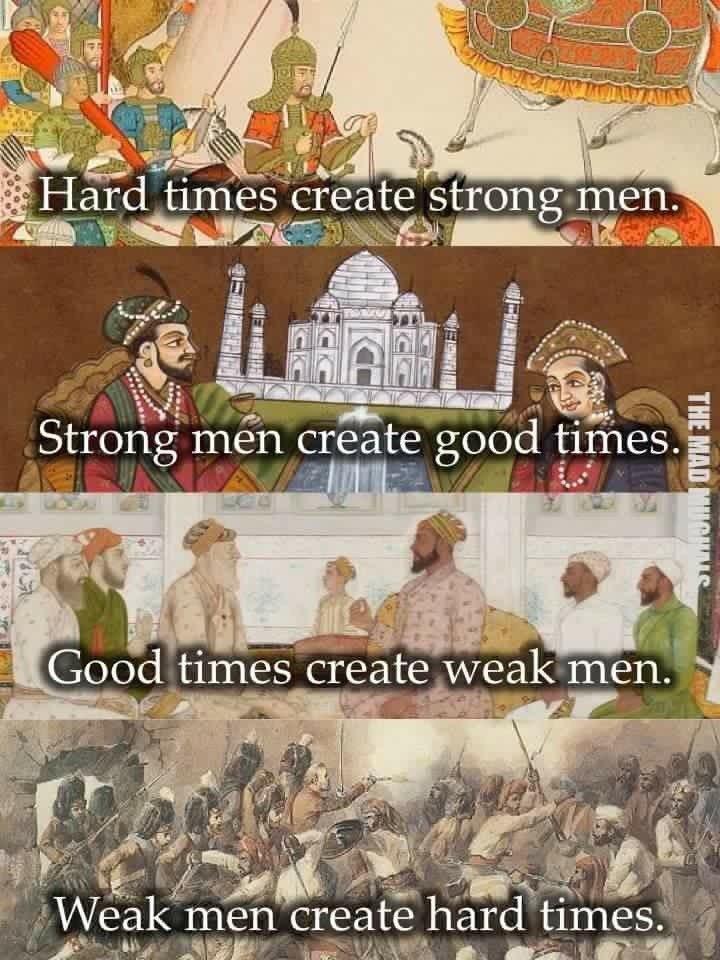
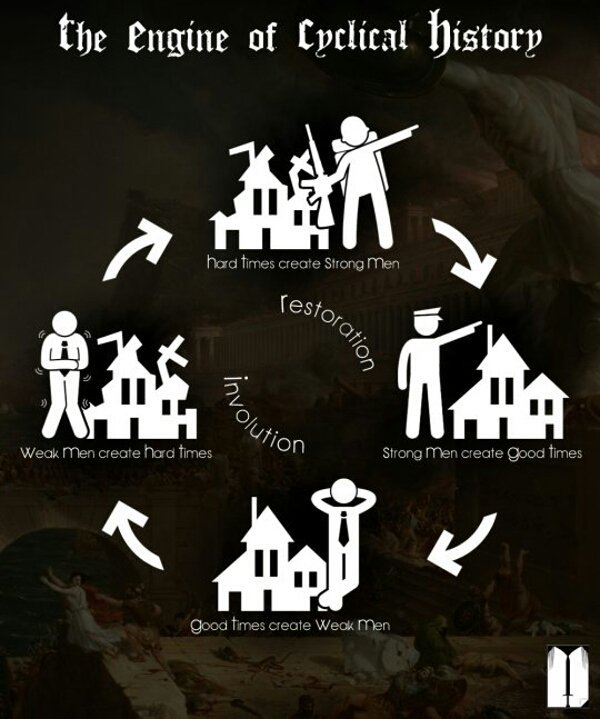
Associated concepts:
- Glubb Cycle
- Tytler's Cycle
- Calhoun's Experiment
- Revolution's Cycle
- Cycle of failure
- Lifecycle of a human
Quotes from literature: in Polish or Google English from Polish
- associated with Social cycle
Social Engineering
Definiens:
A set of methods used to achieve specific social goals by imposing conditions (e.g. laws) in which the society operates by using manipulative techniques.
Social engineering uses the following manipulation methods:
-
apparent choice
the manipulator presents the subjects of manipulation with several points of view. And then the manipulator provides information which leads to the choice of their desire; -
ridicule
the manipulator tries to ridicule ideas that do not match their own; -
authoritative testimony
the manipulator refers to a universally accepted authority; -
transfer
a person manipulating the community tries to associate the message with a positive concept established among its recipients, often by creating word-clusters; -
independent opinion
the manipulator shapes the message so as to create the impression that convincing the recipients to believe an opinion is not important; -
selection of facts
the manipulator chooses only beneficial facts and does not allow recipients to access messages from others; -
name swap (newspeech)
the manipulator creates a new concept, which gives a strong emotional background, and then uses it massively in constructing messages transmitted to the manipulated people; -
indicating negative reference groups (pointing to the enemy)
the manipulator indicates an enemy who is to threaten the group of recipients, which allows the consolidation of the ideas promoted; -
majority opinion
manipulujący twierdzi, że jego zdanie podziela większość i twierdzi, że wszyscy swoi tak mówią;
the manipulator claims that the majority shares the opinion and claims that all of us agrees; -
lie
the manipulator lies, but tries to substantiate his claims and limits the recipient's access to other sources of information, combines lies with facts; -
creating stereotypes
manipulator creates a stereotype and then constantly uses it to promote own strength; -
repetition of slogans
the manipulator invents a slogan which is spread as widely as possible; -
shaping the emotional background
the manipulator tries to associate the message with elements that evoke positive feelings, by creating a pleasant atmosphere or positive background.
[Wikipedia stan 2012.04.24]
Associated concepts:
- Barriers to objective observation
- Characteristic features of those in power
- Systems engineering
- Artificially false messages
- Feedback
- System of a clean sink
Social group
Definiens:
A social group is a set of living objects (at least two), working together to meet their own needs. The group is characterized by a permanent structure and has its own mechanisms of interaction, both internal and external.
Remarks:
-
Any group of people perceiving themselves as different from others can be called a social group. Examples are religious sects, political groups or unions. The main feature of the social group is double standards - different rules apply to intra-group behaviour and the others outside of it. - American ecologist Garrett James Hardin
-
Gustave Le Bon, author of "The Crowd: A Study of the Popular Mind" classified the social groups as follows:
-
Heterogenic crowds (composed of people dissimilar to each other)
- Anonymous (e.g. street crowd, crowd of onlookers)
- Non-anonymous (parliament, a jury)
-
Homogenic crowds (composed of people more or less similar to each other)
- Sect (religious, political)
- Caste (military, priests, skilled workers, etc.)
- Layer (the bourgeoisie, peasants, etc.)
-
Heterogenic crowds (composed of people dissimilar to each other)
-
4 conditions must be met to name a set of humans as a social group:
- The group must be a real set of humans.
- The goal of existence should be stated.
- The reason for cooperation between the members should be stated (material or spiritual).
- The internal structure of the group should be established (determine hierarchy).
Associated concepts:
Social suicide
Definiens:
The process of destroying the basis of society's functioning caused by an autodynamic system composed of:
- a demanding society claiming more and more free resources, otherwise known as social benefits, including statism
- those in power, who use these social demands to consolidate their power and provide more and more of these free resources. The consolidation of power relies on the use of the mechanism of leftism, and the financing of this supply is accomplished mainly through: a/. collecting people's money by coercion, b/. inflation and c/. the creation of state enterprises.
Definiens by Lawrence Reed:
A term that describes the disintegration of the norms of cooperation and mutual respect among people, to be replaced by increasing disregard for rights, contracts, life and property. Social suicide befalls a society from within, not from outside enemies or forces, and is accompanied by the decay of private and civil institutions as the powers of the centralized state take over. In the latter stages of social suicide, violence becomes endemic; toleration disappears; and people who once worked peacefully with each other arrogate to themselves a sense of entitlement, expecting the political process to forcibly redistribute to them what belongs to rightful owners. Synonyms: legalized plunder, welfare/warfare state, statism.
Associated concepts:
- Socialism
- Leftist
- Law of universal gravitation towards socialism
- Socialist hypocrisie
- Primary class struggle
- Constructors of socialism or, in other words virus of socialism
- Socialist-totalitarian gravity field
- Fedoseev’s table
- Szymanski's table
- Fourth stage of Social Cycle
Links:
-
A talk "How to introduce young people to Liberty & Freedom issues. The fall of Rome. Lawrence Reed Jan Kuban"
https://youtu.be/TW-87yBsY60
Social system(/object)
A system composed of living objects.
The most important criterion for deciding whether one deals with a social system or a social object is the selection function. The answer to whether we are dealing with an object or a social system is provided by the Evolutionary classification of systems.
Remarks:
-
Social systems are given various names: a swarm of bees, an ant colony, a school of fish, a swarm of birds, a herd of mammals. Colony and swarm shows their closeness to WSS-type systems.
Associated concepts:
Socialism
Definiens:
A strategy to gain power over the masses and exploit them until driving them into the ground…
Full definition of socialism.
Remarks:
-
Diagram of the development of socialism by Anatoli Pavlovich Fedoseev [1910-2001 Physicist, an expert in the field of electronics, Ph.D., winner of the Lenin Prize, Hero of Socialist Labour. Led the largest research institute of magnetrons used for radars in the USSR.]
Associated concepts:
- Law of Universal Gravitation Towards Socialism
- Socialist hypocrisy
- Social suicide
- Constructors of socialism or in other words "Virus of socialism"
Quotes from literature: in Polish or Google English from Polish
- associated with socialism
- associated with capitalism versus socialism
- Principal quote on socialism
Socialist-totalitarian gravity field
Definiens:
A set of social causative factors causing that, at a certain level of development, societies, by themselfs, strive for a totalitarian-socialist social system.
These factors include among others:
- Tyranny can be created and sustained with a handful of primitives. Freedom requires that almost all members of the society cooperate wisely.
- Tyrants are driven by the will to fight for power, by any means. However, libertarians do not show a similar drive to fight for freedom.
Associated concepts:
- Socialism
- Law of Universal Gravitation Towards Socialism
- Socialist hypocrisy
- Primary class struggle
- Constructors of socialism or in other words "Virus of socialism"
Spate of messages
Definiens:
 Degeneration of the system due to the inability to process an excessive number of messages (information) that comes from environment and/or are generated by the system itself.
In pursuant systems, sensors provide messages from external stimuli. The analyzers must process these messages according to historical knowledge stored in the memory, useing innate and developed decision-making models in order to make right decisions. Then the system have to analyze the effect of corrective actions taken after these decisions, rethink about the issues and possibly reorganize memory and/or restructure the decision-making models that have been used. It is a lot of work!
In complex systems made of billions of pursuant objects (Man is made up of billions of cells, and human populations consists of tens, hundreds and thousands of millions of people), the aforementioned phenomenon multiplies, resulting in an excess of circulation of messages between the elements. Elements programmed by biological evolution can respond in two ways: either to respond to all messages or to ignore some/all of them. In the first case, the elements may be damaged by over-activity or an extension of resources, in the other can not respond to a message viable for them which can lead to damage or even destroy the whole system.
In social systems, there is a natural tendency to the increase in bureaucracy and a monumental shift in laws and regulations. To make matters worse, they are often contradictory or illogical. Meaning that a society which follows them can become completely counterproductive. The work-to-rule strike is confirms this, where employees perform their duties meticulously, following all regulations, which usually results in a downturn of the company's productivity.
Systems naturally defend themselves against the spate of messages: living objects by sleeping and social organisms by social upheavals (The Soviet Revolution, The American Revolution, Polish Solidarity Revolution).
Remarks:
- The concept of "spate of messages" extends concept of "cognitive lockup" known in psychology.
Quotes from literature: in Polish or Google English from Polish
- associated with Spate of messages
Speciation
Definiens:
Process of the natural formation of specialized sub-populations from a homogeneous population over generations, due to different causative factors
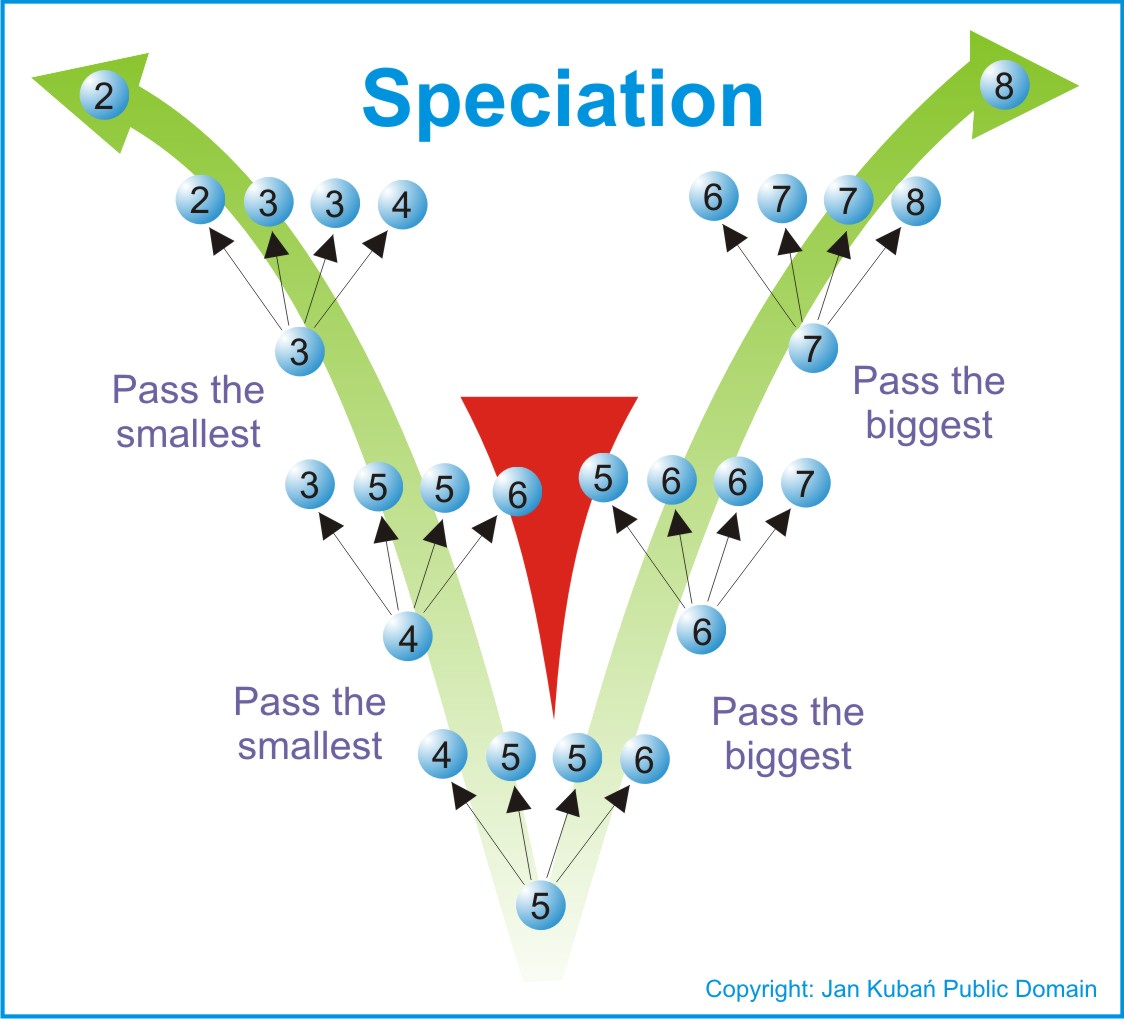
Remarks:
- Speciation is a process described in biology regarding the emergence of new species, but it is a more general process and may relate to the emergence of new nations, new languages and dialects.
Stability
Definiens:
The ability of a system to maintain a given state or to execute a given process (in the mathematical sense of this concept), regardless of any disturbances.
Other definientia:
- One can call a system stable if it returns to a state of equilibrium, when left without any interference. [Wikipedia pol. 2014.11.07]
Remarks:
-
The opposite to stability is instability - the phenomenon of abrupt changes in the behaviour of a system caused by a disturbance, even minor ones.
-
A system can be considered as more stable, when it corrects the influence of a disturbance faster.
-
A system can be considered as more unstable, when a smaller disturbance is able to permanently alter its given state.
-
The analysis how disturbances change the behaviour of a system is called sensitivity analysis, disturbance calculus or vulnerability analysis.
Associated concepts:
- Disturbance
- Sensitivity_analysis
- Non-linearity
- Butterfly effect
Stanford prison experiment
Definiens:
Stanford Prison Experiment - a research project that was designed to investigate the psychological effects of prison life simulation. It was conducted by a group of psychologists from Stanford University under the leadership of Philip Zimbardo in 1971, using students who volunteered to participate. Due to the great controversy regarding the reliability of this experiment, it is not discussed in The Physics of Life.
Remarks:
-
Wladyslaw Szpilman, in his book "The Pianist", wrote about a group of Jewish collaborators in the Warsaw ghetto: It consisted mainly of young people, coming from a wealthy strata. Among them were a large group of our friends. We became disgusted as we saw, gradually, these recently decent people, with whom we shook hands with and treated as friends, transforming into scoundrels. They were infected by the spirit of the Gestapo, so it should be called. At the moment they put on uniforms and caps and gripped police batons in hand, they became animals. Their main goal was to establish contacts with the Gestapo, becoming obsequious, parading with them through the streets, showing off their knowledge of the German language and showing off their brutality against the Jewish population in front of their German masters. Szpilman's record (of course not the only one) became known because his book became a best-seller. For many, this was simply an incredible shock. […] Similar notes were made by Emanuel Ringelblum, Adam Czerniakow, the testimony given in the talks by Marek Edelman, the conclusions of Hannach Arent published in the book "Eichmann in Jerusalem" and the study by American historian Bryan Mark Rigg. In the conclusion of her research, Ewa Kurek comes to the frightening statement that "the most difficult, the most shameful and brutal part of the genocide of the Jews was executed by the Jews themselves".
State of a property
Definiens:
It is one element from the set of given possible states of a feature of a system or object.
Remarks:
-
The feature "temperature of an object" cannot be lower thab absolute zero which is −273.15°C or -459.67°F. The contemporary models of physical cosmology propose that there is an absolute hot.
-
The feature "human driven land vehicle velocity" ranges, up to 2017.09.05, from 0 km/h to 1 227.985 km/h
-
The previously mentioned features can take any value from a given range. However, thera are some features which can be only in one of two (or few) states. For example: the feature "outdoor shoe orientation" can be only in two states, left or right or "switch position" either on or off.
Associated concepts:
Strategy
Definiens:
This set of algorithms, plans, calculation methods, decision-making methods, manufacturing methods, optimization of criteria, resources, structures, configurations, predictions of others living objects steps, principles and rules are used to develop further actions to achieve the goal mainly in pursuant procesess.
Strategy is more than just an algorithm. Strategy helps to plan an action even when the situation is unique and/or unforeseen. The strategy also accepts random decisions.
Associated concepts:
Stratum of innocents
∫ Definiens:
Process ending in crisis due to stratification, one after the other, of seemingly insignificant factors. The factors do not work simultaneously, but overlap one another.
Remarks:
-
An example of this type of process is snow falling in the mountains. Individual flakes do not pose any threat, but as the snow thickens cover the slope, the danger of avalanche increases, and at a certain moment even a small disturbance can trigger an avalanche. The problem with this type of process is that, in the initial period, the falling snowflake, in practice, poses no threat, but in the final stage the same snowflake, which falls exactly the same way as at the beginning, can cause a disaster (crisis).
-
The goal of these politicians, as is clear from the history of the last few decades, was to smuggle this country into a state of "socialist welfare". They did it gradually, in small steps, to gain power. At the same time, they made sure that these steps did not form a rule or principle that could be identified and named. Socialism, therefore, does not appear either through voting nor an armed revolution, but as a result of a series of minor deviations and scams that eventually lead to a fait accompli. [Ayn Rand (1905-1982)].
-
The mere accumulation of innocent factors can be linear, such as snowfall or, for example, exponentially increasing, as in the case of inflation, transforming into hyperinflation.
-
In colloquial language, the following metaphors are used to name such phenomena: "the straw that broke the camel's back" or "pushing to the edge of the envelope".
Associated concepts:
Structure
Definiens:
Spatial arrangements of the components of an object relative to each other.
Remarks:
-
The definition of structure speaks about the arrangement, i.e. the spatial arrangement of elements with respect to each other. It says nothing about the interaction, so structure plus interaction equals a system.
-
Definition of structure expands the mathematical concept of sequence.
Subsidiarity
♥ Definiens:
-
(in the Roman Catholic Church) a principle of social doctrine that all social bodies exist for the sake of the individual. The following principles derives from this doctrine:
-
so that what individuals are able to do, society should not take over
-
what small societies can do, larger societies should not take over
-
-
(in political systems) the principle of devolving decisions to the lowest practical level. Power should be centralized as far as necessary and decentralized as far as possible.
[Source Collins English Dictionary - Complete & Unabridged 10th Edition. Retrieved June 24, 2017 from Dictionary.com website http://www.dictionary.com/browse/subsidiarity]
Full definition of subsidiarity.
Associated concept:
Supercompensation
♥ Definiens:
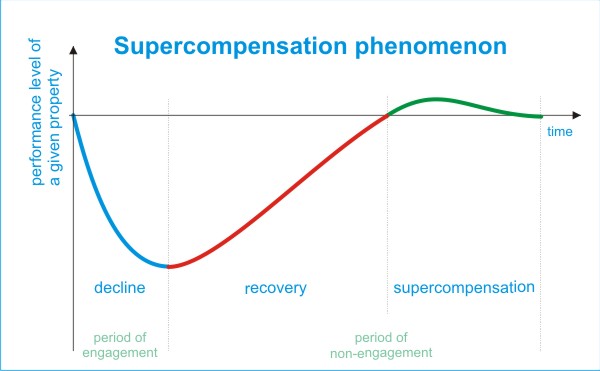
In sports science theory, supercompensation is the phenomenon when the capacity of a given property rises after the training period and subsequent recovery period. In the words of The Physics of Life: supercompensation is the phenomenon when the state of a given property of a living object temporarily increases after a period of active engagement of this property and the subsequent non-engagement period. On the adjacent chart, the vertical axis represents the state of the property and the horizontal - time.
For example: heavy physical work causes fatigue in the muscles, so that the level of efficiency in the field of physical work decreases. During the recovery phase, this capacity gradually returns to its initial state. This phase is named the compensation phase. Afterwards, it is followed by a transitional period of increased efficiency - on the chart this is shown by the green curve, and then efficiency returns to its initial level. This temporary increase in capacity is supercompensation - loosely translated, it is rebuilding with a surplus. This temporary increase in the capacity of the muscles makes them slightly more effective.
The graph shows a single cycle of events (exercise - rest - increase in capacity) which makes a so-called training unit. Note that supercompensation does not last forever and will eventually disappear. If you want to keep your improved capacity for a long time, you need to periodically repeat the training units - regular training.
Remarks:
-
Hypercompensation constitutes the first part of The Second Law of The Physics of Life.
Superorganism
Definiens:
A set of living objects forming a WSS-type group, like bees.
Other definientia:
-
This definition was proposed by E.O. Wilson for social insects in the book titled "The Insect Societies"
Every society, such as a colony of social insects, has organizational characteristics analogous to the physiological properties of a single organism. For example, an insect colony is divided into reproductive castes (analogous to gonads) and worker castes (corresponding to somatic tissue); There may be a food exchange by trophallaxis (analogous to that occurring in the circulatory system) etc.
Remarks:
-
If we accept the concept of Organizational levels of living objects proposed in The Physics of Life, then the concept of an insect community superorganism will be in the fifth organizational level.
Associated concepts:
Syndrome of attraction
Definiens:
We are prone to accept and believe information given by those we consider attractive more than their less attractive counterparts.
Remarks:
-
This applies to individuals of the same sex. Woman groomed and dressed in an elegant tailored suit reaches her audience much easier and an elegant man to his.
-
If the message is transmitted by an attractive woman to a man, or vice versa, the instinct dominates: when a very nice woman is talking to a man, he does not know what she's talking about… his mind is elsewhere.
Associated concepts:
Syndrome of authority
Definiens:
Making decisions and actions not based on our own reasoning, but based on the guidelines and directives of persons recognized as authoritative.
It is dangerous when the authority is giving instructions in areas where he is not experienced or is artificially created only to influence people.
Remarks:
-
In fact, a lot of people accept scientific theories because someone said that they are true, not because they understand them - [Lewis Wolpert, "Unnatural nature of science"]
-
To punish me for my contempt for authority, fate had it that I became an authority - [Albert Einstein]
-
The belief in authorities makes that mistakes of authority are accepted as models - [Leo Tolstoy]
-
Education, completely liberated from authority, tradition and dogma, ends in nihilism - [Leszek Kołakowski]
Links:
Associated concepts:
Syndrome of blindness
Definiens:
To be blind to anything that contradicts their strongly-held beliefs
This syndrome belongs to the group of populationally typical emotional reactions.
Remarks:
-
Those who believe in the existence of God reject any argument that disproves Its existence. On the other hand, people who consider themselves rational thinkers and reject the existence of God, barely (if at all) agree with this; that God, who might be a man-made idea, could be considered as an intangible object having the nature of a causative factor, which, depending on the circumstances, can positively or destructively influence human society.
Associated concepts:
Syndrome of caste
Definiens:
A complete set of actions performed by me to strengthen my group.
Remarks:
-
Typical manifestations of this syndrome:
- Fight between members of the Catholic Church and Galileo.
- Creation of a false history of the course of the Second World War, it especially concerns the years between 1941 and 1942, by Soviet state-dependent historians, now called "historians in epaulets".
- Mutual support for the members of state and all state institutions.
- The so-called "professional solidarity".
-
So, the most artful guys remained on site. For example, the fair food warehouse manager was always sent to the front line, leaving the thieves and crooks behind. Honest, yet gives all the stuff for the soldiers, hiding nothing for himself nor for the chiefs. And bosses like to eat greasy. Crooked, remembering about himself and always making his bosses happy. After all, they decide who to send to the front line. How can the bosses deprive themselves of such a valuable subordinate? Who was finally sent to the front line? Of course, the honest man! So, it created a kind of vicious circle, the dishonest supported the dishonest.
And if some "idiot" out there was trying to fight for justice - they would have destroyed him all together… - [W. Bieszanov, "Defence of Leningrad", page. 315]
Associated concepts:
Syndrome of conforming
Definiens:
Remarks:
-
In fact, a lot of people accept scientific theories, because someone said that they are true, not because they understand them. [Lewis Wolpert, "Unnatural nature of science", page 9]
Associated concepts:
Syndrome of context
Definiens:
The phenomenon of the different reactions of living objects on the same stimulus. The differences in reactions are due to different perceptions of reality and the different experiences of each of the living objects.
Associated concepts:
Syndrome of criticism
Definiens:
The set of phenomena caused by criticism against us. For example: we subconsciously resent negative criticism and automatically dislike the author(s). The opposite is true with positive criticism.
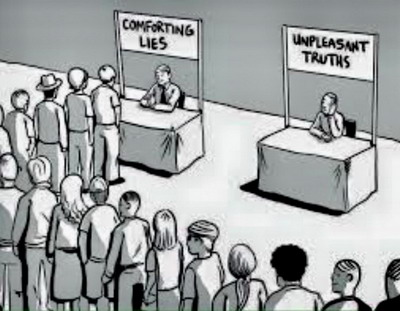
Associated concepts:
Syndrome of defending the group
Definiens:
The set of individual and group behaviours which leads to the protection of the institution or social group, of which they are a member.
Remarks:
-
A description of this syndrome by Adam Wisniewski-Snerg:
Do you know that in the department of physics there are four places available for each potential student and they are fighting each other for this person? In such a situation, any moron who failed to get into any other department may be accepted. So we give them our free places as a life-saver, we coddle them and push them to the top. Thanks to this system, the graduates become our accomplices, and our institution of science is manned by rigid, numbered figures on their respective perches. This became an immovable wall, which cannot be dented by a single man with a notebook in his hand, especially if he has something important to say. Moreover, any of these scientists, who guard our institution, will always forbid disclosure of any valuable thoughts of a newcomer especially from outside the garrison. This is because, all publications, issued so far in order to simulate knowledge, would go - to put it simply - on a toilet nail. Such a tragedy can happen only once every few hundred years. It occurs only when an exceptional mess is formed within some specialty and as a result of huge negligence allowed by scientific officers appointed and trained to guard this emptiness. [Adam Wisniewski-Snerg, "According to the rapscallion"] -
Galileo is usually associated with "conflict with the Catholic Church". This conflict, in a more general level, is a perfect example of the syndrome of defending the group.
Associated concepts:
Syndrome of external blame
Definiens:
Subconsciously attributing the causes of our own failures or inabilities to external forces (agents or people).
Remarks:
-
Of course, the Belarusian dictator, did not think for a moment that he himself caused the crisis, and blamed everything and everyone apart from himself. [James Woziński, "Panic in Minsk", Nczas XLII]
-
Everyone is holy, perfect and only some evil power has conspired to spoil everything, but they are still perfect and without fault. [Tomasz Maciejewski]
-
"Locus of External Blame" - Julian Rotter
Associated concepts:
Quotes from literature: in Polish or Google English from Polish
- associated with Syndrome of external blame"
Syndrome of groupthinking
Definiens:
is a psychological phenomenon when systematic errors are made by groups when making collective decisions, pertaining to desires for harmony or conformity within the group. Group members try to minimize conflict and reach a consensus decision without critical evaluation of alternative ideas or viewpoints, and by isolating themselves from outside influences. When subjectivity rules over objectivity or when emotions dominate reason.
The assumption is that the accumulation of knowledge and experience reduces the frequency of errors and leads to the best possible solution. Assuming that each participant brings a creative personal contribution, as a result of groupthinking, should be an informed, multilateral evaluation of the situation and make the right decision. This is why it is commonly believed that groupthinking provides better results than thinking alone.
But it turns out, more than you think, that the intelligence of the group does not exceed the intelligence of its individual members; that the decisions of the various committees and commissions are extremely broad and it would be better if they were made by a single person. In fact, the group is falsely perceived to be infallibile and intellectually superior. The higher the social status of each member of the group, the stronger this illusion is. The higher education level and the higher the internal cohesion of the group, also increases this illusion.
There are many factors that cause that a group makes decisions of inferior quality and often with a greater level of risk. These factors are called the syndrome of groupthinking.
By Irving Janis, who examined this issue, groupthinking is characterized by the following symptoms:
- illusion of infallibility and subsequent self-confidence,
- ignoring unfavourable information,
- faith in their own work ethic, not taking into account ethical and moral aspects of the decision,
- manipulation of the results and people outside the team,
- applying social pressure to enforce conformity,
- self-censoring themselves (to avoid repeating negative reactions of other people in the groups, silencing its critical members),
- illusion of unanimity (silence is regarded as an expression of consent),
- filtering of information, i.e.: members of the group are trying to block all kinds of information which they think can disrupt the group.
Group thinking leads to making bad decisions and forming crises, as it allows a group to see and hear only what the collective wants. Information inconsistent with the views of the group are ignored, especially if you are an outsider. The group does not look for and does not anticipate new opportunities, leading to unjustified optimism, complacency which can result in crisis. [translated from Wikipedia, pol, 2011.01.11]
Syndrome of jamb
Definiens:
Set of phenomena associated with the deviation away from the main goal and, instead, focusing on a secondary goal (goals) to show that they are still focused on the main objective.
Remarks:
-
A good way for climbers to practice is for them to perform chin-ups using a door jamb. Some of these people think that if they can do 25 chin-ups, they will be able to climb the North Face of the Eiger.
Associated concepts:
Syndrome of Kali
Definiens:
Set of phenomena associated with a moral evaluation based on biased standards. One evaluates his own behaviour (or behaviour of social groups he belongs to) differently than to the evaluation of the same behaviour performed by others.
Remarks:
-
As a buyer we want everything for nothing, as a seller we want the largest profit we can get. So buyers and sellers are the same people, but motivated (and acting) differently according to their current situation.
-
If someone takes Kali's cows […] this is a bad thing […], a good thing is… when Kali takes somebody else's cows. [Henryk Sienkiewicz, "In Desert and Wilderness"]
Associated concepts:
Syndrome of Machiavelli
Definiens:
Subconsciously attributing negative traits (or positive) to the person explaining (for example, in a scientific manner) negative (or positive) social issues.
Examples:
- immoral is the one who talks about the immoral
- when a person is discussing the issue of corruption, perceived by the majority as a negative phenomenon, and he starts to to show its positive impacts to the society, he is conisdered to be a corrupter
- a person who preaches about social justice is perceived positively
- anyone who is neutrally discussing Hitler's thoughts is considered a fascist
Remarks:
-
This syndrome works in both ways - automatically assigning positive traits to those who talk about positive social issues. The Communists, who history has shown to be cruel and incompetent economists are sympathised, because they are talking about helping the poor (which is the majority of us).
-
the title of the syndrome is named after Niccolo Machiavelli. He was the author of "Prince" (1513) - one of the first scientific papers devoted to the issue of governance. But to discuss governance without immoral issues is impossible. When Machiavelli wrote that cruelty and terror should be used, but reasonably, and only if necessary, he is automatically classified [on the basis of Machiavelli's syndrome] as a bully by the vast majority of readers. However, he is a great because, as Stendhal said, "he let us know the man".
-
Some criticisms of sociobiology have its origins in religious and political beliefs. The main complaint for "tolerance" or even "acceptance" of fugitive behaviour in our culture as immoral is largely due to a misunderstanding of the essence of the assumptions of sociobiology. Sociobiological theories do not comment at all about the "morality" or "rightness" of some behaviours. Their description does not mean evaluation, more acceptance. - Edward O. Wilson
-
Another definiendum: messenger syndrome
Associated concepts:
Quotes from literature: in Polish or Google English from Polish
- associated with Syndrome of Machiavelli
Syndrome of Matrix
♥ Definiens:
When people, conciously or otherwise, manipulate the truth for their own, or the group(s) they belong to, benefit.
Remarks:
-
The original name of this syndrome is Syndrome of universal bullshit
Syndrome of Mr John
Definiens:
The tendency to bestow disproportionate trust to representatives of foreign nations, currently the leading nation economically and militarily. We believe them more than the facts.
Remarks:
-
This phenomenon is the result of the blind imitation of successful people. For example, if the master wears a gold signet ring a lot of people will also wear a similar signet, thinking that by doing this they automatically become a master.
-
This phenomenon has been known for centuries. It captures the essence of the great Latin proverb: Quidquid Latine dictum sit, altum videtur (whatever you say in Latin sounds smart). This can be paraphrased as: Poles believe anything an American says.
Associated concepts:
Syndrome of Prometheus
Definiens:
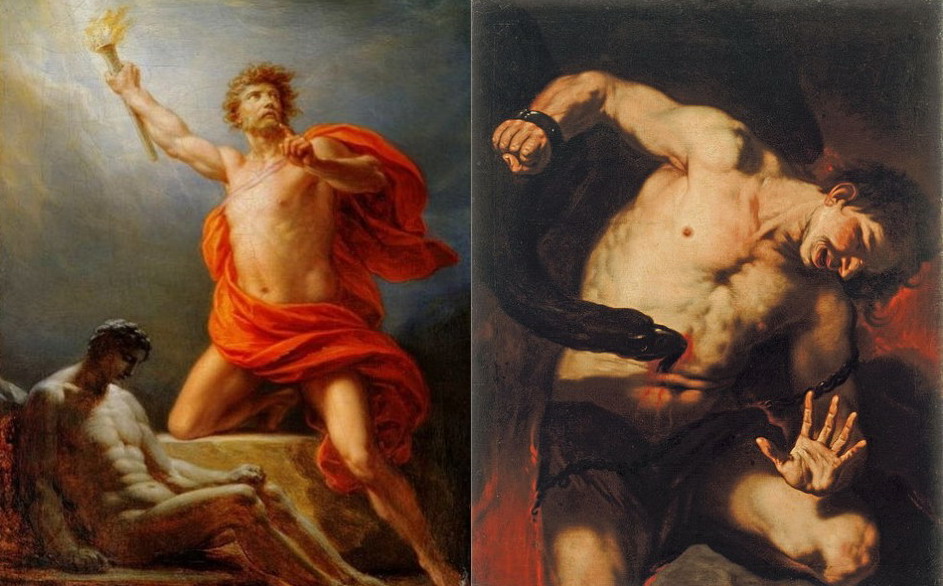 A phenomenon whereby a person devotes themselves to the well-understood interest of a social group (e.g. humanity) but is exposed to the enormous costs and ingratitude of that group. Prometheus, exposing himself, provided people with fire, for which he was condemned (not by them, but by Zeus) to eternal torment.
Quotes from literature:
- connected with the Syndrome of Prometheus.
Associated concepts:
Syndrome of red eyes
Definiens:
Red-eye syndrome expresses the desire that everyone is as flawed as I am, and taking appropriate actions to bring this about.
Remarks:
-
Do you know what is the hallmark of mediocrity? Reluctance to accept other people's achievements. These touchy mediocrities who sit and shake that someone else's work did not turn out to be greater than their own. - "Atlas Shrugged", Ayn Rand
Associated concepts:
Syndrome of Semmelweis
♥ Definiens:
Syndrome of Semmelweis (or Semmelweis reflex) is a phenomenon of rejection of new knowledge (or new evidence) because it overturns entrenched norms, popular beliefs and accepted paradigms.
Remarks:
-
The term derives from the Hungarian physician, Ignaz Semmelweis, who, in 1847, discovered that childbed fever mortality rates fell ten-fold when doctors washed their hands with a chlorine solution between patients or, most particularly, after an autopsy. Semmelweis's decision stopped the ongoing cross-contamination of patients, mostly pregnant women, with "cadaverous particles". His fellow doctors rejected his hand-washing suggestions, often for non-medical reasons. For instance, some of them refused to believe that a gentleman's hands could transmit a disease.
-
Galileo Galilei (1564–1642) encountered a similar phenomenon. He conducted an experiment involving the simultaneous dropping of two balls of different mass (cannon and musket ones) from the tower, which, shortly after simultaneously hit the pavement. Despite the fact that he had many witnesses and that everyone could at any time carry out a similar experiment, the scholars of that day "did not believe" him. They strongly believed that heavier objects fall faster, supported by Aristotle's writings. However, if you ask a child, it is natural to believe heavier objects fall quicker.
Associated concepts:
Syndrome of universal bullshit
When people, conciously or otherwise, manipulate the truth for their own, or the group(s) they belong to, benefit.
Synthesizing replicator
Definiens:
A system built from RPD-type objects which not only absorbs resources and divides, but also (as it were, "on the side") builds chemical particles (in terrestrial conditions - proteins) from the available elements (in terrestrial conditions - amino acids). These particles are built using a design which are stored in the RPD-type objects, consisting of synthesizing replicators.
A synthethising replicator can be considered as the transitional form between chemistry and life.
Remarks:
-
One such system is the biological cell:
the design is DNA (RPD-type object),
protein building machinery - ribosomes,
and both DNA and ribosomes are packed within the cell membrane (which is also a RPD-type object).
Associated concepts:
Symbiogenesis
Definiens:
The theory of new species of living objects being created by the symbiotic integration of living objects of different species.
Other definientia:
-

 Symbiogenesis - the theory of species formation through symbiotic integration of various species. It was formulated for the first time by Konstantin Mereschkowski, (Russian biologist and botanist, operating in Kazan), based on his research on lichen. According to his concept, larger, more complex cells arose over generations as a result of symbiotic relationships between less complex cells. He described his theory in 1909 in Russian, although his assumptions had already appeared in his work in 1905.
Wiki-pol 2009.05
Symbiogenesis - the theory of species formation through symbiotic integration of various species. It was formulated for the first time by Konstantin Mereschkowski, (Russian biologist and botanist, operating in Kazan), based on his research on lichen. According to his concept, larger, more complex cells arose over generations as a result of symbiotic relationships between less complex cells. He described his theory in 1909 in Russian, although his assumptions had already appeared in his work in 1905.
Wiki-pol 2009.05
Remarks:
-
Cyclic endosymbiosis - a theory explaining the formation of eukaryotic cells. Lynn Margulis had great trouble publishing this theory. Her work, which was revolutionary in its thinking, was only adopted in the 23rd scientific journal. Now this theory is in every biology textbook. Cyclic endosymbiosis explained the presence of foreign DNA in the cell (non-nuclear) and showed the emergence of new species through integration and fusion. Now we can call this process symbiogenesis and we found a lot of similar examples.
[Source: http://czachorowski.blox.pl/2013/04/Endosymbioza-symbiogeneza-Gaja-i-hologenom.html] -
Symbiogenesis, because it is also called cyclic endosymbiosis, can be confused with endosymbiosis, so it's worth taking a look at the definition of the latter.
-
Viral eukaryogenesis - is the hypothesis that the cell nucleus of eukaryotic life forms evolved from a large DNA virus in a form of endosymbiosis within a methanogenic archaeon. More on Viral eukaryogenesis.
Symbiosis
Definiens:
The phenomenon of the close coexistence of at least two species of living objects, which benefits each party (mutualism) or one major beneficiary but the others do not lose out (commensalism).
Other definientia:
Systemic solutions
Definiens:
Creation of systems that implement given processes in a stable way. This issue occurs not only in aviation and space science, but also in the management of people, organizations and societies. Social engineering is part of this.
Remarks:
-

An example of a slimming systemic solution. The door is so narrow only thin people can pass through to eat. 
An example of a ranging systemic solution

Systems theory
♥ Definiens:
Systems Theory is a interdisciplinary study of systems at a high level of generality. Its purpose is to discover the general principles and methods of analysis that can be applied to all types of systems in all areas of research.
Associated concepts:
Systemic thinking
Definiens:
Systemic thinking expands from reductionist thinking by examining all the details even the theoretically unpredictable factors. Important elements of this thinking are:
- feedback
- flow diagrams (see flow systems)
Systemic thinking has allowed people to understand many complex issues and the construction of many new devices. However, it occured that it is not entirely suitable for capturing the subtle nature of a certain class of systems - social systems, i.e. those which are built of living objects, including ourselves.
In a very general form, we can say that systemic thinking is the modelling of an investigated phenomenon as an object/system, finding its causative factors and defining its affiliations and their impact on the phenomenon-object.
Associated concepts:
Systems engineering
Definiens:
A science focusing on how to build a system, which:
-
behaves in a given way;
-
has a given natural tendency;
-
causes that living objects (including man) behave in a way that the systems engineer wants.
Links:
System of a clean sink
Definiens:
 The classic model of how to build a complex system of rules and feedbacks imposed on people using a sink that ensures the sink is kept clean.
At first glance, it seems that if one starts with the initial condition: "the sink is clean and empty" it is enough that peaople act according to the rule: "if you put dishes in the sink, you must thoroughly wash them and put them on the dryer, while the sink must be rinsed and wiped, then the cloth has to be hung to dry".
However, such a system is not a guarantee that the sink will be clean permanently because it is not resistant to random disturbances (eg. A person who has just started washing the dishes has a heart attack) or resulting from the nature of an honest man (eg. When no one sees anybody leaving dirty dishes in the sink).
Further analysis leads to some interesting observations:
- The natural tendency of the system is to fill up the sink with dirty dishes.
- Maintaining a clean sink requires an active control system based on feedbacks
- The following rule guarantees a clean sink: "If you bring dishes, put them in the sink. Wash all the dishes in the sink and put them on the dryer, rinse and wipe the sink, hang the cloth to dry." But of course everyone will argue why they should wash somebody else's dirty plates.
- With the above rule, it pays to cheat and toss dirty dishes into the sink.
- How do you guarantee that people won't put dirty dishes into the sink then walk away if there is no control?
- It is, therefore, necessary to introduce a system of full control, discovering who cheats and responding to it.
- Who will protest the most against this system?
- How does the system administrator use the information obtained from it?
- …
Remarks:
-
It is an excellent introductory model for systems engineering and game theory, in relation to social problems.
-
Once you have discussed flow systems in relation to this study you are able to start learning about absolute thinking.
Associated concepts:
Systems theory
Definiens:
Is the interdisciplinary study of systems in general, with the goal of elucidating principles that can be applied to all types of systems at all nesting levels in all fields of research. The term does not yet have a well-established, precise meaning, but systems theory can reasonably be considered a specialization of systems thinking, a generalization of systems science, a systems approach. The term originates from Bertalanffy's general system theory (GST) and is used in later efforts in other fields. In the social systems theory of Niklas Luhmann, word systems is used to refer specifically to self-regulating systems, i.e. which are self-correcting through feedback.
Self-regulating systems are found in nature, including the physiological systems of our body, in local and global ecosystems, and in climate and in human learning processes.
Associated concepts:
Tactics of behaviour
Definiens:
Tactics expressed through action taken by the object, e.g. behaviour
Associated concepts:
Tactics of structure
Definiens:
Tactics expressed in location of elements, something fixed, sustainable and with potential. An example of tactic of structure is our own anatomy.
Remarks:
-
Sometimes, to achieve a goal, we do not need to move or relocate - it is enough to have a suitable body structure (location of elements) and/or proper positioning (being in the right place).
Associated concepts:
Terminators
Any factors bringing an object to an end. Factors which cause that the criteria of objectivity are no longer fulfilled.
Remarks:
- Terminators of the object "fence" include: demolition, dismantling;
- Termination means that the object has ceased to be the object. For example: it can have been destroyed (after transformation, e.g. house into a pile of rubble) or disappeared (e.g. belief in the Greek gods).
Associated concepts:
 Theft is the taking over of a resource from an object in such a way that the object is unaware of it.
"The State"
Definiens:
"The State" is a set of people working in the governing (or state) institutions and the institutions that support them, mainly those financed by those in power.
According to the principle of developing natural defense mechanisms within the social group, these people directly and indirectly, consciously and unconsciously defend their group.
Remarks:
-
This definiens is the original definiens from The Physics of Life, so the speechmarks are its integral component.
-
When labeling a person to "The State" we should research how much the person is dependent on the state. Dependence on institutions of power can be achieved in many different ways, for example: by total financing, co-financing or permissions.
-
The state is an abstract concept, the state is a set of specific people - officials having power.
-
The state is composed of various gangs that have different interests.
-
The state is a set of addicts.
Links:
Quotes from literature:
- Homo estatikus
- The State
- Social/Private
-
The quote by Albert J. Nock from "Our Enemy the State":
IT IS a commonplace that the persistence of an institution is due solely to the state of mind that prevails towards it, the set of terms in which men habitually think about it. So long, and only so long, as those terms are favourable, the institution lives and maintains its power; and when for any reason men generally cease thinking in those terms, it weakens and becomes inert. At one time, a certain set of terms regarding man's place in nature gave organized Christianity the power largely to control men's consciences and direct their conduct; and this power has dwindled to the point of disappearance, for no other reason than that men generally stopped thinking in those terms. The persistence of our unstable and iniquitous economic system is not due to the power of accumulated capital, the force of propaganda, or to any force or combination of forces commonly alleged as its cause. It is due solely to a certain set of terms in which men think of the opportunity to work; they regard this opportunity as something to be given. Nowhere is there any other idea about it than that the opportunity to apply labour and capital to natural resources for the production of wealth is not in any sense a right, but a concession1. This is all that keeps our system alive. When men cease to think in those terms, the system will disappear, and not before.It seems pretty clear that changes in the terms of thought affecting an institution are but little advanced by direct means. They are brought about in obscure and circuitous ways, and assisted by trains of circumstance which before the fact would appear quite unrelated, and their erosive or solvent action is therefore quite unpredictable. A direct drive at effecting these changes comes as a rule to nothing, or more often than not turns out to be retarding. They are so largely the work of those unimpassioned and imperturbable agencies for which Prince de Bismarck had such vast respect - he called them the imponderabilia - that any effort which disregards them, or thrusts them violently aside, will in the long-run find them stepping in to abort its fruit.
Thus it is that what we are attempting to do in this rapid survey of the historical progress of certain ideas, is to trace the genesis of an attitude of mind, a set of terms in which now practically everyone thinks of the State; and then to consider the conclusions towards which this psychical phenomenon unmistakably points. Instead ofrecognizing the State as "the common enemy of all well-disposed, industrious and decent men", the run of mankind, with rare exceptions, regards it not only as a final and indispensable entity, but also as, in the main, beneficent. The mass-man, ignorant of its history, regards its character and intentions as social rather than anti-social; and in that faith he is willing to put at its disposal an indefinite credit of knavery, mendacity and chicane, upon which its administrators may draw at will. Instead of looking upon the State's progressive absorption of social power with the repugnance and resentment that he would naturally feel towards the activities of a professional-criminal organization, he tends rather to encourage and glorify it, in the belief that he is somehow identified with the State, and that therefore, in consenting to its indefinite aggrandizement, he consents to something in which he has a share - he is, pro tanto, aggrandizing himself. Professor Ortega y Gasset analyzes this state of mind extremely well. The mass-man, he says, confronting the phenomenon of the State,
"sees it, admires it, knows that there it is… Furthermore, the mass-man sees in the State an anonymous power, and feeling himself, like it, anonymous, he believes that the State is something of his own. Suppose that in the public life of a country some difficulty, conflict, or problem, presents itself, the mass-man will tend to demand that the State intervene immediately and undertake a solution directly with its immense and unassailable resources… When the mass suffers any ill-fortune, or simply feels some strong appetite, its great temptation is that permanent sure possibility of obtaining everything, without effort, struggle, doubt, or risk, merely by touching a button and setting the mighty machine in motion."
It is the genesis of this attitude, this state of mind, and the conclusions which inexorably follow from its predominance, that we are attempting to get at through our present survey. These conclusions may perhaps be briefly forecast here, in order that the reader who is for any reason indisposed to entertain them may take warning of them at this point, and close the book.
The unquestioning, determined, even truculent maintenance of the attitude which Professor Ortega y Gasset so admirably describes, is obviously the life and strength of the State; and obviously too, it is now so inveterate and so widespread - one may freely call it universal - that no direct effort could overcome its inveteracy or modify it, and least of all hope to enlighten it. This attitude can only be sapped and mined by uncountable generations of experience, in a course marked by recurrent calamity of a most appalling character. When once the predominance of this attitude in any given civilization has become inveterate, as so plainly it has become in the civilization of America, all that can be done is to leave it to work its own way out to its appointed end. The philosophic historian may content himself with pointing out and clearly elucidating its consequences, as Professor Ortega y Gasset has done, aware that after this there is no more that one can do.
"The result of this tendency", he says, "will be fatal. Spontaneous social action will be broken up over and over again by State intervention; no new seed will be able to fructify2. Society will have to live forthe State, man for the governmental machine. And as after all it is only a machine, whose existence and maintenance depend on the vital supports around it3, the State, after sucking out the very marrow of society, will be left bloodless, a skeleton, dead with that rusty death of machinery, more gruesome than the death of a living organism. Such was the lamentable fate of ancient civilization."
1 - Consider, for example, the present situation. Our natural resources, while much depleted, are still great; our population is very thin, running something like twenty or twenty-five to the square mile; and some millions of this population are at the moment "unemployed", and likely to remain so because no one will or can "give them work". The point is not that men generally submit to this state of things, or that they accept it as inevitable, but that they see nothing irregular or anomalous about it because of their fixed idea that work is something to be given.2 - The present paralysis of production, for example, is due solely to State intervention, and uncertainty concerning further intervention.
3 - It seems to be very imperfectly understood that the cost of State intervention must be paid out of production, this being the only source from which any payment for anything can be derived. Intervention retards production; then the resulting stringency and inconvenience enable further intervention, which in turn still further retards production; and this process goes on until, as in Rome, in the third century, production ceases entirely, and the source of payment dries up.
The most important experiments in
The Physics of Life
Definiens:
The Physics of Life considers the following experiments to be of great importance:
-
Social:
-
Experiment "2,4,6" - shows that the first data and analysis on a given topic block the access to further data and subsequent analysis of this topic.
-
Asch's conformity experiment - showing the phenomenon of submission to the majority - conformity - motivated by the fear of rejection by the group and the desire to be accepted by it.
-
John Calhoun's experiment - showing the process to the extinction of the population, due to the lack of challenges.
-
Ron Jones' experiment - showing that, in just five days, one can transform a group of teenagers into a group of militant fascists.
-
Stanley Milgram's experiment - shows that even perceived authority can motivate individuals to carry out horrendous things.
-
Theory
Definiens:
The most brief model of reality
- allowing to understand it and
- enabling, within the assumed accuracy, its prediction and
- used to achieve the set goals (for example, understanding, predicting, winning, creating)
Other definientia:
-
A theory is a contemplative and rational type of abstract or generalizing thinking, or the result of such thinking. Depending on the context, the results might, for example, include generalized explanations of how nature works. The word has its roots in ancient Greek, but in modern use it has taken on several related meanings. - [Wikipedia 2018.08.22]
Associated concepts:
Thinking
Definiens:
There are many definitions of thinking so it is difficult to find a universal one. The vast majority of them describe thinking as a process carried out by the brain, used to achieve a goal. The common theme of these definitions are models of various objects. Thought is said to be the creation of these models within the brain, analyzing their perceived behaviours, drawing conclusions after this analysis and making decisions based on this.
The types of thinking classified within The Physics of Life are shown in the Diagram of Absolute Thinking.
Associated concepts:
Training
Definiens:
The formation and development, in a practical way, of abilities to perform pursuant processes more effectively, by an object or a group of objects.
All features can be trained, for example:
-
Individual motor skills: strength, speed, endurance, flexibility, coordination, routines;
-
Individual mental skills: motivation, determination, memorization, associations, focus, resistance, desire, game anticipation;
-
Group motor skills: cohesion, adapting physical features to fit better within the requirements of the team;
-
Group mental skills: tactics of cheating, tactics of mutual motivation, negotiation, communication, knowledge of how the team operates and ones role within it;
-
Individual technological skills: weapon use, knowledge of computer programming, etc.;
-
Group technological skills: tank crew cooperation, team dynamics, etc.
The essential elements of training:
-
Gaining theoretical knowledge;
-
Basic unit training: practical implementation of a feature and rest, aimed to profit from the phenomenon of supercompensation;
-
Training cycles: a given sequence of basic training units;
-
Systematic and repetitive training of a feature(s);
-
Feedback: external analysis of whether the applied training has brought the desired results. If they have not been achieved then new methods need to be found/invented and implemented;
-
Competitive training: sparring and competition enables one to practice in real-life situations and try new tactics. See Syndrome of jamb;
-
Trainer(s), Coach(es) & Supervisor(s)>, environment, practical experience:
Remarks:
-
In judo there are several, well-defined, training methods: individual motor skills (kata), competitive training (randori) and competition (shiai). [Read more]
ich,ni,san albo dziu waza, alba katari geiko
Associated concepts:
Transcription
Definiens:
The process of rewriting the information contained in the DNA chain into a shorter RNA chain. The resulting RNA particle, e.g. mRNA, tRNA or rRNA, has different biological properties depending on the ribose nucleotide sequence.
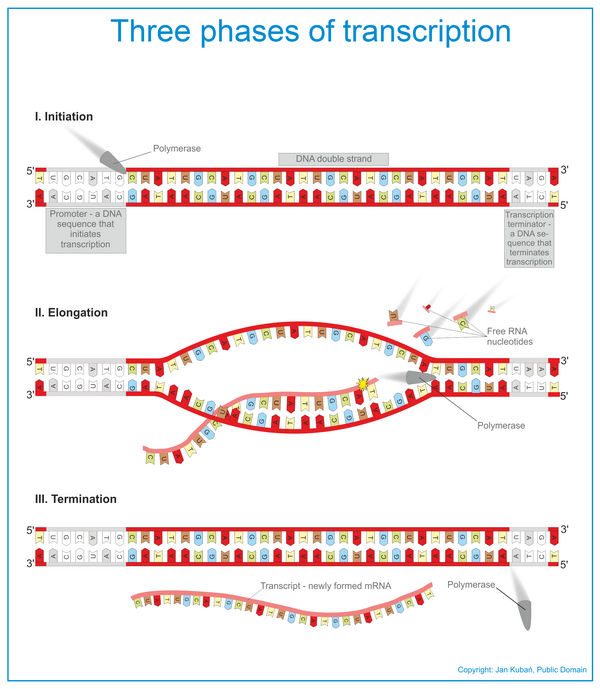
Remarks:
-
Helicase, as we already know, splits the DNA ladder-like chain into two distinct strands. There are also other enzymes*, that divide DNA, but not permanently, just temporarily. These enzymes are called RNA Polymerase. Each of them can move along the DNA helix, splitting it along a dozen hydrogen bonds. And when it splits, something really interesting happens! The ribose-based nucleotides, slightly different from the nucleotides from which DNA is built, insert themselves into this split. Using their nitrogen bases, they bond to a DNA strand with hydrogen bonds. Moreover, they connect to each other with a phosphodiester bond. In this way, an RNA strand is created. It differs from the DNA strand because it was built from ribonucleotides, and not, like DNA, from deoxyribonucleotides. This might seem to be an insignificant difference, but it results in very important consequences. The combination of the RNA strand with the DNA strand is weak enough that the two DNA strands, which were split for a short while, tend to merge. The newly formed RNA strand is preventing the DNA strands from merging, but this is not an obstacle, as they squeeze the RNA strand out of the way allowing them to merge.
The aforementioned process of transcribing a DNA nitrogen base sequence into the mirror sequence of complementary ribonucleotides is called transcription, and the resulting RNA strand – a transcript. As a result of this process, depending on what type of RNA polymerase serves to split the DNA, one of the following types of RNA is formed:- mRNA which is messenger RNA – information carrier
- tRNA which is transfer RNA – transporter of amino acids
- rRNA ribosomal RNA – peptide producer
- and some others
At this point, I strongly recommend to find videos related to the word “transcription” on the internet and see how transcription works.[Source: "The 59 keys for understanding the beginning of life", page 60]
Associated concepts:
Translation
♥ Definiens:
Translation is a process occurring inside the cell, in which, on the basis of a design stored in the mRNA, free amino acids are combined into a given sequence. As a result of translation, the primary protein structure is formed. Then due to the subsequent processes, secondary, tertiary and quaternary structures are formed. As a result of translation and these subsequent processes, based on the design stored in the mRNA, the cell produces proteins with the required properties.
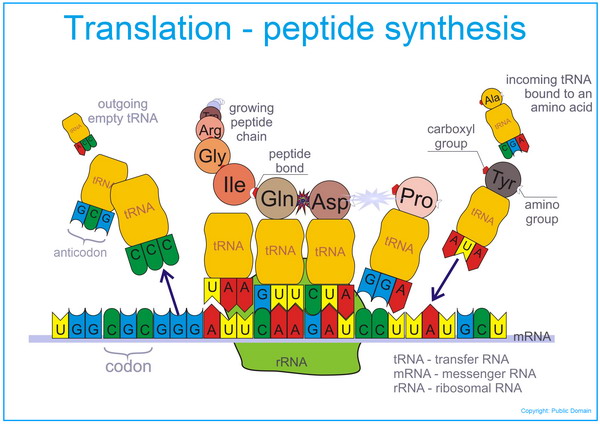
Remarks:
-
As we recall, proteins, which are the building blocks of all living objects, are formed from 22 basic amino acids which are attached in a certain sequence for each kind of protein. They can be short (TRP-Cage – 20 amino acids) or long (Titin – 27-33 thousand). The various properties of proteins depend on the order of their attachment and their number.
Some of you will probably already be aware of how proteins are assembled. When combined with the correct amino acid, the transporter (tRNA) goes to the factory (ribosome – rRNA) in which the mRNA is already waiting. At one spot, the ribosome exposes a three-element sequence of mRNA, called a codon, and allows the tRNA to access this spot only if it has the corresponding anticodon. Once the connection is completed, the ribosome moves to expose the adjoining codon of mRNA for another suitable tRNA. As each tRNA aligns with the mRNA matrix, the amino acid attached to it joins with the peptide bond of the amino acid that came with the previous tRNA. The primary structure of the assembled protein is the amino acid sequence, and corresponds to the sequence of codons stored in the mRNA. It is called RNA translation because the essence of this process is to translate the code stored in the nucleotide sequence into the amino acid sequence. Translation reads the information from the design and, from this, builds the required protein. In the construction industry, instead of being translated, you are talking about building on the basis of a blueprint.
There are 64 ways to set the four elements into a three-element sequence. There are only 22 basic amino acids from which terrestrial living objects are built, so some amino acids attach to the tRNA with different anticodons. For example, arginine binds to up to six different tRNAs – GCA, GCG, GCU, GCC, UCU, UCC. tRNA with anticodon UAC has a special function – it connects to methionine and the corresponding AUG codon is the translation start point – the sign for the ribosome “Hey, we start building a new protein”. However, the UAA, UGA and UAG codons do not bind to tRNA, they are the signal to the ribosome to complete the translation process.
At this point, I recommend that you look for films on the Internet related to the word “translation” in relation to biology.[Source: "The 59 keys for understanding the beginning of life", page 70]
Associated concepts:
Typical dilemmas
♥ Definiens:
A set of typical dilemmas.
These are examples of typical dilemmas:
- Prisoner's dilemma
- "I/group" dilemma
- "Short-/long-term benefit" dilemma
- Madison's Dilemma - Key dilemma of ruling
- S-Nastu dilemma
- Iterated prisoner's dilemma
Typical instruments of governance
Definiens:
A list of instruments used throughout history by those in power to ensure that they maintain and increase their control:
-
constantly striving to gather more and more power
-
gathering the resources necessary to exercise power:
- excessive taxation,
- inflation increase the amount of money but decrease the value of the money
- public debt,
-
formation of social groups supporting the rulers, so-called "state beneficiaries" (employees of state offices, state scientists, state teachers, etc.)
-
unwillingness to system solutions
- biased distribution of privileges,
- favouritism through finance
-
willingness to regulate everything by law and procedures
- excessive legislation
- imposing illogical and mutually contradictory rules (so that you always have a "loophole" when required)
- discretionary interpretation of regulations
-
applying different standards for their own proclivities and those of others:
- lack of transparency of their own actions yet with an ever-increasing scrutinization of others,
- running their own businesses with different regulations than the rest of the population,
- transferring responsibility from the rulers to the ruled
-
making justice complex, costly and difficult to access
-
make the people dependent on the state by:
- educational system
- scientific research system
- gratification of "pro-government" attitudes like giving the dog a treat when it has learnt a new trick
- increased benefits for state workers
-
aggressive propaganda instead of explaining and teaching social mechanisms,
-
conviction in management style:
- "any problem can be resolved by greasing someone`s palm",
- "to solve any problem you need the appropriate procedures and a team of state officials",
-
disregard the social costs of decisions made,
-
restricting freedom
- aversion to independent non-governmental organizations
- aversion to independent entrepreneurs and thinkers
-
creating their own monopolies
- internal national security
- judicial system
- educational system
- making economy and trade dependent on the system through arbitrarily imposed regulations, privileges, tax relief and "looking the other way"
Remarks:
-
According to them everything should be:
National
Centralised
For the state
as in Soviet countries
and their obsessive need to control and grip everything is unbelievable. -
This party, barely after seizing power, has dealt with just one thing: perpetuating its rule and spreading by establishing a government of terror feeding the instincts and rage of the people.
-
Most governments and political parties are eager to restrict the sphere of private initiative and free enterprise. - Ludwig von Mises, "Planned chaos"
Associated concepts:
Tyranny tiptoe
Definiens:
The process implemented by rulers imposing tyranny using small steps. Freedom is gradually taken away by introducing new and seemingly unrelated restrictions which lead to the total and utter control of human mind and perception.
Remarks:
-
The term coined by David Icke at the moment 1:40:30 of interview with LondonReal.tv: It is what I am calling a tyranny tiptoe: you go in steps and each step is promoted as unconnected to the other steps. Until you get down the line, you look back and you see all apparently but not. Unconnected steps have taken you in a very clear and obvious direction, they led you to the total and utter control of human mind and perception.
Associated concepts:
- Degeneration of power
- Elitism
- Model of governance
- Typical instruments of governance
- Cycle of failure
- Aristocraticization
- Key dilemma of ruling
Tytler's cycle
♥ Definiens:
The cycle is named after the Scottish philosopher Alexander Tytler (1774-1813), who is credited with the following statement:
The average age of the world's greatest civilizations from the beginning of history has been about 200 years. During those 200 years, these nations always progressed through the following sequence:
- From bondage to spiritual faith;
- From spiritual faith to great courage;
- From courage to liberty;
- From liberty to abundance;
- From abundance to selfishness;
- From selfishness to complacency;
- From complacency to apathy;
- From apathy to dependence;
- From dependence back into bondage.
Associated concepts:
Venture
♥ Definiens:
A venture is a set of activities related to each other in a certain way, aimed at achieving a complex goal, based on limited resources. Examples are: production of a unique product, creating new technology, reaching the summit, blowing up a bridge, winning the game. Only the beginning and the end of the venture is usually defined. To some extent a venture is unique and complex.
Victory factor
♥ Definiens:
Any factor stored in the genetic or memetic design which helps ensure the living object (or a group of) to pass through to the next stage of selection.
Associated concepts:
- Evolutionary self-supporting object
- Biological evolution
- This concept belongs to the Paradigm of The Physics of Life
Quotes from literature: in Polish or Google English from Polish
- associated with Victory factor
von Celebrra tactic
Definiens:
Tactics involving the use of suitable ornamentations, wearing special clothing, implementing specific behaviours and gestures, enable us to show our adversary that we are more powerful than we really are. By doing this, people are able to intimidate or scare others into doing what we want.
Associated concepts:
- von tactics
- Tactics of behaviour
- von Croesuss tactics
- von Neumann tactics
- von Shamann tactics
- von Sociall tactic
Quotes from literature: in Polish or Google English from Polish
- associated with von Celebrra tactic
von Compradorr tactics
Definiens:
Characteristic behaviours of people who acts as an intermediary of strangers, partitioners, colonizers and occupants.
Associated concepts:
von Croesuss tactics
Definiens:
Cheat in such a way that the adversary belives that his ally is his enemy
Remarks:
-
The name of this tactic comes from the fight carried out by the communist media against private entrepreneurs. The media insisted that producers of goods are the foremost enemies of the society, because they make themselves richer. According to the propagandists, the state manufacturers, in this regard, were much more socially useful, although they were more expensive and less productive. Society needs people to produce necessities, and not people who work unproductively for free.
-
Treasures collected by Croesus at the Sardis gold mines and forced taxes, have become proverbial. His name is now synonymous with being a rich man.
-
The particle "von" is an integral part of this name. It comes from John von Neumann's name - the father of the mathematical game theory.
Associated concepts:
- von tactics
- Tactics of behaviour
- von Celebrra tactics
- von Neumann tactics
- von Shamann tactics
- von Sociall tactics
von Neumann tactics
Definiens:
Cheating in such a way that the adversary belives that they are not being cheated.
Remarks:
-
Previous definition:
Duel action which leads to victory over the opponent (achieving the benefits of his cost) by:
- bluff (fraud) and
- double bluff - undermine his defence by raising confidence in him that we do not bluff
Associated concepts:
- von tactics
- Tactics of behaviour
- von Celebrra tactics
- von Croesuss tactics
- von Shamann tactics
- von Sociall tactics
von Self tactics
Definiens:
Making the opponent destroy himself, by his own forces.
Pojęcia skojarzone:
- von tactics
- Tactics of behaviour
- von Celebrra tactics
- von Croesuss tactics
- von Shamann tactics
- von Sociall tactics
von Shamann tactics
Definiens:
Cheating in such a way that the adversary believes that we have contact with a supernatural being, Gods, ancestral spirits or demons, or with a very influential person from whom we can receive aid. For example, kill our enemy, heal a loved one or solve a problem.
Associated concepts:
- von tactics
- Tactics of behaviour
- von Celebrra tactics
- von Croesuss tactics
- von Neumann tactics
- von Sociall tactics
von Sociall tactics
Definiens:
Cheating in such a way that the adversary belives that we are doing everything for his victory.
Associated concepts:
von tactics
Definiens:
The name of the set of effective tactics of disinformation used to facilitate the achievement of certain benefits. These tactics manipulate the emotions of the adversary. These include: von Croesus tactics, von Neumann tactics and von Sociall tactics.
The name "von" stems from the fact that the names of all these tactics begin with the prefix "von" (from the name of John von Neumann), and their names have a double letter "nn" - von Neumann, "ll" - von Sociall,…
Associated concepts:
- Tactics of behaviour
- von Celebrra tactics
- von Croesuss tactics
- von Neumann tactics
- von Self tactic
- von Shamann tactics
- von Sociall tactic
Watchwords worth promoting
Definiens:
Slogans which are worth promoting and popularizing are those which accurately express certain social processes that are difficult to understand for most people, and maybe, thanks to their popularization, people will understand them faster.
-
Inflation is a measure of the incompetence and thievery of those in power!
Jan Kubań
-
Honest money causes the world to develop in an honest direction,
Dishonest money causes the world to develop in a dishonest direction!Sebastian Pitoń & Jan Kubań
-
The core of Western civilization is competition!
Krzysztof Szczawiński
-
Criminals have taken over the state and turned it into a tool for even greater crimes.
Excerpt from the Nuremberg trials
Worldview
Definiens:
A relatively stable, at a given stage of the Lifecycle of a human, set of judgments, beliefs and opinions about the world. It comes from mimicry, personal experience, education and localised culture: the media, religion, art, gossip, superstition, science and philosophy. Paired with thinking, it serves to analyze and evaluate received information in order to make decisions and actions.
Remarks:
-
Thomas J. Elpel in his book "Roadmap to Reality" described the following levels of worlview:
Name Characteristic Remarks In The Physics of Life Preconscious Unaware of self-existance Infants Magical Anything is possible Children Mythical Understanding the rules of society in black-and-white terms Older children Sequential Critical thinking and an understanding of linear cause and effect. Adolescents & young adults Reductionist Thinking Most adults mature to a blend of the mythical and sequential worldviews. Systemic Interconnected systems processing Systemic Thinking Holistic Global environmental awareness Mystical Observer Non-Linear Game Theory Thinking Universal Absolute Thinking -
Table of interdependance of Worldviews, Technology, Cultural Evolution, and Human Development received from Thomas J. Elpel in 2015.08.12
Yang and Yin
Definiens:
Opposing factors. Pro and con. Hegelian thesis and antithesis. In The Physics of Life: the factor and the opposing factor.
Remarks:
-
In Chinese philosophy, yin and yang (lit. "dark-bright", "negative-positive") describe how seemingly opposite or contrary factors may actually be complementary, interconnected and interdependent in the natural world.